
Notice of Appeal in Thailand
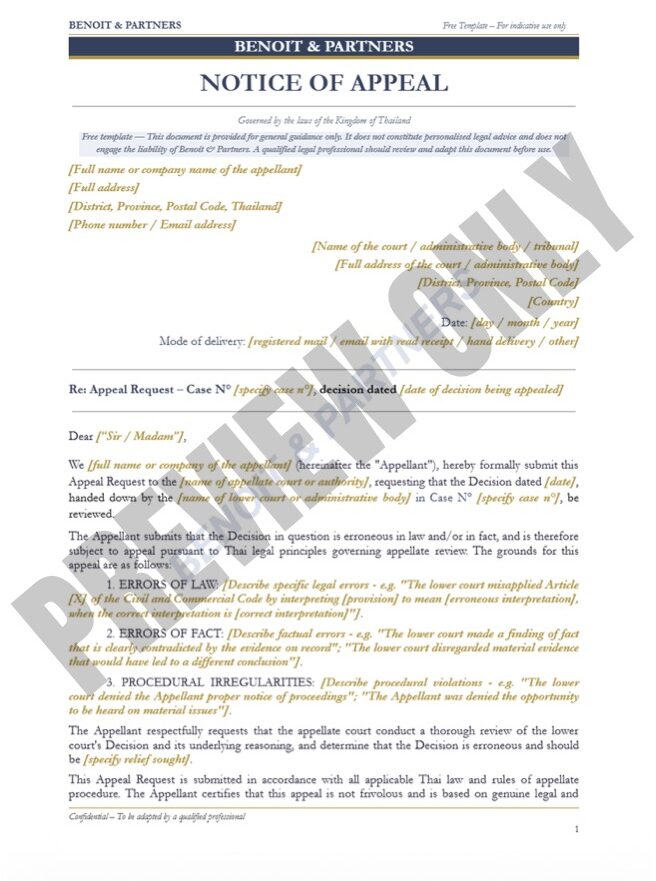
Our Notice of Appeal in Thailand is drafted and reviewed by experienced lawyers to ensure compliance with Thai law and practical business use. It provides a reliable legal framework for formally initiating an appeal against a judgment, order, or decision of a Thai court or administrative authority within the applicable procedural framework.
Designed for individuals, businesses, and legal professionals seeking to formally challenge a court judgment or administrative decision in Thailand, this template covers key legal aspects such as identification of the appellant and respondent, the judgment or decision being appealed, the grounds of appeal, the relief sought on appeal, and compliance with the procedural requirements of the Thai Civil Procedure Code and applicable court rules governing the filing of appeals.
However, some situations may require additional clauses or tailored structuring depending on the level of court or authority from which the appeal is being brought, the nature of the underlying proceedings, the specific grounds of appeal, or the relief that can properly be sought at the appellate level. Our legal team can assist clients with customised Notices of Appeal adapted to their specific situation within a short timeframe.
Disclaimer: This template is provided for general informational purposes only and does not constitute legal advice. While it has been prepared by legal professionals, it may not reflect your specific situation or regulatory constraints. Given the strict procedural and time requirements that govern appeals in Thailand, legal advice should be sought without delay to ensure that the appeal is properly filed and that no applicable deadline is missed.
Need a Contract Tailored to Your Needs? Get a Free Consultation.
When should you use a Notice of Appeal in Thailand?
A Notice of Appeal Thailand is the appropriate instrument when a party to court or administrative proceedings in Thailand wishes to formally challenge a judgment, order, or decision that has gone against them and seek its reversal, modification, or referral back for reconsideration by a higher court or appellate body.
Thai civil appeals are governed by the Civil Procedure Code, which sets out the procedure for appealing judgments of the Courts of First Instance to the Courts of Appeal, and from the Courts of Appeal to the Supreme Court. Each level of appeal involves distinct procedural requirements, grounds of challenge, and jurisdictional thresholds that shape both the content of the notice and the prospects of a successful outcome.
Strict time limits apply to the filing of appeals in Thailand. Under the Civil Procedure Code, an appeal against a judgment of the Court of First Instance must generally be filed within one month of the date of the judgment.
A properly prepared Notice of Appeal identifies the specific errors of law or fact in the judgment being challenged, presents the grounds of appeal in a clear and structured manner, and specifies the precise relief sought at the appellate level. A notice that fails to articulate specific and arguable grounds is at risk of being rejected by the appellate court at the outset.
Filing an appeal without proper legal preparation not only risks procedural failure but may also crystallise adverse costs consequences and limit the party’s ability to pursue other remedies.

1. Identification of the Parties
The notice should clearly identify the appellant and the respondent by their full names, together with their roles in the underlying proceedings and, where applicable, their registered addresses and legal representative
2. Identification of the Judgment or Decision Being Appealed
The notice should state the issuing court, case reference, judgment date, and a brief summary of its operative provisions, clearly identifying the decision and orders made.
3. Grounds of Appeal
The notice sets out why the judgment is considered wrong, such as errors of law, evidence, or procedure. The grounds should be specific, arguable, and clearly linked to the judgment’s errors.
4. Relief Sought
The notice should clearly state what the appellant asks the appellate court to do, such as reversing the judgment, changing an order, adjusting damages, or sending the case back to the lower court.
5. Statement of Facts
A concise summary of the relevant background facts, the nature of the underlying dispute, and the procedural history of the case provides the appellate court with the context it needs to assess the grounds of appeal efficiently.
6. Legal Authorities Relied Upon
Where the grounds of appeal raise points of law, the notice should identify the statutory provisions, case law, or legal principles on which the appellant relies, demonstrating that the challenge is grounded in recognised legal authority rather than mere dissatisfaction with the outcome.
Key Clauses and Essential Elements in a Notice of Appeal
A well-drafted Notice of Appeal Thailand gives the appellate court a precise account of the judgment being challenged, the specific grounds on which it is said to be wrong, and the relief the appellant is seeking. It presents the grounds of challenge in a structured and legally coherent manner, demonstrates that the appeal has a proper basis in law or fact, and satisfies the formal procedural requirements for filing.
Thai appellate courts apply defined criteria for assessing whether an appeal discloses arguable grounds and merits consideration. A notice that is vague, unsupported, or procedurally deficient is likely to face early challenge and may be dismissed without a full hearing.
This document is relevant across all categories of civil litigation from contract and property disputes to employment and administrative matters and is applicable whether the appellant is an individual, a company, or a public body. The core structure remains consistent, though the specific grounds and the relief sought will vary significantly depending on the nature of the underlying proceedings and the errors alleged in the judgment.
Why customise a Notice of Appeal with a lawyer in Thailand?
A Notice of Appeal Thailand is one of the most technically demanding documents in Thai civil procedure, and the consequences of a poorly prepared or procedurally deficient notice can be severe and irreversible. The strict time limits, formal requirements, and substantive standards that govern appeals in Thailand mean that professional legal assistance is not merely advisable in most cases it is essential.
The specific grounds available on appeal, the procedural requirements at each level of the appellate hierarchy, and the strategic considerations that shape the conduct of appellate proceedings all require a level of expertise that goes well beyond what a generic template can provide.
In some cases, the notice should also address key issues such as the distinction between questions of law and fact and its impact on appellate jurisdiction, the requirements for staying execution pending appeal, the effect of any enforcement actions, the strategic role of the appeal, and the possibility of seeking leave to appeal to the Supreme Court on an important point of law.
Our legal team works with clients at all stages of Thai civil litigation to prepare notices of appeal that are procedurally correct, legally precise, and strategically sound. Work is completed within the applicable time constraints, and the result is a notice that gives the appellant the strongest possible platform for a successful challenge.
Notice of Appeal Thailand
Instant Download
Easy to Customize
Ready to Sign
Crafted by Lawyers
FAQ
What is a Notice of Appeal in Thailand?
A formal procedural document through which a party to court or administrative proceedings formally challenges a judgment, order, or decision and initiates the appellate process before a higher court or appellate body in Thailand.
How long does a party have to file an appeal in Thailand?
Under the Civil Procedure Code, an appeal against a judgment of the Court of First Instance must generally be filed within one month of the date of the judgment. Different time limits may apply to specific types of proceedings or to appeals at higher levels of the court hierarchy. Missing the deadline will ordinarily result in the appeal being time-barred.
On what grounds can a judgment be appealed in Thailand?
Appeals in Thai civil proceedings may be brought on grounds of error of law, misapplication of the evidence, procedural irregularity, or a combination of these. Appeals to the Supreme Court are generally limited to questions of law and must satisfy additional jurisdictional thresholds.
Does filing a Notice of Appeal automatically stay enforcement of the judgment in Thailand?
No. Filing an appeal does not automatically suspend enforcement of the judgment below. A party wishing to prevent enforcement while the appeal is pending must apply separately for a stay of execution, which the court will consider on its merits.
Can new evidence be introduced on appeal in Thailand?
As a general rule, appellate proceedings in Thailand are conducted on the record established in the court below, and the introduction of new evidence is restricted. In limited circumstances where evidence was not available at the time of the original hearing an application may be made to adduce new material, but this is subject to the court’s discretion.
What are the costs consequences of an unsuccessful appeal in Thailand?
An unsuccessful appellant may be ordered to pay the respondent’s costs of the appellate proceedings in addition to the costs awarded at first instance. The potential costs exposure should be carefully assessed as part of the decision-making process before an appeal is filed.
Can a party appeal an administrative decision as well as a court judgment in Thailand?
Yes. In addition to civil court appeals, Thai law provides mechanisms for challenging decisions of administrative bodies through the Administrative Court system. The procedural framework, time limits, and grounds of challenge applicable to administrative appeals differ from those that govern civil appeals and must be considered separately.
How does the PDPA apply to appellate proceedings in Thailand?
Where the appeal involves personal data including information about individuals contained in the evidence or submissions both parties and the court must handle that data in accordance with the Personal Data Protection Act B.E. 2562 (2019). Personal data should be included in the appellate record only to the extent strictly necessary for the resolution of the grounds of appeal.