
Notice of Breach of Contract Letter Template in Thailand
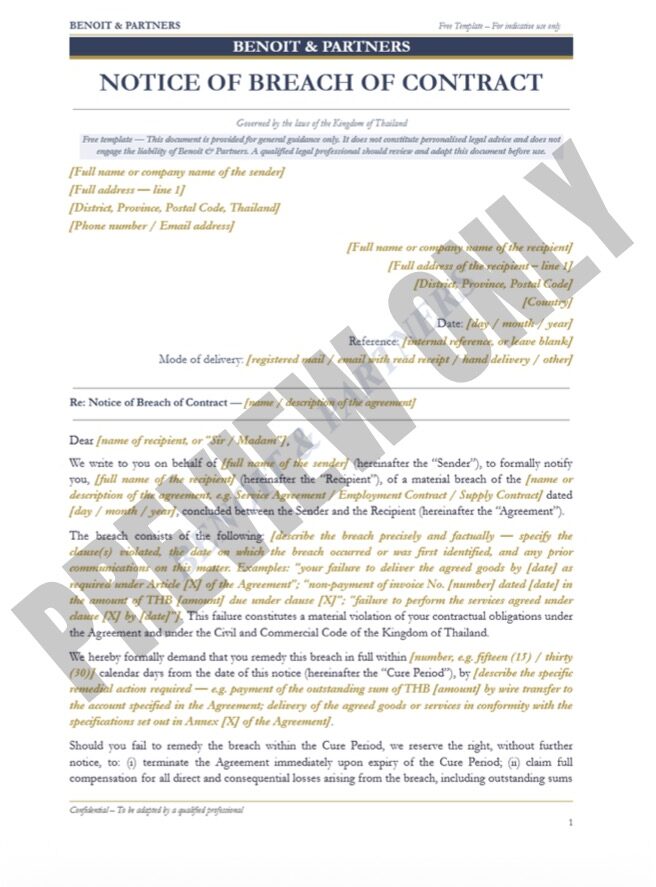
Our Notice of Breach of Contract Letter template for Thailand is drafted and reviewed by experienced lawyers to ensure compliance with Thai law and practical business use. It provides a reliable legal framework for formally notifying a contracting party of its failure to perform contractual obligations.
Designed for businesses, individuals, and companies involved in commercial or civil disputes in Thailand, this template covers key legal aspects such as identification of the parties and the contract concerned, description of the breach, remedy required, cure period, financial claims and damages, and the consequences of continued non-performance under Thai law.
However, some disputes may require additional clauses or tailored structuring depending on the nature of the contract, the type of breach involved, the value of the claim, or cross-border considerations. Our legal team can assist clients with customised Notices of Breach adapted to their specific contractual situation within a short timeframe.
Disclaimer: This template is provided for general informational purposes only and does not constitute legal advice. While it has been prepared by legal professionals, it may not reflect your specific situation or regulatory constraints. For complex or high-value disputes, legal advice should be sought to ensure proper structuring and compliance under Thai law.
Need a Contract Tailored to Your Needs? Get a Free Consultation.
When should you use a Notice of Breach of Contract in Thailand?
A Notice of Breach of Contract is used whenever a party to a contract fails to perform one or more of its obligations, and the other party wishes to formally document that failure, demand remedy, and preserve its legal rights under Thai law. This situation commonly arises in commercial disputes, service agreement failures, unpaid invoices, non-delivery of goods, and failures to perform within agreed deadlines.
Under Thai law, contractual breaches are governed by the Civil and Commercial Code B.E. 2468 (1925), notably Sections 387 to 394, which regulate the consequences of non-performance, the right to fix a reasonable period for remedy, and the conditions under which a contract may be terminated. A formal written notice is often a prerequisite before any termination or legal action can be validly pursued.
This notice becomes particularly important when the transaction involves significant financial value, ongoing commercial relationships, or situations where the breaching party has not responded to informal demands. It allows the notifying party to clearly document the nature of the breach, the remedy required, and the consequences of continued non-performance.
In more complex disputes, additional considerations may arise regarding liquidated damages clauses, penalty provisions, force majeure defences, or compliance with contractual notice requirements. Our legal team assists clients with the preparation of customised Notices of Breach tailored to their specific dispute and contractual context.
In practice, issuing a formal Notice of Breach is also a critical step before initiating litigation or arbitration, as it demonstrates good faith and establishes the factual and legal basis for any subsequent claim.

1. Identification of the Parties
The notice must clearly identify the notifying party and the breaching party, including their full legal names, registration details, and addresses, as well as a precise reference to the contract concerned.
2. Contract Reference and Description
The notice must specify the full title of the contract, its date of execution, and the relevant clause or obligation that has been breached, with sufficient factual detail to leave no ambiguity.
3. Nature and Description of the Breach
The notice must describe the breach clearly, including its nature (e.g. failure to pay, failure to deliver, failure to perform by the agreed date), the date on which it occurred or was first identified, and any prior communications on the matter.
4. Remedy Required and Cure Period
The notice must specify the exact action required from the breaching party and fix a reasonable period within which the breach must be remedied, in accordance with Section 387 of the Civil and Commercial Code.
5. Damages and Financial Claims
The notice must set out any amounts currently claimed, the basis of those claims, and whether default interest is applicable, whether at the contractual rate or at the statutory rate of 5% per annum under Section 224 of the Civil and Commercial Code.
6. Consequences of Failure to Remedy
The notice must clearly state the consequences of non-remedy within the cure period, including the right to terminate the contract, initiate legal proceedings, and claim all losses sustained as a result of the breach.
Key clauses and additional protections in a Share Purchase Agreement
A Notice of Breach of Contract is a key legal document that formally records a contractual failure and puts the breaching party on notice of the consequences. It defines the rights and obligations of the notifying party while preserving all available remedies under Thai law.
Under the Civil and Commercial Code, a party wishing to terminate a contract for non-performance must generally fix a reasonable period and demand performance before exercising its right to terminate. A properly drafted Notice of Breach helps secure this requirement and reduces legal risk for the notifying party.
This type of notice is commonly used in commercial disputes, service and supply agreements, employment contract failures, real estate transactions, and loan or finance arrangements.
While standard disputes may rely on a general template, complex situations often require additional legal protections and customised clauses depending on the nature of the breach and the risks involved.
Why customise a Notice of Breach of Contract with a lawyer in Thailand?
While a standard Notice of Breach of Contract template for Thailand may be sufficient for simple disputes, many contractual failures involve legal, financial, and procedural considerations requiring more careful drafting and tailored protections.
In practice, each dispute has its own structure and level of legal risk. The nature of the contract, the identity of the parties, the type of breach involved, and the remedies available may all require provisions that are not included in a standard template.
Depending on the situation, specific clauses may be needed addressing the applicable notice period under the contract, the calculation and quantification of damages, the interaction between penalty clauses and statutory compensation rights under Section 383 of the Civil and Commercial Code, the preservation of evidence and prior communications, the risk of a force majeure or hardship defence being raised, PDPA compliance where personal data has been exchanged, dispute resolution procedures and governing law, or the strategic decision between demanding performance and electing to terminate.
Tailoring a Notice of Breach also allows the notifying party to better protect its legal position, anticipate likely defences, and ensure that all procedural requirements for subsequent litigation or arbitration have been met. This is particularly important in high-value commercial disputes, cross-border transactions, regulated industries, or situations involving foreign parties.
Our legal team assists businesses and individuals with the preparation and review of customised Notices of Breach of Contract for Thailand adapted to their specific contractual situation and commercial objectives. In many cases, a tailored notice can be prepared within a short timeframe while ensuring full compliance with Thai contract and civil law.
A properly drafted notice not only strengthens the notifying party’s legal position, but also reduces the risk of procedural challenges, failed terminations, and unenforceable damage claims.
Notice of Breach of Contract Letter Template
Instant Download
Easy to Customize
Ready to Sign
Crafted by Lawyers
FAQ
What is a Notice of Breach of Contract in Thailand?
A Notice of Breach of Contract is a formal written communication by which one party notifies the other that it has failed to perform one or more obligations under a contract, demands remedy within a specified period, and reserves all legal rights in the event of continued non-performance. In Thailand, it is governed by the Civil and Commercial Code, notably Sections 387 to 394.
Is a Notice of Breach of Contract legally required in Thailand before terminating a contract?
In most cases, yes. Under Section 387 of the Civil and Commercial Code, a party wishing to terminate a contract for non-performance must generally give written notice fixing a reasonable period for the other party to perform before the right to terminate arises. Failure to issue such a notice may render a purported termination invalid.
Can a foreigner issue a Notice of Breach of Contract in Thailand?
Yes. Foreign nationals and foreign companies can issue a Notice of Breach of Contract in Thailand in respect of contracts governed by Thai law. The notice should comply with the formal requirements of the contract and Thai civil law. Legal assistance is strongly recommended to ensure the notice is properly drafted and enforceable.
Is a Notice of Breach of Contract legally binding in Thailand?
A Notice of Breach of Contract is a formal legal communication that triggers specific rights and obligations under the contract and Thai law. Once validly issued and received, it starts the running of the cure period and, if remedy is not made, entitles the notifying party to terminate the contract and claim damages in accordance with the Civil and Commercial Code.
Do I need a lawyer to draft a Notice of Breach of Contract in Thailand?
For simple disputes involving low-value contracts, a standard template may be sufficient. For commercial disputes, high-value contracts, cross-border transactions, or situations involving complex breach and damages questions, legal assistance is strongly recommended to ensure the notice is properly structured, legally effective, and protects the notifying party’s full range of remedies.
Does a Notice of Breach of Contract need to be delivered in a specific way in Thailand?
The contract itself may specify the required method of delivery. In the absence of a specific provision, the notice should be sent by registered post, courier with delivery confirmation, or email with read receipt, to the address of the breaching party as stated in the contract. Proper proof of delivery is essential.
What happens if the breaching party does not remedy the breach within the cure period?
If the breaching party fails to remedy the breach within the period specified in the notice, the notifying party may terminate the contract pursuant to Sections 387 to 389 of the Civil and Commercial Code, claim damages for all losses sustained, and pursue any other remedies available under the contract or Thai law.
How does the PDPA apply to a Notice of Breach of Contract in Thailand?
If the notice or related proceedings involve the exchange of personal data between the parties — such as identification documents, contact details, or financial records — both parties must comply with the Personal Data Protection Act B.E. 2562 (2019). The notice and any supporting documentation should be handled in accordance with applicable data protection obligations.