
Notice of Termination of Agreement in Thailand
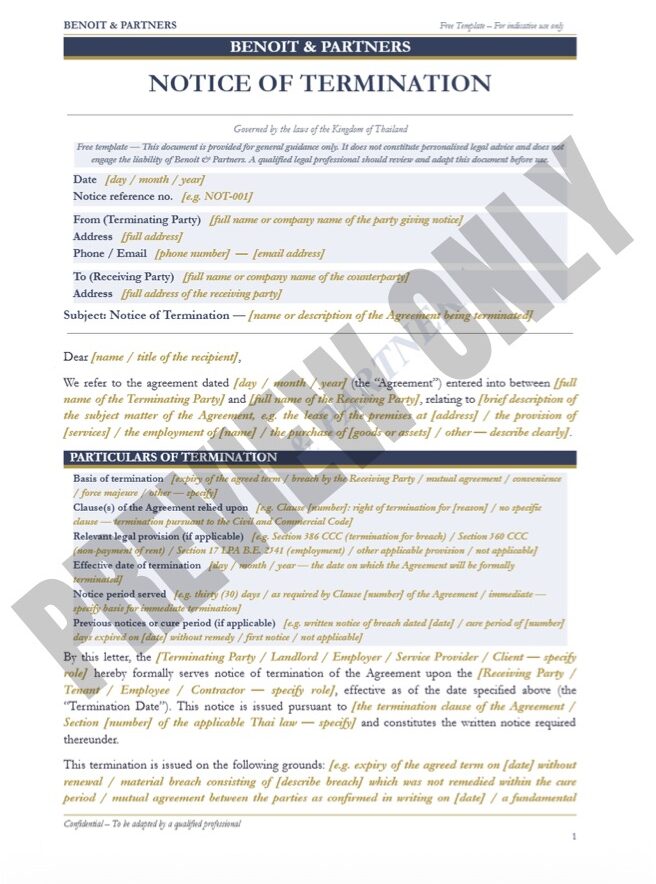
Our Notice of Termination of Agreement in Thailand is drafted and reviewed by experienced lawyers to ensure compliance with Thai law and practical business use. It provides a reliable legal framework for formally bringing a commercial contract or other agreement to an end in Thailand, whether by the exercise of a contractual termination right, a statutory right of termination, or by giving the agreed notice period.
Designed for businesses and individuals seeking to formally terminate a contract or commercial arrangement in Thailand, this template covers key legal aspects such as identification of the parties and the agreement being terminated, the legal or contractual basis for the termination, the effective date, the obligations of each party upon and following termination, and compliance with the applicable provisions of the Thai Civil and Commercial Code.
However, some situations may require additional clauses or tailored structuring depending on the nature of the agreement, the grounds for termination, the financial consequences of bringing the arrangement to an end, or the interaction between the termination and related contracts or ongoing obligations. Our legal team can assist clients with customised Notices of Termination of Agreement adapted to their specific situation within a short timeframe.
Disclaimer: This template is provided for general informational purposes only and does not constitute legal advice. While it has been prepared by legal professionals, it may not reflect your specific situation or regulatory constraints. For complex commercial arrangements or situations involving significant financial exposure, legal advice should be sought to ensure proper structuring and compliance under Thai contract and civil law.
Need a Contract Tailored to Your Needs? Get a Free Consultation.
When should you use a Notice of Termination of Agreement in Thailand?
A Notice of Termination of Agreement in Thailand is the appropriate instrument when a party to a commercial contract or other arrangement in Thailand decides to formally bring that relationship to an end, whether by exercising a termination right under the contract, relying on a statutory right under Thai law, or giving the agreed notice period to bring a periodic arrangement to a close.
Thai contract law is governed by the Civil and Commercial Code, which sets out the general rules on contract termination and the consequences of bringing an agreement to an end before its natural expiry.
Documenting the termination in a formal written notice creates a clear and dated record of the decision to terminate, confirms the effective date, and sets out the obligations of each party in the period leading up to and following termination.
More complex terminations may involve additional considerations, including the financial settlement between the parties, the treatment of intellectual property or other assets developed under the agreement, the interaction between the termination and related contracts, or the consequences of termination for employees or subcontractors engaged in connection with the arrangement. Our legal team is available to assist with tailored notices that address these dimensions with precision and care.
Without a properly documented termination notice, both parties risk uncertainty about the effective end date of the agreement and the scope of their surviving obligations, which can create disputes that are both costly and difficult to resolve.

1. Identification of the Parties
The notice should clearly identify both parties to the agreement being terminated by their full legal names and, where applicable, their registered addresses and company registration numbers.
2. Identification of the Agreement
The specific agreement being terminated should be identified by its title, date of execution, and any relevant reference number, confirming the contractual framework within which the termination is being effected.
3. Legal or Contractual Basis for Termination
The notice should state the specific provision of the agreement or the statutory right under which the termination is being exercised, demonstrating that the decision to terminate has a recognised legal foundation and reducing the scope for the other party to challenge its validity.
4. Effective Date of Termination
The date on which the agreement will come to an end should be stated precisely, taking into account any applicable notice period required by the contract or the Civil and Commercial Code. Where a notice period applies, both the date of notice and the date of effectiveness should be confirmed.
5. Obligations Upon Termination
The notice should address the key obligations of each party in the period leading up to and following the termination date including the completion of work in progress, the settlement of outstanding invoices, the return of property or confidential information, and the cessation of any ongoing activities carried out under the agreement.
6. Surviving Obligations
The notice should identify which obligations of the parties survive the termination of the agreement such as confidentiality undertakings, non-solicitation provisions, intellectual property assignments, and dispute resolution clauses so that both parties have a clear understanding of their continuing duties.
Key Clauses and Essential Elements in a Notice of Termination of Agreement
It ensures that both parties have a shared understanding of how and when the agreement will end. By setting out the key terms in writing, it reduces the risk of misunderstanding or later dispute about the consequences of termination.
Under the Civil and Commercial Code, a termination notice is only effective if it complies with the relevant contractual requirements, including notice periods, delivery methods, and clear identification of the legal basis for termination. A properly drafted notice that meets these conditions provides an enforceable record of termination and removes uncertainty regarding its timing and effect.
It also helps preserve legal certainty by creating a clear documentary trail that can be relied upon in the event of any disagreement or enforcement action arising after termination.
Why customise a Notice of Termination of Agreement with a lawyer in Thailand?
A standard Notice of Termination of Agreement in Thailand provides a workable starting point for routine contract terminations, but a significant range of commercial situations call for a more carefully considered approach before the notice is issued.
The nature of the agreement, the grounds for termination, the financial consequences of bringing the arrangement to an end, and the ongoing relationship between the parties all shape what the notice needs to achieve. A termination that involves a long-standing commercial partnership, a high-value service agreement, or an arrangement with complex financial obligations requires a level of legal precision that a generic template cannot deliver.
Depending on the situation, the notice may need to address: the distinction between a termination for convenience and a termination for cause, and the different financial consequences that flow from each; the interaction between the termination and any penalty, compensation, or liquidated damages provisions in the contract; the treatment of intellectual property, confidential information, or other assets developed in the course of the agreement; the impact of the termination on employees, subcontractors, or third parties engaged in connection with the arrangement.
Our legal team works with businesses and individuals to prepare termination notices that are legally sound, clearly structured, and precisely calibrated to the specific agreement and circumstances, ensuring that the commercial relationship is brought to a clean and enforceable conclusion.
Notice of Termination of Agreement
Instant Download
Easy to Customize
Ready to Sign
Crafted by Lawyers
FAQ
What is a Notice of Termination of Agreement in Thailand?
A formal written document through which a party to a commercial contract or other arrangement formally brings that agreement to an end, specifying the legal basis for the termination, the effective date, the obligations of each party upon termination, and any financial or other consequences that flow from the decision to terminate.
Can any commercial agreement be terminated by notice in Thailand?
The right to terminate a commercial agreement by notice depends on the terms of the specific contract and the applicable provisions of Thai law. Most commercial contracts contain an express termination clause specifying the circumstances in which termination is permitted and the notice period required.
What is the difference between termination for cause and termination for convenience in Thailand?
Termination for cause occurs where one party exercises a right to terminate arising from the other’s breach of the agreement. Termination for convenience occurs where a party exercises a contractual right to bring the agreement to an end without the need to establish fault.
What financial consequences flow from terminating a commercial agreement in Thailand?
The financial consequences depend on the terms of the specific contract and the basis for the termination. They may include payment of outstanding invoices, payment of a contractual termination fee, compensation for work in progress, or in the case of wrongful termination of damages equivalent to the value of the unexpired portion of the contract.
What is a Work From Home Agreement in Thailand?
A written agreement governing the terms under which an employee performs their duties from their private residence. Governed by the Labour Protection Act B.E. 2541 (1998) as amended in 2023, which introduced specific provisions on home working and the right to disconnect.
Are work from home arrangements legally recognised in Thailand?
Yes. The 2023 amendments to the Labour Protection Act formally recognised home working arrangements and require the terms to be agreed in writing, with the employer obliged to respect the employee’s right to disconnect outside of agreed working hours.
Can a commercial agreement be terminated by mutual consent in Thailand?
Yes. The parties may agree at any time to bring their agreement to an end on mutually acceptable terms. A mutual termination should be documented in a written agreement that records the agreed termination date, the financial settlement between the parties, and any continuing obligations that are to survive the termination.
How does the PDPA apply to a Notice of Termination of Agreement in Thailand?
Where the notice or the termination process involves the handling of personal data — including the names and contact details of individuals involved in the performance of the agreement — both parties must comply with the Personal Data Protection Act B.E. 2562 (2019).