
Notice to Vacate in Thailand
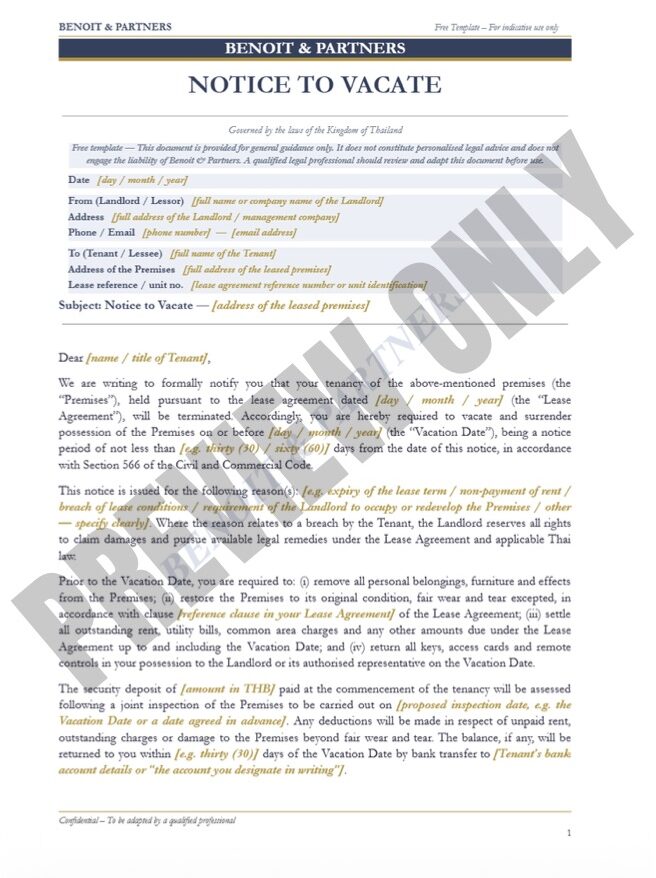
Our Notice to Vacate in Thailand is drafted and reviewed by experienced lawyers to ensure compliance with Thai law and practical business use. It provides a reliable legal framework for formally requiring a tenant or occupant to vacate a property in Thailand at the end of a lease term or following the lawful termination of their right to occupy.
Designed for landlords and property owners seeking to formally require a tenant, subtenant, or other occupant to vacate residential or commercial premises in Thailand, this template covers key legal aspects such as identification of the parties and the property, the basis on which vacation is required, the date by which the property must be vacated, the condition in which it must be returned, and compliance with the applicable provisions of the Thai Civil and Commercial Code governing lease termination and possession recovery.
However, some situations may require additional clauses or tailored structuring depending on the type of property, the basis for the vacation requirement, the nature of the occupancy arrangement, or the presence of third-party interests. Our legal team can assist clients with customised Notices to Vacate adapted to their specific situation within a short timeframe.
Disclaimer: This template is provided for general informational purposes only and does not constitute legal advice. While it has been prepared by legal professionals, it may not reflect your specific situation or regulatory constraints. For contested occupancies or situations where court proceedings may be required to recover possession, legal advice should be sought to ensure proper structuring and compliance under Thai property law.
Need a Contract Tailored to Your Needs? Get a Free Consultation.
When should you use a Notice to Vacate in Thailand?
A Notice to Vacate in Thailand is the appropriate instrument when a landlord or property owner wishes to formally require a tenant or occupant to leave a property and return possession of the premises. Common situations include the expiry of a fixed-term lease without renewal, the termination of a periodic tenancy by giving the required notice, the exercise of a right to terminate following the tenant’s breach, or the recovery of possession following the sale or transfer of the property.
Lease agreements in Thailand are governed by the Civil and Commercial Code, which sets out the rights and obligations of landlords and tenants at the end of the lease term. Where a fixed-term lease expires, the tenant is required to vacate and return possession unless a new agreement has been concluded.
Issuing a formal written Notice to Vacate Thailand creates a clear and dated record of when the requirement to vacate was communicated, establishes the precise date by which possession must be returned, and provides a sound documentary basis for any subsequent possession proceedings if the occupant fails to leave voluntarily.
More complex situations may require additional provisions covering the condition in which the property must be returned, the treatment of fixtures and fittings installed by the tenant, the return of the security deposit, or the consequences of holding over beyond the vacation date. Our legal team is available to assist with tailored notices that address these dimensions comprehensively.
Without a formal written notice, a landlord seeking to recover possession may face difficulties in establishing the basis and timing of their demand, potentially complicating and delaying any subsequent court proceedings.

1. Identification of the Parties and the Property
The notice should clearly identify the landlord or property owner and the tenant or occupant, together with the full address of the property and, where applicable, the title deed reference and Land Office registration details.
2. Basis for the Vacation Requirement
The notice should state the legal or contractual basis on which vacation is required whether the lease has expired, a termination right has been exercised, or the tenancy is being brought to an end by notice in accordance with the Code.
3. Vacation Date
The date by which the property must be vacated and possession returned should be stated precisely. This is the critical reference point for any subsequent possession proceedings and for the assessment of any holding-over liability.
4. Required Condition of the Property
The notice should specify the condition in which the property must be returned typically the condition described in the inventory or schedule of condition attached to the lease and identify any specific reinstatement or restoration obligations.
5. Treatment of Fixtures and Personal Property Where
Where the tenant has installed fixtures, fittings, or made alterations to the property, the notice should address whether these are to be removed or left in place, and the timetable for any required reinstatement works.
6. Security Deposit
The notice should confirm the arrangements for the return of the security deposit following vacation, including the timetable for the landlord's inspection and the basis on which deductions may be made.
Key Clauses and Essential Elements in a Notice to Vacate
A well-drafted Notice to Vacate in Thailand clearly informs the occupant that they must leave the property, specifying the deadline for doing so and the required condition of the premises upon return.
It also helps prevent disputes by setting out the expectations in a clear and formal manner. By stating the key terms of departure, it provides both parties with certainty and reduces the risk of misunderstanding or delay in the handover of the property.
Under the Civil and Commercial Code, a Notice to Vacate Thailand is only effective if it respects the required notice periods and proper methods of service. When these conditions are met, the notice creates a binding obligation for the occupant to vacate by the stated date, and strengthens the landlord’s position in any subsequent enforcement action.
A properly structured notice also ensures that any later legal proceedings are supported by clear documentary evidence. This reduces the risk of procedural challenges and reinforces the landlord’s ability to recover possession efficiently.
Why customise a Notice to Vacate with a lawyer in Thailand?
A standard template of Notice to Vacate in Thailand is adequate for straightforward vacation requirements in routine lease situations, but a number of circumstances call for a more carefully considered approach before the notice is issued.
The specific basis for the vacation requirement, the terms of the lease, and the likely response of the occupant all influence what the notice needs to contain and how it should be structured. A notice issued in connection with a contested termination, a high-value commercial property, or a situation where the occupant is expected to resist vacation requires a level of legal precision and strategic consideration that a generic template cannot provide.
In certain situations, the notice may need to address a number of issues, including how the vacation requirement interacts with any outstanding rent or other financial claims; the procedural steps for commencing possession proceedings before the Thai courts if the occupant fails to vacate; the position of any sub-tenants or licensees in occupation; and the implications at the Land Office when terminating a registered long-term lease.
Our legal team works with landlords and property owners to prepare notices to vacate that are legally effective, clearly structured, and calibrated to the specific property and circumstances.
Notice to Vacate Thailand
Instant Download
Easy to Customize
Ready to Sign
Crafted by Lawyers
FAQ
What is a Notice to Vacate in Thailand?
A formal written document through which a landlord or property owner requires a tenant or occupant to leave the property and return possession of the premises by a specified date, identifying the basis for the vacation requirement and the condition in which the property must be returned.
How much notice must a landlord give a tenant to vacate in Thailand?
The required notice period depends on the type of tenancy and the terms of the lease. For periodic tenancies, the Civil and Commercial Code generally requires at least two rent periods of advance notice. For fixed-term leases, the tenant is required to vacate at the end of the agreed term without the need for additional notice, though a formal demand is advisable.
What can a landlord do if a tenant refuses to vacate in Thailand?
If a tenant refuses to vacate following a valid Notice to Vacate, the landlord must apply to the Thai courts for a possession order. Self-help remedies such as changing locks or removing the tenant’s belongings without a court order are not permitted under Thai law and may expose the landlord to criminal and civil liability.
Can a tenant be required to vacate before the end of the lease term in Thailand?
Yes, where the landlord has a valid right to terminate the lease for example, due to the tenant’s breach of a material obligation a Notice to Vacate may be issued requiring the tenant to leave before the contractual end date. The termination must be based on a recognised legal or contractual ground, and proper notice must be given.
What happens to the security deposit when a tenant vacates in Thailand?
The landlord is entitled to inspect the property following vacation and to make deductions from the security deposit for unpaid rent, damage beyond fair wear and tear, and the cost of any required reinstatement works. The balance must be returned to the tenant within the period specified in the lease or a reasonable time thereafter.
Does a Notice to Vacate need to be registered at the Land Office in Thailand?
Registration is not required for the notice itself, but where a registered long-term lease is being terminated, the termination should be recorded at the Land Office to ensure that the property title reflects the current position and to prevent any dispute about the ongoing enforceability of the lease.
Can a subtenant be required to vacate following the termination of the head lease in Thailand?
Where a subtenant is in occupation, their right to remain in the property following the termination of the head lease depends on the terms of the sublease and the basis for the head lease termination. Legal advice should be sought to ensure that the vacation requirement is directed to the right parties and is legally effective against all occupants.
How does the PDPA apply to a Notice to Vacate in Thailand?
Where the notice contains personal data including the names, contact details, and identification information of the tenant or occupant it must be handled in accordance with the Personal Data Protection Act B.E. 2562 (2019). Personal data should be used only for the purpose of communicating the vacation requirement and must be stored securely.