
Office Lease Agreement Thailand
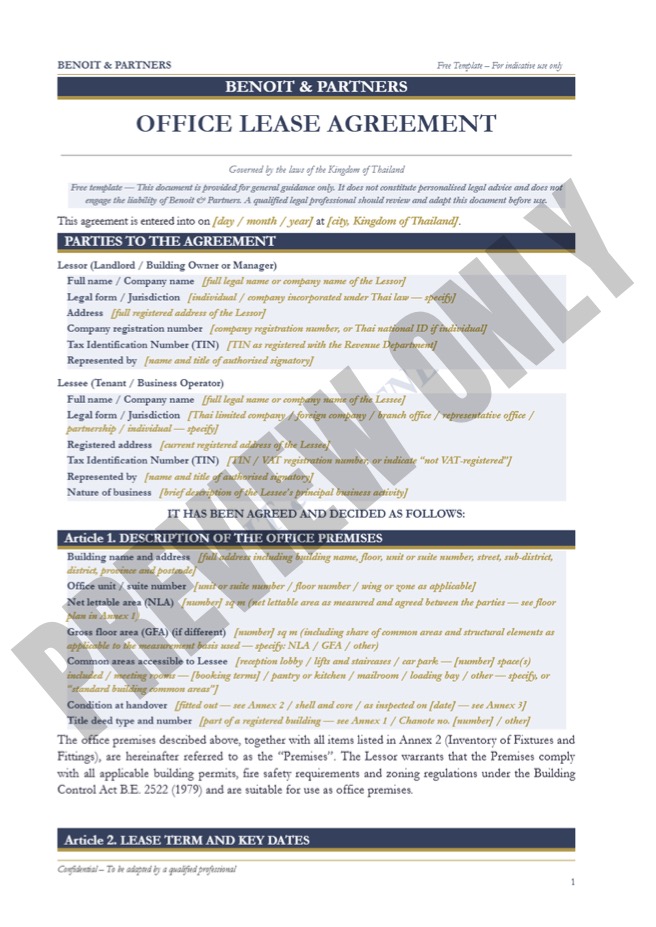
Our Office Lease Agreement in Thailand is drafted and reviewed by experienced lawyers to ensure compliance with Thai law and practical business use. It provides a reliable legal framework for formally setting out the terms on which office premises are leased between a landlord and a business tenant in Thailand.
Designed for landlords, businesses, and corporate tenants seeking to establish a clear and enforceable leasing arrangement for office space in Thailand, this template covers key legal aspects such as identification of the parties and premises, rent and service charges, fit-out and maintenance obligations, and compliance with applicable provisions of the Thai Civil and Commercial Code.
However, some situations may require additional clauses or tailored structuring depending on the size of the premises, the length of the lease term, building management arrangements, or the specific needs of the tenant’s business. Our legal team can assist clients with customised Office Lease Agreements adapted to their specific situation within a short timeframe.
Disclaimer: This template is provided for general informational purposes only and does not constitute legal advice. While it has been prepared by legal professionals, it may not reflect your specific situation or regulatory constraints. For complex or high-value office leases, legal advice should be sought to ensure proper structuring and compliance under Thai property law.
Need a Contract Tailored to Your Needs? Get a Free Consultation.
When should you use an Office Lease Agreement in Thailand?
An Office Lease Agreement in Thailand is required whenever a landlord agrees to make office premises available to a business tenant in exchange for rent. This covers situations ranging from a single floor in a commercial tower to an entire standalone office building.
Under Thai law, office leases are governed by the Civil and Commercial Code, particularly Sections 537 to 571. Any lease with a term exceeding three years must be registered with the competent Land Office to be enforceable for the full agreed period against third parties.
This document is especially important when the lease involves fit-out works, shared building services, or a significant financial commitment, since it enables both parties to clearly set out their respective rights and obligations regarding the use, maintenance, and condition of the premises.
For larger transactions, particularly those involving multinational tenants or premises within managed office buildings, additional provisions covering service charges, building rules, and exclusivity may be necessary.
Without a properly executed Office Lease Agreement, both landlord and tenant risk significant legal and financial exposure arising from disputes over service charges, fit-out responsibilities, or the unenforceability of the lease under Thai property law.

1. Identification of the Parties and Premises
The agreement should identify the landlord and tenant by full name and address, and describe the leased premises precisely, including the floor, unit number, and approximate area, so that the subject matter of the lease is unambiguous.
2. Term and Renewal
The lease term should be clearly stated, together with any renewal options, the notice required to exercise them, and any rent adjustment that will apply on renewal.
3. Rent and Service Charges
The agreement should specify the base rent, any applicable service or common area maintenance charges, the payment schedule, and the mechanism for periodic rent review.
4. Fit-Out and Alterations
Where the tenant intends to carry out fit-out works, the agreement should address the approval process, compliance with building regulations, and the treatment of fixtures and fittings at the end of the lease.
5. Building Rules and Shared Facilities
The agreement should reference any building management rules governing access, signage, and the use of shared facilities such as lobbies, lifts, and parking areas.
6. Maintenance and Repair Obligations
A clear allocation of responsibility for maintenance and repair of the premises, distinguishing between the landlord's obligations regarding the building structure and the tenant's obligations regarding the interior fit-out.
Key Clauses and Essential Elements in an Office Lease Agreement
An Office Lease Agreement in Thailand is a central legal document governing the relationship between a landlord and a business tenant in Thailand. It defines the rights and obligations of each party throughout the lease term and provides a framework for managing common situations such as fit-out works, service charges, maintenance obligations, and lease renewal.
Under the Civil and Commercial Code, leases exceeding three years must be registered at the Land Office to be enforceable for their full duration. A properly drafted agreement reduces legal uncertainty and protects both parties against disputes over interpretation or performance.
In addition to regulating the commercial terms of the tenancy, a well-drafted Office Lease Agreement should clearly address matters such as permitted use of the premises, repair and maintenance responsibilities, common area management, insurance requirements, security deposits, and conditions for assignment or subletting.
Why customise an Office Lease Agreement with a lawyer in Thailand?
While a standard Office Lease Agreement in Thailand may be suitable for simple transactions, many office leases involve financial, legal, and regulatory considerations that require more advanced drafting and tailored protections.
In practice, each lease carries its own risk profile. Factors such as the length of the term, the scope of fit-out works, the tenant’s business profile, and the building’s management structure can significantly affect the legal framework required.
Depending on the transaction, specific provisions may be needed covering service charge reconciliation, exclusivity or non-compete restrictions, break clauses, building management obligations, or tailored dispute resolution procedures.
Customising an Office Lease Agreement allows the parties to allocate responsibilities clearly and anticipate risks specific to their transaction. This is particularly important for large office leases, long-term agreements, or arrangements involving multinational tenants.
Our legal team assists landlords, tenants, and corporate clients with the preparation of office lease agreements adapted to their particular situation, ensuring compliance with Thai property and commercial law.
Office Lease Agreement Thailand
Instant Download
Easy to Customize
Ready to Sign
Crafted by Lawyers
FAQ
What is an Office Lease Agreement in Thailand?
A contract under which a landlord grants a business tenant the right to occupy office premises for a defined period in exchange for rent, setting out the term, rent, service charges, and the parties’ respective obligations.
Is registration required for an office lease in Thailand?
Registration at the Land Office is required for any lease with a term exceeding three years in order for it to be enforceable for its full duration against third parties. Shorter leases are valid between the parties without registration.
Who is responsible for fit-out costs in an office lease in Thailand?
Responsibility for fit-out costs is a matter of negotiation between the parties. Landlords may offer a fit-out contribution or rent-free period in exchange for a longer lease commitment, and the agreement should clearly record what has been agreed.
Can service charges be increased during an office lease term in Thailand?
Service charges may be adjusted during the lease term if the agreement permits it, typically subject to a cap or a requirement for the landlord to provide supporting cost documentation. The agreement should specify the mechanism and any limitations that apply.
What happens to fit-out works at the end of an office lease in Thailand?
The treatment of fit-out works at lease end depends on the agreement. Tenants may be required to remove their fit-out and reinstate the premises, or the landlord may agree to retain certain improvements. This should be addressed explicitly in the lease.
Can an office lease be terminated early in Thailand?
Early termination is possible where the lease includes a break clause or where both parties agree to a surrender. Without such provisions, premature termination may expose the terminating party to a claim for the remaining rent or damages.
Are office leases in Thailand subject to VAT?
Commercial property leases in Thailand are generally subject to value added tax where the landlord is VAT-registered, and the agreement should clarify whether rent is quoted inclusive or exclusive of VAT.
How does the PDPA apply to an Office Lease Agreement in Thailand?
Where the agreement contains personal data relating to the landlord, tenant, or their representatives, the parties must handle that data in accordance with the Personal Data Protection Act B.E. 2562 (2019), using it only for purposes connected with the lease.