
Part-Time Employment Contract Thailand
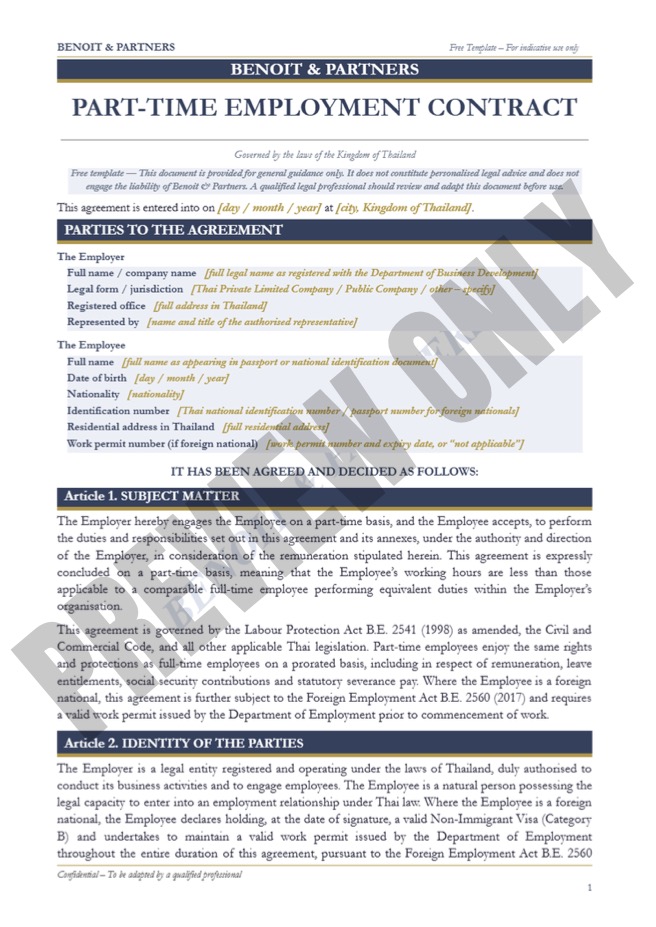
Our Part-Time Employment Contract template for Thailand is drafted and reviewed by experienced lawyers to ensure compliance with Thai law and practical business use. It provides a reliable legal framework for formalising part-time employment relationships between employers and employees in Thailand.
Designed for employers, HR departments, and companies engaging part-time staff in Thailand, this template covers key legal aspects such as identification of the parties, scope of the role, working hours and schedule, remuneration and pro-rata benefits, leave entitlements, termination procedures, and compliance with the Labour Protection Act and other applicable Thai employment regulations.
However, some situations may require additional clauses or tailored structuring depending on the nature of the role, the seniority of the employee, the sector of activity, foreign national employment considerations, or the specific terms of the working arrangement. Our legal team can assist clients with customised Part-Time Employment Contracts adapted to their specific situation within a short timeframe.
Disclaimer: This template is provided for general informational purposes only and does not constitute legal advice. While it has been prepared by legal professionals, it may not reflect your specific situation or regulatory constraints. For complex or senior-level appointments, legal advice should be sought to ensure proper structuring and compliance under Thai employment law.
Need a Contract Tailored to Your Needs? Get a Free Consultation.
When should you use a Part-Time Employment Contract in Thailand?
A Part-Time Employment Contract is used whenever an employer engages an individual to work on a regular basis for fewer hours than a standard full-time working week. This situation commonly arises in retail, hospitality, education, healthcare, professional services, and any other sector where flexible working arrangements are required, whether for operational reasons or at the request of the employee.
Under Thai law, part-time employment relationships are governed by the Labour Protection Act B.E. 2541 (1998) and its amendments, which establish minimum employment standards applicable to all employees regardless of the number of hours worked. Part-time employees are entitled to pro-rata benefits, including wages, leave entitlements, and social security contributions, in proportion to their working hours. The standard maximum working week under Thai law is 48 hours for general work and 42 hours for work deemed hazardous.
This agreement becomes particularly important when the working arrangement involves a regular and ongoing commitment, as it provides both parties with a clear and legally compliant framework governing the terms of the engagement. It allows the parties to define the working schedule, remuneration, pro-rata leave entitlements, notice period for termination, and any specific obligations applicable to the role.
In more complex situations, additional provisions may be required regarding confidentiality and intellectual property obligations, restrictions on working for competing employers, social security and provident fund arrangements, or work permit and visa requirements for foreign national employees. Our legal team assists clients with the preparation of customised Part-Time Employment Contracts tailored to their specific requirements and compliance obligations under Thai employment law.
In practice, this agreement is also crucial for distinguishing a genuine part-time employment relationship from an independent contractor or freelance arrangement, as the distinction has significant implications for tax, social security, and statutory employment rights under Thai law.
Without a properly drafted Part-Time Employment Contract, employers risk disputes over working hours, remuneration, leave entitlements, termination rights, and the classification of the working relationship under Thai employment law.

1. Identification of the Parties
The contract must clearly identify the employer and the employee, including the employer's full legal name and registered address, the employee's full name and identification details, and the names and titles of the authorised representatives signing on behalf of each party.
2. Position, Duties and Reporting Line
The contract must specify the position held by the employee, a description of the principal duties and responsibilities, the department or business unit in which the employee will work, the location of employment, and the reporting line including the title of the direct supervisor.
3. Working Hours and Schedule
The contract must define the agreed working schedule, including daily and weekly hours, specific working days, start and end times, and any flexibility arrangements, in compliance with the Labour Protection Act.
4. Remuneration and Payment Terms
The contract must set out the agreed wage or salary, whether calculated on an hourly, daily, or monthly basis, the frequency and method of payment, and any applicable overtime rates, in compliance with the minimum wage and overtime provisions of the Labour Protection Act.
5. Pro-Rata Leave Entitlements
The contract must confirm the employee's entitlement to statutory leave on a pro-rata basis, including annual leave, sick leave, public holidays, maternity leave where applicable, and any other statutory leave entitlements under the Labour Protection Act, calculated in proportion to the employee's agreed working hours.
6. Social Security and Provident Fund
The contract must address the employer's and employee's respective obligations in respect of social security contributions under the Social Security Act B.E. 2533 (1990), and confirm whether the employee will be enrolled in the employer's provident fund scheme on a pro-rata basis where applicable.
Key Clauses and Essential Elements in a Part-Time Employment Contract
A Part-Time Employment Contract is a key legal document governing the terms of a part-time employment relationship in Thailand. It defines the rights and obligations of the employer and the employee while ensuring compliance with the Labour Protection Act and other applicable Thai employment regulations.
Under the Labour Protection Act, employers must comply with minimum employment standards regardless of the number of hours worked by the employee. A properly drafted Part-Time Employment Contract helps ensure compliance with these requirements and reduces the risk of future disputes over the agreed terms of the engagement.
This type of contract is commonly used across all sectors of the Thai economy for roles involving regular part-time working arrangements, whether on a fixed daily, weekly, or monthly schedule.
While standard situations may rely on a general template, more complex arrangements often require additional provisions depending on the nature of the role and the specific terms agreed.
Why customise a Part-Time Employment Contract with a lawyer in Thailand?
While a standard Part-Time Employment Contract template for Thailand may be sufficient for straightforward part-time arrangements, many part-time employment situations involve legal, regulatory, and practical considerations requiring more careful drafting and tailored protections.
In practice, each part-time arrangement has its own structure and level of risk. Variable working schedules, multiple employer arrangements, foreign national employees, sector-specific regulations, or complex remuneration packages may all require provisions that are not included in a standard template.
Depending on the situation, specific clauses may be added relating to flexible working schedule arrangements, restrictions on working for competing employers, confidentiality and non-solicitation obligations, work permit and visa sponsorship for foreign national employees, PDPA compliance, or the correct classification of the working relationship to avoid misclassification as an independent contractor.
Tailoring a Part-Time Employment Contract also allows the employer to clearly communicate the working arrangement, manage expectations on both sides, and ensure that the document accurately reflects the agreed terms while remaining compliant with Thai employment law. This is particularly important for roles involving access to confidential information, client-facing responsibilities, or work in regulated sectors.
Our legal team assists employers, HR departments, and companies with the preparation and review of customised Part-Time Employment Contracts for Thailand adapted to their specific workforce management needs and compliance obligations. In many cases, tailored contracts can be prepared within a short timeframe while ensuring full compliance with Thai labour, social security, and data protection law.
A properly drafted Part-Time Employment Contract not only provides clarity and certainty for both the employer and the employee, but also reduces the risk of future employment disputes, regulatory penalties, and unexpected liabilities arising from the part-time working arrangement.
Part-Time Employment Contract Thailand
Instant Download
Easy to Customize
Ready to Sign
Crafted by Lawyers
FAQ
What is a Part-Time Employment Contract in Thailand?
A written contract governing the terms of a regular part-time employment relationship in Thailand, where the employee works fewer hours than a standard full-time week. Governed by the Labour Protection Act B.E. 2541 (1998) and subject to all applicable minimum employment standards on a pro-rata basis.
Are part-time employees entitled to the same rights as full-time employees in Thailand?
Yes, on a pro-rata basis. Part-time employees are entitled to minimum wage, statutory leave, social security coverage, and severance pay in proportion to their working hours and length of service, in accordance with the Labour Protection Act.
What is the maximum number of hours a part-time employee can work in Thailand?
Labour Protection Act sets a maximum of 48 hours per week for general work and 42 hours for hazardous work. Part-time employees work fewer than these maximums by definition. Hours worked in excess of the agreed part-time schedule may attract overtime pay obligations.
Is a written Part-Time Employment Contract required in Thailand?
A written contract is not strictly required by law for all employment relationships, but is strongly recommended. A written contract provides clear evidence of the agreed terms, protects both parties in the event of a dispute, and ensures compliance with applicable statutory requirements.
Are part-time employees entitled to severance pay in Thailand?
Yes. Part-time employees who are terminated without cause are entitled to severance pay under the Labour Protection Act, calculated on a pro-rata basis by reference to their length of service and agreed remuneration, in the same way as full-time employees.
Can a foreign national work part-time in Thailand?
Yes, subject to obtaining a valid work permit and appropriate visa. A work permit is required for all foreign nationals working in Thailand regardless of the number of hours worked. The employer is typically responsible for sponsoring the work permit application.
Can a part-time employee work for multiple employers in Thailand?
Thai law does not generally prohibit part-time employees from working for multiple employers, unless the employment contract contains a specific restriction. Employers in sensitive sectors or roles involving confidential information may wish to include appropriate restrictions in the contract.
How does the PDPA apply to a Part-Time Employment Contract in Thailand?
Personal data collected and processed in connection with the employment relationship must be handled in accordance with the Personal Data Protection Act B.E. 2562 (2019). Employers should ensure that appropriate lawful bases exist for processing employee personal data and that suitable data protection provisions are included in the employment contract.