
Partnership Agreement in Thailand
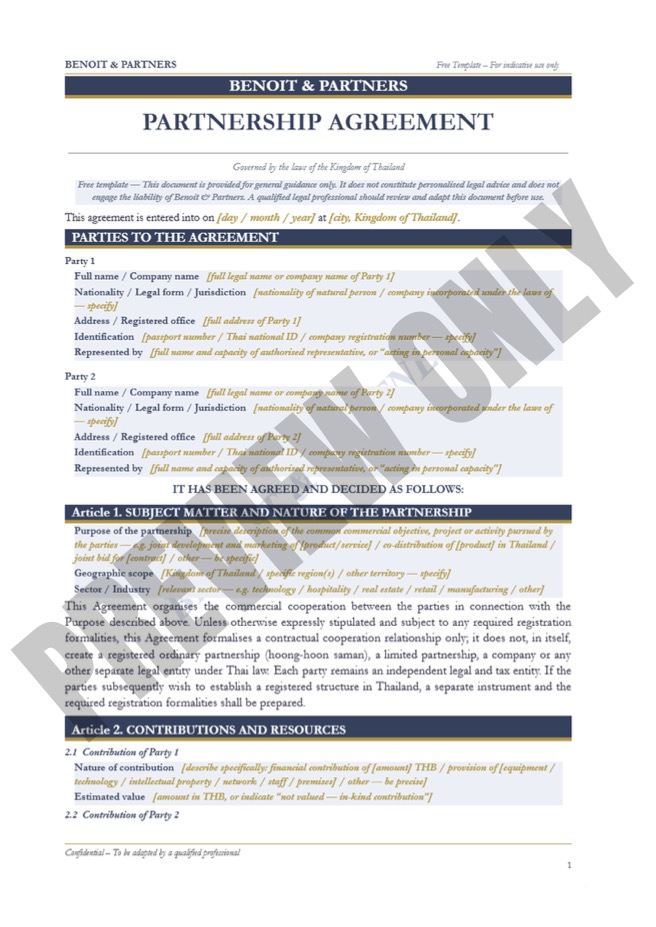
Our Partnership Agreement in Thailand is drafted and reviewed by experienced lawyers to ensure compliance with Thai law and practical business use. It provides a reliable legal framework for formally establishing the rights, obligations, and governance arrangements between two or more persons carrying on business together as partners in Thailand.
Designed for entrepreneurs, investors, and business professionals seeking to formalise a partnership arrangement in Thailand, this template covers key legal aspects such as identification of the partners, the nature and purpose of the partnership business, capital contributions, profit and loss sharing, management and decision-making authority, and compliance with the applicable provisions of the Thai Civil and Commercial Code governing ordinary and registered partnerships.
However, some situations may require additional clauses or tailored structuring depending on the type of partnership being established, the respective roles and contributions of the partners, applicable regulatory or licensing requirements, or the specific governance arrangements the parties wish to put in place. Our legal team can assist clients with customised Partnership Agreements adapted to their specific situation within a short timeframe.
Disclaimer: This template is provided for general informational purposes only and does not constitute legal advice. While it has been prepared by legal professionals, it may not reflect your specific situation or regulatory constraints. For complex commercial partnerships or arrangements involving foreign partners, legal advice should be sought to ensure proper structuring and compliance under Thai partnership and commercial law.
Need a Contract Tailored to Your Needs? Get a Free Consultation.
When should you use a Partnership Agreement in Thailand?
A Partnership Agreement in Thailand is the appropriate instrument when two or more persons decide to carry on a business together in Thailand and wish to define the terms of their relationship in a clear and binding document. .
Thai partnership law is governed by the Civil and Commercial Code, which recognises three categories of partnership: the ordinary partnership, in which all partners bear unlimited joint liability for the debts of the partnership; the registered ordinary partnership, which has legal personality distinct from its partners; and the limited partnership, in which at least one partner has unlimited liability and at least one has liability limited to their agreed contribution.
A written partnership agreement is not strictly required by Thai law, but it is strongly advisable in all but the most straightforward arrangements. Without a written agreement, the partners’ rights and obligations are governed entirely by the default provisions of the Civil and Commercial Code, which may not reflect the commercial intentions of the parties and can give rise to disputes in areas such as profit sharing, management authority, and the consequences of a partner’s withdrawal or death.
More complex partnerships , particularly those involving foreign partners, significant capital contributions, or regulated business activities — may require additional provisions covering foreign business licensing, work permit arrangements, capital repatriation, or the interaction between the partnership structure and applicable tax obligations. Our legal team is available to assist with tailored agreements that address these dimensions comprehensively.
Without a properly documented Partnership Agreement, disputes about the terms of the partnership are resolved by reference to statutory defaults that the parties may never have intended to apply, often with commercially unsatisfactory results.
.

1. Identification of the Partners and the Partnership
The agreement should clearly identify all partners by their full legal names, addresses, and identification or passport numbers, and should specify the name under which the partnership will carry on business, the nature of the business, and its principal place of operation.
2. Capital Contributions
The agreement should set out each partner's agreed capital contribution whether in cash, property, or services, the timetable for making those contributions, and the consequences of a failure to contribute as agreed. The treatment of additional capital requirements should also be addressed.
3. Profit and Loss Sharing
The basis on which profits and losses are to be shared among the partners should be clearly defined, including the timing and mechanics of profit distributions and the procedure for agreeing the annual accounts of the partnership.
4. Management and Decision-Making
The agreement should specify which partners have authority to manage the business on a day-to-day basis, what decisions require the consent of all partners or a defined majority, and how deadlocks in decision-making are to be resolved.
5. Partners' Duties and Obligations
The specific duties of each partner including obligations of good faith, non-competition undertakings, and requirements to devote time and attention to the partnership business should be clearly set out to avoid ambiguity about what is expected of each party.
6. Admission and Withdrawal of Partners
The conditions under which new partners may be admitted to the partnership, and the procedure and financial consequences of a partner's withdrawal, retirement, or death, should be addressed in detail to provide a clear and workable framework for changes in the composition of the partnership.
Key Clauses and Essential Elements in a Partnership Agreement
A well-drafted Partnership Agreement in Thailand gives the partners a clear and complete framework for the conduct of their business, the management of their relationship, and the resolution of any disputes that may arise between them.
It aligns the legal structure of the partnership with the commercial intentions of the parties and provides a documented basis for decision-making throughout the life of the business.
Under the Civil and Commercial Code, the rights and obligations of partners are defined primarily by the partnership agreement itself, with the statutory defaults applying only where the agreement is silent. A comprehensive written agreement that addresses the key aspects of the partnership relationship reduces reliance on those defaults and minimises the risk of future disputes.
This document is relevant across all types of partnership from small professional practices to large commercial ventures and in both domestically owned Thai partnerships and arrangements involving foreign partners.
The core structure remains consistent, though the specific terms will vary significantly depending on the nature of the business, the composition of the partnership, and the commercial objectives of the parties.
Why customise a Partnership Agreement with a lawyer in Thailand?
A standard Partnership Agreement in Thailand provides a useful starting point for simple partnership arrangements, but a wide range of commercial and legal considerations call for a more carefully tailored approach before the agreement is signed.
The specific composition of the partnership, the nature of the business, and the respective contributions and expectations of the partners all shape what the agreement needs to achieve. A partnership involving foreign nationals, a regulated business activity, significant intellectual property, or a complex profit-sharing structure requires a level of legal precision and commercial awareness that a generic template cannot deliver.
Depending on the situation, the agreement may need to address: the interaction between the partnership structure and Thailand’s foreign business licensing requirements; the tax treatment of partnership income and distributions for both Thai and foreign partners; the registration requirements for a registered ordinary partnership or limited partnership; intellectual property ownership and licensing arrangements within the partnership; the implications of a partner’s insolvency or incapacity; or dispute resolution mechanisms tailored to the specific relationship between the parties.
Our legal team works with partners and investors to prepare partnership agreements that are structurally sound, commercially realistic, and legally enforceable and that give all parties a clear and shared understanding of the basis on which they are going into business together.
Partnership Agreement Thailand
Instant Download
Easy to Customize
Ready to Sign
Crafted by Lawyers
FAQ
What is a Partnership Agreement in Thailand?
A written contract through which two or more persons formally establish the terms of their partnership, defining their respective contributions, rights, obligations, and governance arrangements for the conduct of a business in Thailand.
What types of partnership are recognised under Thai law?
The Civil and Commercial Code recognises three types: the ordinary partnership, in which all partners have unlimited joint liability; the registered ordinary partnership, which has separate legal personality; and the limited partnership, in which at least one partner has unlimited liability and at least one has liability limited to their capital contribution.
Is a written Partnership Agreement required in Thailand?
Thai law does not require a partnership agreement to be in writing, but a written agreement is strongly advisable. Without one, the partners’ rights and obligations are governed by the statutory defaults in the Civil and Commercial Code, which may not reflect the commercial intentions of the parties.
Can a foreign national be a partner in a Thai partnership?
Yes, but the involvement of foreign partners may trigger the requirements of the Foreign Business Act B.E. 2542 (1999), which restricts foreign participation in certain categories of business activity. The structure and licensing implications should be assessed carefully before a foreign partner joins a Thai partnership.
How are partnership profits taxed in Thailand?
The tax treatment of partnership income depends on the type of partnership. Registered ordinary partnerships and limited partnerships are treated as juristic persons for tax purposes and are subject to corporate income tax. Ordinary partnerships are generally taxed at the partner level. The applicable tax position should be confirmed with a tax adviser before the structure is finalised.
What happens if a partner in Thailand wishes to leave the partnership?
The procedure for a partner’s withdrawal is governed primarily by the partnership agreement. In the absence of agreement, the Civil and Commercial Code applies default rules. A departing partner may be entitled to a payment representing their share of the partnership’s net assets, and their withdrawal may trigger a dissolution of the partnership unless the remaining partners agree to continue.
Can a Partnership Agreement in Thailand be amended after signing?
Yes, provided all partners consent to the amendment. Amendments should be documented in a written addendum signed by all partners to ensure they are legally effective and clearly recorded.
How does the PDPA apply to a Partnership Agreement in Thailand?
Where the agreement involves the collection and processing of personal data of the partners or third parties, the partnership must comply with the Personal Data Protection Act B.E. 2562 (2019). This includes ensuring that personal data is collected with a lawful basis, stored securely, and used only for legitimate business purposes.