
Payment Request Letter in Thailand
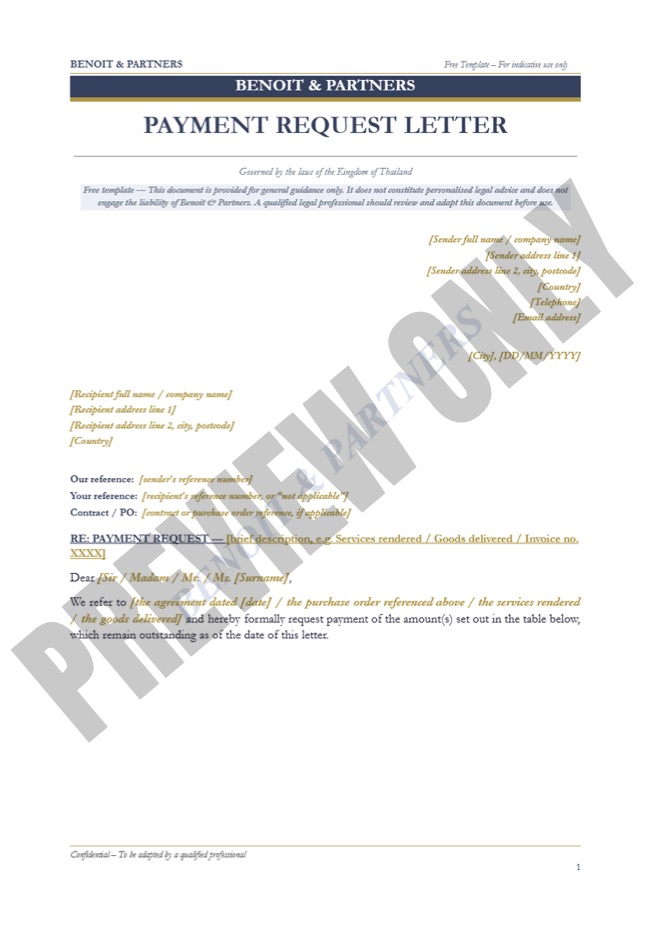
Our Payment Request Letter in Thailand is drafted and reviewed by experienced lawyers to ensure compliance with Thai law and practical business use. It provides a reliable legal framework for formally requesting payment of an outstanding amount from a debtor in Thailand, whether in connection with a commercial invoice, a contractual obligation, or any other recognised payment liability.
Designed for businesses and individuals seeking to formally pursue an outstanding payment from a counterparty in Thailand, this template covers key legal aspects such as identification of the parties, a clear statement of the amount due and its basis, reference to the underlying invoice or contractual obligation, a defined payment deadline, and compliance with applicable Thai civil and commercial law requirements.
However, some situations may require additional clauses or tailored structuring depending on the nature and age of the debt, the relationship between the parties, the applicable contractual payment terms, or the escalation strategy being pursued. Our legal team can assist clients with customised Payment Request Letters adapted to their specific situation within a short timeframe.
Disclaimer: This template is provided for general informational purposes only and does not constitute legal advice. While it has been prepared by legal professionals, it may not reflect your specific situation or regulatory constraints. For disputed debts or matters where legal proceedings may follow, legal advice should be sought to ensure proper structuring and compliance under Thai civil and commercial law.
Need a Contract Tailored to Your Needs? Get a Free Consultation.
When should you use a Payment Request Letter in Thailand?
A Payment Request Letter in Thailand is the appropriate instrument when a business or individual wishes to formally notify a debtor of an outstanding payment obligation and request settlement within a defined period.
Thai civil law as set out in the Civil and Commercial Code governs the rights and obligations of creditors and debtors in commercial payment relationships. A creditor whose payment has not been received by the due date is entitled to demand payment and, in appropriate circumstances, to claim interest on the outstanding amount.
Committing the payment demand to a formal written letter carries significant practical and legal advantages. It places the request on official record, demonstrates that the creditor has given the debtor a reasonable opportunity to settle before further action is taken, and creates a clear reference point for any subsequent escalation whether through a demand letter from a lawyer, mediation, or court proceedings.
More complex situations may require a more forceful or legally detailed approach, such as a formal lawyer’s letter of demand, a notice of intent to commence legal proceedings, or a referral to a debt collection agency. Our legal team is available to assist with tailored correspondence that reflects the specific circumstances of the debt and the creditor’s escalation strategy.
Without a formally documented payment request, the creditor may find it difficult to demonstrate that the debtor was given adequate notice of the outstanding obligation before legal action was commenced, potentially affecting the costs position in any subsequent proceedings.

1. Identification of the Parties
The letter should clearly identify the creditor and the debtor by their full legal names, addresses, and contact details, together with any relevant customer or account reference numbers that link the letter to the underlying commercial relationship.
2. Statement of the Outstanding Amount
The total amount due should be stated precisely, with a breakdown showing the principal amount, any applicable interest accrued to the date of the letter, and any other charges that form part of the outstanding balance.
3. Basis of the Debt
The letter should identify the invoice number, contract reference, or other document that gives rise to the payment obligation, and should confirm the date on which the payment fell due under the applicable terms.
4. Payment Deadline
A clear and reasonable deadline by which payment must be received should be stated.
5. Payment Instructions
The letter should include clear instructions for making payment, including the bank account details, payment reference to be used, and the accepted methods of payment, to remove any practical obstacles to prompt settlement.
6. Interest and Additional Charges
Where the creditor is entitled to charge interest on the overdue amount under the terms of the contract or applicable law, the applicable rate and the basis of calculation should be stated, together with confirmation that interest will continue to accrue until payment is received in full.
Key Clauses and Essential Elements in a Payment Request Letter
A well-drafted Payment Request Letter in Thailand gives the debtor a precise and complete account of the outstanding obligation, a clear statement of the amount due, and a defined deadline for payment while signalling that the creditor is serious about pursuing the matter if a satisfactory response is not received.
Under Thai law, a formal written demand for payment is relevant to the running of interest on the outstanding amount and to the commencement of limitation periods in some circumstances.
A properly structured and dated letter therefore serves both a practical and a legal function.
This document is relevant across all categories of commercial and personal debt from unpaid trade invoices to outstanding loan repayments and contractual payment obligations and is applicable whether the creditor and debtor are both Thai entities, both foreign, or a combination of the two.
Why customise a Payment Request Letter with a lawyer in Thailand?
A standard template of Payment Request Letter in Thailand is adequate for routine payment reminders in straightforward commercial relationships, but a range of situations call for a more carefully considered approach before the letter is sent.
The nature and age of the debt, the debtor’s circumstances, and the creditor’s escalation strategy all influence what the letter needs to achieve and how it should be framed. A payment demand relating to a significant outstanding debt, a disputed invoice, or a debtor who has indicated an inability or unwillingness to pay requires a level of legal precision and strategic awareness that a generic template cannot deliver.
The letter may, where appropriate, need to take into account: the calculation and basis of contractual or statutory interest on the overdue amount; the applicable limitation period for the debt under Thai law and the risk of the claim becoming time-barred; the interaction between the payment request and any security or guarantee that supports the debt; the PDPA implications of including personal data in the correspondence; or the tone and framing most likely to produce a prompt payment response from the specific debtor.
Our legal team works with businesses and individuals to prepare payment request letters that are precise, legally grounded, and calibrated to produce the most effective outcome in the specific circumstances. The result is a letter that the debtor cannot reasonably ignore and that positions the creditor effectively for any necessary escalation.
Payment Request Letter Thailand
Instant Download
Easy to Customize
Ready to Sign
Crafted by Lawyers
FAQ
What is a Payment Request Letter?
A formal written communication through which a creditor notifies a debtor of an outstanding payment obligation, specifies the amount due and its basis, sets a deadline for payment, and indicates the steps that will be taken if the debt is not settled within the stated period.
Is a formal Payment Request Letter required before taking legal action in Thailand?
While Thai procedural law does not always require a formal demand letter as a prerequisite to commencing court proceedings, issuing one is strongly advisable. It demonstrates that the creditor gave the debtor a reasonable opportunity to settle, which is relevant to the court’s assessment of costs and the conduct of the parties.
Can interest be claimed on an overdue payment in Thailand?
Yes. Where the underlying contract provides for interest on late payment, that rate applies. In the absence of a contractual rate, the Civil and Commercial Code provides for statutory interest at the prescribed rate from the date the debt fell due or the date of formal demand, depending on the circumstances.
How long does a creditor have to pursue a payment claim in Thailand?
Limitation periods for commercial claims in Thailand vary depending on the nature of the debt. Claims on commercial contracts are generally subject to a five-year limitation period under the Civil and Commercial Code, although shorter periods apply to specific categories of claim. Legal advice should be sought if there is any risk that the limitation period may be approaching.
What should a creditor do if a Payment Request Letter is ignored in Thailand?
If the debtor fails to respond or make payment within the stated period, the creditor may escalate the matter by instructing a lawyer to issue a formal demand letter, initiating mediation or conciliation proceedings, or commencing a claim in the Thai courts. The documented payment request letter serves as important evidence in any subsequent process.
Can a Payment Request Letter be sent by email in Thailand?
Yes, provided the parties have established a practice of communicating by email or have agreed to accept electronic notices. The sender should retain evidence of delivery and, where possible, seek acknowledgement of receipt from the debtor.
What are the tax implications of writing off an unpaid debt in Thailand?
Where a creditor determines that a debt is irrecoverable and writes it off, the tax treatment will depend on whether the write-off qualifies as a deductible expense under Thai revenue law. Specific conditions apply, and tax advice should be sought before a debt is formally written off for accounting purposes.
How does the PDPA apply to a Payment Request Letter in Thailand?
Where the letter contains personal data including the debtor’s name, address, and financial information it must be handled in accordance with the Personal Data Protection Act B.E. 2562 (2019). The data should be used only for the purpose of pursuing the outstanding payment and must be stored and transmitted securely.