
Performance Evaluation Form Thailand
Our Performance Evaluation Form Thailand is drafted and reviewed by experienced lawyers to ensure compliance with Thai law and practical business use. It provides a reliable legal framework for formally assessing and documenting an employee’s performance within a structured review process in Thailand.
Designed for employers, HR professionals, and managers seeking to conduct fair and documented performance assessments in Thailand, this template covers key legal aspects such as identification of the parties, evaluation criteria and scoring methodology, performance ratings by category, overall assessment, and compliance with applicable Thai employment and labour regulations.
However, some situations may require additional clauses or tailored structuring depending on the seniority of the position, the nature of the role being assessed, applicable collective bargaining arrangements, or the specific performance framework operated by the employer. Our legal team can assist clients with customised Performance Evaluation Forms adapted to their specific situation within a short timeframe.
Disclaimer: This template is provided for general informational purposes only and does not constitute legal advice. While it has been prepared by legal professionals, it may not reflect your specific situation or regulatory constraints. For complex or senior-level employment situations, legal advice should be sought to ensure proper structuring and compliance under Thai employment law.
Need a Contract Tailored to Your Needs? Get a Free Consultation.
When should you use a Performance Evaluation Form in Thailand?
A Performance Evaluation Form Thailand becomes the appropriate instrument when an employer needs to conduct a structured and documented assessment of an employee’s work performance in Thailand. Typical occasions include scheduled annual or mid-year reviews, the conclusion of a probationary period, a promotion process, a performance improvement plan, or any situation where a formal record of the employee’s output and conduct is required for HR or legal purposes.
Thai employment law is grounded primarily in the Labour Protection Act B.E. 2541 (1998) and its subsequent amendments, which govern the conditions of employment and the procedures that must be followed when employment terms are varied or the relationship is brought to an end. While the Act does not prescribe a specific format for performance assessments, documented evaluations play a critical role in demonstrating fair process, particularly where disciplinary action, demotion, or termination may follow.
Conducting evaluations through a written and structured form carries significant practical advantages. It ensures consistency across the workforce, gives employees a transparent account of where they stand, and provides the employer with a defensible record in the event that the assessment becomes relevant to a subsequent employment decision or dispute. A properly completed form shows that the employer has engaged seriously with the employee’s performance rather than relying on informal impressions.
More complex assessment scenarios may call for additional considerations, including the interaction with contractual performance targets, applicable bonus or incentive schemes, or the procedural requirements that apply before any adverse employment action can lawfully be taken. Our legal team is available to assist with tailored evaluation frameworks that address these dimensions while remaining fully aligned with Thai employment law requirements.
A completed evaluation form also serves as a contemporaneous record of the employer’s assessment at a given point in time, which can prove significant if the matter later becomes part of a broader employment dispute or termination process.
Relying on verbal feedback alone, without a written evaluation record, leaves the employer without documentary support for the assessments made and exposes the business to challenge if an employee disputes the grounds for a subsequent employment decision.

1. Identification of the Parties
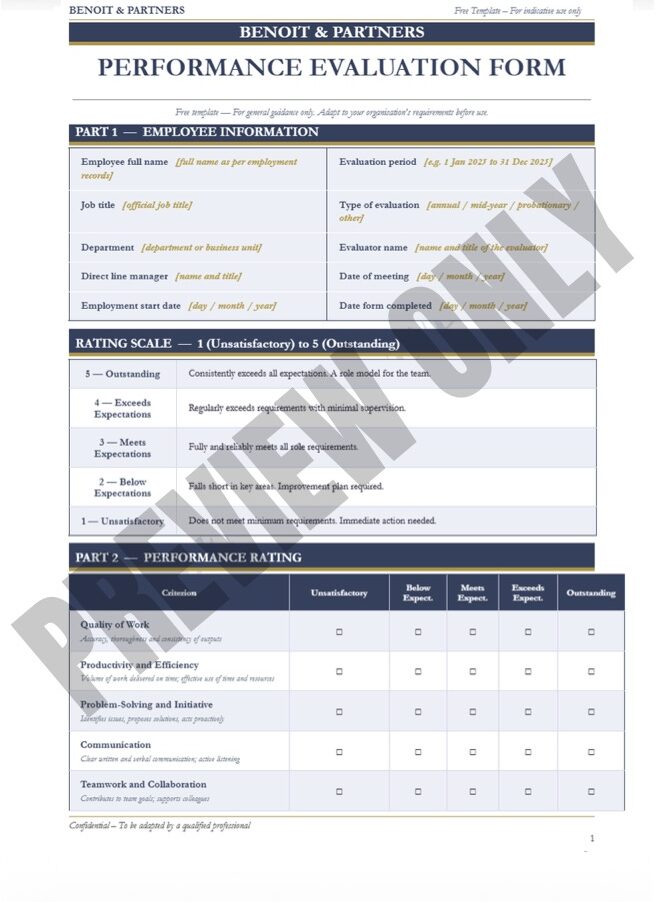
The form should clearly state the employee's full name, job title, department, and the evaluation period covered, together with the name and title of the evaluating manager and the date on which the assessment is completed.
2. Performance Criteria and Scoring Framework
A defined set of assessment categories — such as quality of work, productivity, communication, teamwork, and adherence to internal policies — should be set out alongside a clearly explained scoring scale, so that ratings are applied consistently and can be understood by the employee.
3. Individual Category Ratings
Each criterion should be assessed and scored separately, with space for the evaluating manager to provide specific comments that explain and support the rating given. Narrative observations add credibility to the scores and demonstrate that the assessment is grounded in actual performance rather than general impressions.
4. Overall Performance Rating
A consolidated assessment drawing on the individual category scores should be provided, giving a clear summary of the employee's overall performance during the review period. This overall rating should be consistent with the category-level assessments and reflect a balanced view of the employee's contribution.
5. Development Objectives and Action Points
The form should include a forward-looking section setting out specific objectives, training needs, or improvement targets for the next review period. Clear and measurable goals give the employee a defined path and support the employer's ability to demonstrate that fair notice was given of any performance concerns.
6. Employee Acknowledgement and Comments
The employee should be given the opportunity to review the completed assessment and add their own observations or responses before signing. This section confirms that the evaluation has been shared and discussed, which is an important element of a fair and transparent review process.
Key Clauses and Essential Elements in a Performance Evaluation Form
A well-structured Performance Evaluation Form Thailand gives both the employer and the employee a clear and shared understanding of how performance has been assessed and what expectations apply going forward. It frames the assessment in objective terms, supports consistent application across the workforce, and ensures that the process meets the standards of good employment practice in Thailand.
Under the Labour Protection Act, any decision to discipline or terminate an employee must be grounded in a demonstrable and fair process. A properly completed evaluation form contributes directly to that evidentiary foundation, particularly where the assessment leads to a performance improvement requirement or informs a subsequent termination decision.
This document is applicable across all levels of the organisation — from entry-level staff to senior management — and in both local Thai enterprises and international businesses operating in Thailand.
The core structure remains consistent, though the specific criteria and weighting will vary according to the nature of the role and the employer’s internal performance management framework.
Why customise a Performance Evaluation Form with a lawyer in Thailand?
A Performance Evaluation Form Thailand works well for routine annual assessments in stable employment relationships, but a number of workplace situations call for a more carefully constructed approach before the evaluation is conducted and documented.
The specific context of each assessment shapes what the form needs to achieve. An evaluation that will directly inform a termination decision, a demotion, or the activation of a performance improvement plan requires a level of rigour and legal precision that goes beyond what a generic template can provide.
Depending on the situation, the form may need to address: the alignment between the evaluation criteria and the employee’s contractual job description; the procedural requirements under the Labour Protection Act that apply before disciplinary action or termination can lawfully follow; the relationship between the assessment and any applicable bonus, commission, or incentive entitlements; PDPA considerations arising from the collection, storage, and use of personal performance data; the evidentiary weight the form will need to carry if the evaluation is subsequently challenged; or the interaction between the assessment and any ongoing grievance or disciplinary process involving the same employee.
Ensuring that the form is properly structured from the outset, both in its evaluation criteria and in its procedural safeguards , reduces the risk of challenge and demonstrates that the employer has approached the process with appropriate care and objectivity.
Our legal team works with HR functions, line managers, and business owners to design performance evaluation frameworks that are consistent, legally sound, and tailored to the specific requirements of the organisation and the role being assessed. The result is a process that protects the employer, supports the employee’s understanding of expectations, and withstands scrutiny if the assessment is ever called into question.
A well-designed evaluation form does more than record a performance score, it creates a structured and defensible basis for employment decisions, supports a culture of clear expectations and accountability, and ensures that the employer’s assessment process is aligned with the requirements of Thai employment law.
Performance Evaluation Form Thailand
Instant Download
Easy to Customize
Ready to Sign
Crafted by Lawyers
FAQ
What is a Performance Evaluation Form in Thailand?
A structured written document through which an employer formally assesses an employee’s work performance across a defined set of criteria during a specific review period, producing a documented record of ratings, observations, and agreed objectives.
Is a performance evaluation legally required in Thailand?
There is no statutory obligation to conduct formal performance reviews. However, a documented evaluation process is strongly advisable, particularly where the employer anticipates making employment decisions — such as pay adjustments, promotions, or terminations — that may need to be justified by reference to the employee’s performance record.
Can an employee refuse to sign a Performance Evaluation Form in Thailand?
An employee may decline to sign, but the employer should document the refusal and proceed with filing the completed form. The employee’s signature acknowledges receipt and the opportunity to comment; it does not necessarily indicate agreement with the ratings given.
How does the PDPA apply to performance evaluations in Thailand?
Performance data collected during an evaluation constitutes personal data under the Personal Data Protection Act B.E. 2562 (2019). Employers must ensure that this data is collected with an appropriate lawful basis, stored securely, used only for legitimate HR purposes, and retained no longer than necessary.
Can a performance evaluation be used as evidence in a dismissal process in Thailand?
Yes. A properly completed and documented evaluation forms part of the evidentiary basis for employment decisions. Where termination is contemplated, a record of prior performance concerns — communicated to the employee and reflected in formal evaluations — significantly strengthens the employer’s legal position.
How often should performance evaluations be conducted in Thailand?
Practice varies, but annual and mid-year reviews are the most common cycles. Additional evaluations may be appropriate at the end of a probationary period, following a significant change in role, or where performance concerns have been identified that require closer monitoring.
What happens if an employer fails to follow a fair evaluation process before terminating an employee in Thailand?
Termination without a demonstrable and fair process may expose the employer to an unfair dismissal claim under the Labour Protection Act, potentially resulting in severance liability or an order for compensation.
Can an employee challenge the results of a Performance Evaluation Form in Thailand?
Yes. While Thai law does not prescribe a formal appeal procedure for performance evaluations, employees may submit written comments, objections, or supporting evidence if they disagree with the assessment. Employers are encouraged to maintain a transparent review process and retain any employee responses as part of the personnel record.