
Power of Attorney Form in Thailand
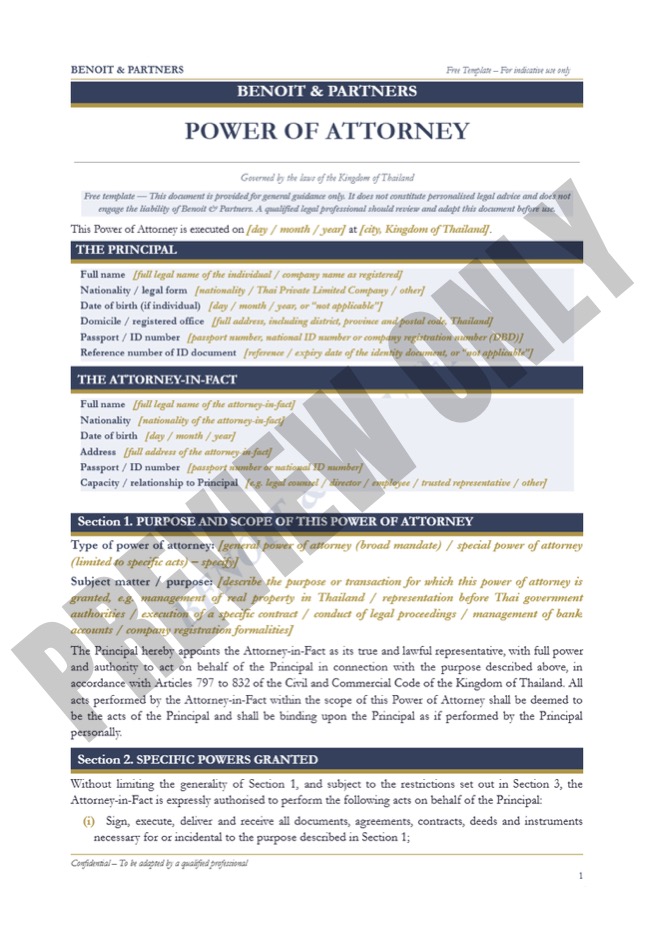
Our Power of Attorney Form in Thailand is drafted and reviewed by experienced lawyers to ensure compliance with Thai law and practical business use. It provides a reliable legal framework for formally authorising a designated individual to act on behalf of the grantor in legal, financial, or administrative matters in Thailand.
Designed for individuals and businesses seeking to delegate authority to a trusted representative for specific or general purposes in Thailand, this template covers key legal aspects such as identification of the grantor and the attorney-in-fact, the scope of authority granted, the duration of the power, and compliance with the requirements of the Civil and Commercial Code governing agency and powers of attorney.
However, some situations may require additional clauses or tailored structuring depending on the nature of the transaction for which the power is granted, whether the power relates to property, banking, litigation, or company matters, or specific requirements imposed by the receiving authority or counterparty. Our legal team can assist clients with customised Powers of Attorney adapted to their specific situation within a short timeframe.
Disclaimer: This template is provided for general informational purposes only and does not constitute legal advice. While it has been prepared by legal professionals, it may not reflect your specific situation or regulatory constraints. For high-value transactions or powers granted for property or litigation purposes, legal advice should be sought to ensure proper structuring and compliance under Thai law.
Need a Contract Tailored to Your Needs? Get a Free Consultation.
When should you use a Power of Attorney Form in Thailand?
A Power of Attorney Form in Thailand is the appropriate instrument whenever an individual or company wishes to authorise another person to act on their behalf in a legal, financial, or administrative matter in Thailand, particularly where the grantor is unable or unavailable to attend to the matter personally. Common situations include property transactions, opening or operating bank accounts, representing the grantor before government authorities, managing company affairs, or handling litigation on the grantor’s behalf.
Under the Civil and Commercial Code, a power of attorney creates an agency relationship between the grantor and the attorney-in-fact, under which acts performed by the attorney within the scope of the authority granted are legally binding on the grantor. Certain transactions, particularly those involving land or property, require the power of attorney to be in a specific form and, in many cases, registered or certified before it can be relied upon.
A properly drafted power of attorney gives third parties such as government offices, banks, or the Land Department clear assurance of the attorney’s authority to act, reducing the risk of the document being rejected or queried at the point of use. It also protects the grantor by clearly defining the scope and limits of the authority being delegated.
Granting authority informally, or through a document that does not meet the formal requirements applicable to the specific transaction, risks the power of attorney being rejected by the receiving authority and may expose the grantor to acts taken outside the intended scope of delegation.

1. Identification of the Grantor
The form should state the full name, identification or passport number, and address of the person or entity granting the power, together with confirmation of their legal capacity to do so.
2. Identification of the Attorney-in-Fact
The form should clearly identify the person being appointed to act on the grantor's behalf, including their full name, identification number, and address.
3. Scope of Authority
The specific acts the attorney is authorised to perform should be set out precisely whether that is signing a specific contract, representing the grantor before a named authority, or managing a defined category of affairs. General powers should be used with caution given the broad authority they confer.
4. Duration of the Power
The form should state whether the power is granted for a specific transaction, a defined period, or until revoked, providing clarity about when the authority comes to an end.
5. Restrictions and Limitations
Any specific limitations on the attorney's authority such as a maximum transaction value or a requirement to consult the grantor before taking certain actions should be clearly stated to prevent the authority from being exercised beyond the grantor's intentions.
6. Signature and Witnessing
The form should be signed by the grantor and, depending on the transaction, may require witnesses, certification by a notarial services attorney, or legalisation, particularly where the document is to be used for property transactions or has been executed outside Thailand.
Key Clauses and Essential Elements in a Power of Attorney Form
A well-drafted Power of Attorney Form in Thailand gives the attorney-in-fact clear and specific authority to act, while protecting the grantor through carefully defined limits on the scope and duration of that authority. It must be drafted with precision, as Thai authorities and counterparties will generally construe the scope of the power narrowly, limited to what is expressly stated.
For certain transactions, particularly those involving registered land, the power of attorney must follow specific forms prescribed by the relevant authority, such as the Land Department’s standard power of attorney forms, and may require certification or notarisation depending on whether the grantor is signing within or outside Thailand.
This document is used across a wide range of contexts, from straightforward administrative tasks to complex property and corporate transactions, and the appropriate scope and formalities will vary significantly depending on the purpose for which the power is granted.
Why customise a Power of Attorney Form with a lawyer in Thailand?
A standard Power of Attorney Form in Thailand is suitable for simple, low-risk administrative tasks, but many situations call for a more carefully tailored power of attorney to ensure the document is accepted by the relevant authority and properly protects the grantor’s interests.
Property transactions, company management matters, litigation, and powers granted to attorneys located outside Thailand each carry specific formal requirements and risk considerations that a generic template may not adequately address.
Depending on the situation, the power of attorney may need to comply with specific Land Department form requirements, include notarisation or legalisation for use abroad, address the interaction with an existing power of attorney, or incorporate specific restrictions to protect the grantor in high-value or sensitive transactions.
Our legal team works with individuals and businesses to prepare powers of attorney that are properly scoped, correctly formatted for their intended purpose, and accepted without difficulty by the relevant Thai authority or counterparty.
Power of Attorney Form Thailand
Instant Download
Easy to Customize
Ready to Sign
Crafted by Lawyers
FAQ
What is a Power of Attorney Form in Thailand?
A legal document through which a person or entity, known as the grantor, formally authorises another person, the attorney-in-fact, to act on their behalf in specified legal, financial, or administrative matters.
Does a Power of Attorney in Thailand need to be notarised?
Notarisation is not always required, but it is commonly necessary for powers of attorney executed outside Thailand or used in connection with property transactions, in order to satisfy the requirements of the Land Department or other receiving authorities.
Can a Power of Attorney in Thailand be used for property transactions?
Yes, provided it is prepared on the prescribed form and meets the specific requirements of the Land Department, including, in many cases, execution before a District Office official or notarisation if signed abroad.
How long is a Power of Attorney valid in Thailand?
The validity period depends on the terms set out in the document itself. A power of attorney may be limited to a specific transaction, granted for a defined period, or remain valid until expressly revoked by the grantor.
Can a Power of Attorney be revoked in Thailand?
Yes. The grantor may revoke a power of attorney at any time, provided the attorney-in-fact and any relevant third parties relying on the power are properly notified of the revocation to avoid acts being taken after the authority has ended.
What happens if an attorney-in-fact exceeds their authority under a Power of Attorney in Thailand?
Acts performed beyond the scope of the authority granted are not binding on the grantor, although the grantor should take prompt action to clarify the position with any third party who may have relied on the attorney’s apparent authority.
Can a foreigner grant or receive a Power of Attorney in Thailand?
Yes. Foreign nationals can both grant and be appointed under a power of attorney in Thailand, though additional formalities such as notarisation and legalisation are often required where the document is executed outside the country.
How does the PDPA apply to a Power of Attorney Form in Thailand?
The form contains personal data relating to both the grantor and the attorney-in-fact. Any party relying on or processing this document must ensure that the personal data it contains is handled in accordance with the Personal Data Protection Act B.E. 2562 (2019).