
Privacy Policy Thailand
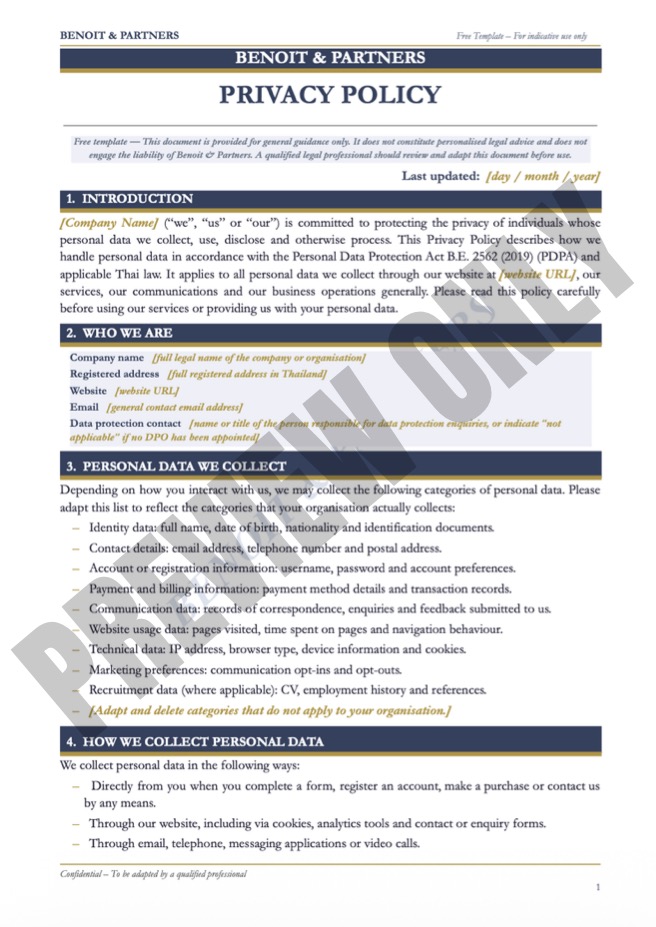
Our Privacy Policy Thailand is drafted and reviewed by experienced lawyers to ensure compliance with Thai law and practical business use. It provides a reliable legal framework for informing individuals about how their personal data is collected, used, stored, and disclosed by an organisation operating in Thailand.
Designed for businesses, websites, applications, and organisations of all sizes seeking to meet their obligations under Thai data protection law, this template covers key legal aspects such as identification of the data controller, the categories of personal data collected, the purposes and legal bases for processing, data retention periods, the rights of data subjects, disclosure to third parties, and compliance with the Personal Data Protection Act B.E. 2562 (2019).
However, some situations may require additional clauses or tailored structuring depending on the nature of the organisation’s activities, the categories of sensitive personal data processed, the involvement of third-party processors or international data transfers, or the specific sector in which the organisation operates. Our legal team can assist clients with customised Privacy Policies adapted to their specific situation within a short timeframe.
Disclaimer: This template is provided for general informational purposes only and does not constitute legal advice. While it has been prepared by legal professionals, it may not reflect your specific situation or regulatory constraints. For organisations processing sensitive personal data or operating across multiple jurisdictions, legal advice should be sought to ensure proper structuring and compliance under the PDPA and applicable international data protection frameworks.
Need a Contract Tailored to Your Needs ? Get a Free Consultation.
When should you use a Privacy Policy in Thailand?
A Privacy Policy Thailand is required whenever an organisation collects, uses, stores, or discloses personal data in connection with its activities in Thailand. The Personal Data Protection Act B.E. 2562 (2019) . Thailand’s primary data protection legislation obliges data controllers to provide data subjects with clear and accessible information about how their personal data is processed, and a Privacy Policy is the principal mechanism through which that obligation is discharged.
The PDPA applies to any organisation that collects or processes personal data of individuals located in Thailand, regardless of whether the organisation itself is based in Thailand.
Failing to maintain a compliant Privacy Policy exposes an organisation to enforcement action by the Personal Data Protection Committee, administrative fines of up to five million Baht per violation, and potential civil and criminal liability.
More complex data processing activities such as the use of cookies and tracking technologies, automated decision-making, profiling, or the transfer of personal data to processors outside Thailand, require additional provisions that go beyond the scope of a standard template. Our legal team is available to assist with tailored Privacy Policies that address these dimensions while remaining fully aligned with the PDPA and applicable international frameworks.
Without a compliant and accessible Privacy Policy, an organisation cannot lawfully process personal data in Thailand and risks significant legal and reputational exposure.

1. Identity of the Data Controller
The Privacy Policy should clearly identify the organisation responsible for processing personal data, including its full legal name, registered address, and contact details, together with the contact details of any Data Protection Officer where one has been appointed.
2. Categories of Personal Data Collected
The policy should set out the specific categories of personal data collected by the organisation such as names, contact details, financial information, health data, or behavioural data so that data subjects understand precisely what information is being held about them.
3. Purposes and Legal Bases for Processing
For each category of personal data and each processing activity, the policy should identify the specific purpose for which the data is used and the legal basis on which processing is carried out under the PDPA.
4. Data Retention Periods
The policy should specify how long each category of personal data is retained and the criteria used to determine retention periods. Data should not be held for longer than is necessary for the stated purpose, and the policy should explain what happens to personal data when the retention period expires.
5. Disclosure to Third Parties
The policy should identify the categories of third parties to whom personal data may be disclosed.
6. International Data Transfers
Where personal data is transferred outside Thailand, the policy should identify the countries to which transfers are made and the safeguards in place to ensure that the data receives an adequate level of protection in accordance with the PDPA's transfer requirements.
Key Clauses and Essential Elements in a Privacy Policy
A well-structured Privacy Policy in Thailand gives data subjects a complete and transparent picture of how their personal data is handled by the organisation. It satisfies the PDPA’s transparency requirements, demonstrates the organisation’s commitment to lawful data processing, and provides individuals with the information they need to exercise their statutory rights.
The PDPA requires data controllers to provide specific categories of information to data subjects at or before the time their personal data is collected. A Privacy Policy that addresses each of these categories in clear and accessible language is the cornerstone of a compliant data governance framework.
This document is relevant across all sectors and all sizes of organisation from sole traders and small businesses to large corporations and public bodies and is applicable whether personal data is collected online, in person, or through other means.
A clear Privacy Policy also helps build trust by showing that the organisation handles personal data responsibly and transparently. It reinforces compliance with data protection obligations and good governance practices.
Why customise a Privacy Policy with a lawyer in Thailand?
A standard template of Privacy Policy Thailand provides a useful starting point for organisations with straightforward data processing activities, but a significant range of business models and data processing practices require a more carefully tailored approach to achieve genuine PDPA compliance.
The specific nature of the data processed, the sectors in which the organisation operates, and the technical architecture of its data collection and processing systems all influence what the Privacy Policy needs to address and how it should be structured.
Depending on the situation, the policy may need to address: the processing of sensitive personal data such as health, biometric, or criminal record data which attracts heightened obligations under the PDPA; the use of cookies, tracking technologies, and behavioural advertising; automated decision-making and profiling activities and their implications for data subject rights; the legal requirements for international data transfers and the appropriate safeguards.
Our legal team works with organisations of all sizes to prepare Privacy Policies that are genuinely compliant with the PDPA, clearly written for their intended audience, and properly integrated into the organisation’s broader data governance framework.
Privacy Policy Thailand
Instant Download
Easy to Customize
Ready to Sign
Crafted by Lawyers
FAQ
What is a Privacy Policy in Thailand?
A formal written document through which an organisation informs individuals about how their personal data is collected, used, stored, disclosed, and protected, in compliance with the transparency and information obligations imposed by the Personal Data Protection Act B.E. 2562 (2019).
Is a Privacy Policy legally required in Thailand?
Yes. The PDPA requires data controllers to provide data subjects with prescribed categories of information about the processing of their personal data. A Privacy Policy is the standard mechanism for discharging this obligation and is a legal requirement for any organisation that collects or processes personal data of individuals in Thailand.
What are the penalties for non-compliance with the PDPA in Thailand?
The PDPA provides for administrative fines of up to five million Baht per violation, civil liability for actual damages caused by unlawful processing, and criminal penalties including imprisonment of up to one year for the most serious violations involving sensitive personal data.
Does the PDPA apply to foreign companies with Thai customers?
Yes. The PDPA applies to any organisation that collects or processes personal data of individuals located in Thailand, regardless of where the organisation itself is established. Foreign businesses with Thai users or customers are required to comply with the Act.
What is the difference between a Privacy Policy and a Data Processing Agreement in Thailand?
A Privacy Policy is a public-facing document that informs data subjects about how their personal data is processed. A Data Processing Agreement is a contract between a data controller and a data processor that governs the terms on which the processor handles personal data on behalf of the controller. Both are required under the PDPA in the appropriate circumstances.
How often should a Privacy Policy be updated in Thailand?
A Privacy Policy should be reviewed and updated whenever there is a material change to the organisation’s data processing activities, when new categories of personal data are collected, or when the legal framework changes. Regular annual reviews are also advisable to ensure continued compliance.
What are sensitive personal data categories under the PDPA in Thailand?
The PDPA identifies a specific list of sensitive personal data categories that attract heightened obligations, including racial or ethnic origin, political opinions, religious or philosophical beliefs, sexual behaviour, criminal records, health data, disability data, trade union membership, genetic data, and biometric data.
How does a Privacy Policy interact with cookie consent requirements in Thailand? Where
Where an organisation uses cookies or similar tracking technologies that involve the processing of personal data, the Privacy Policy should address this activity specifically and should be linked to any cookie consent mechanism deployed on the organisation’s website or application.