
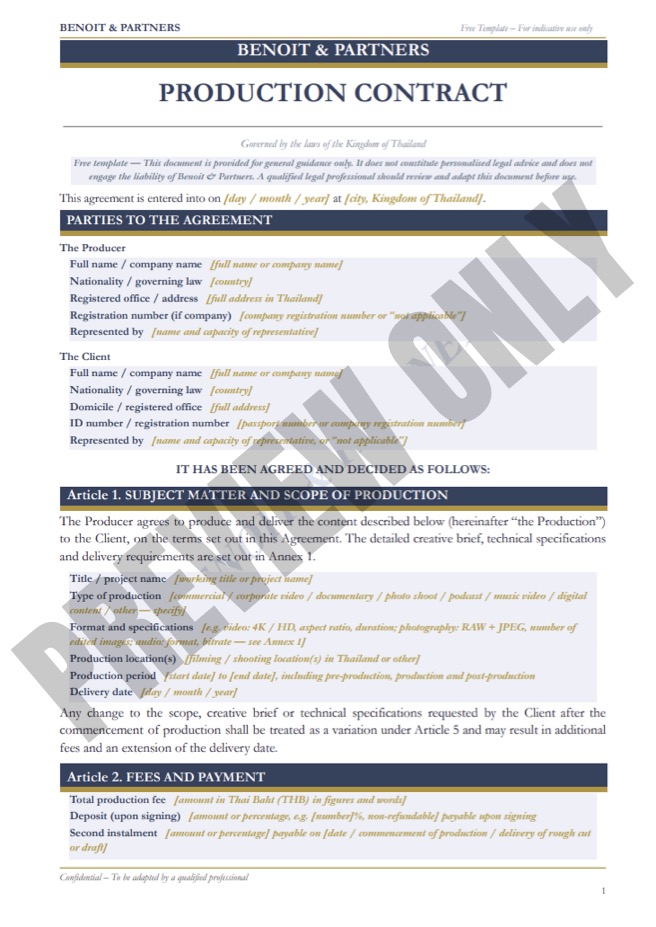
Production Contract Template for Thailand
Our Production Contract template for Thailand has been professionally drafted and reviewed by experienced lawyers to comply with Thai commercial law and industry practices. It provides a reliable legal framework for businesses and individuals engaging manufacturers, producers, or contractors to produce goods, products, or specific deliverables in Thailand.
Prepared for companies, entrepreneurs, manufacturers, brand owners, distributors, and investors, this template regulates essential legal and commercial matters including production specifications, quality standards, delivery schedules, payment terms, intellectual property rights, confidentiality obligations, and liability provisions.
Certain production arrangements may require more advanced drafting or customised protections, particularly where international supply chains, proprietary technology, exclusive manufacturing rights, regulatory compliance obligations, or large-scale production volumes are involved. In such cases, our legal team can prepare a tailored Production Contract adapted to the specific structure and commercial objectives of the transaction.
Disclaimer: This template is provided for general informational purposes only and should not be considered legal advice. Although prepared by legal professionals, it may not address all operational, regulatory, or commercial risks associated with your production arrangement. Independent legal advice is recommended for complex, international, or high-value manufacturing projects under Thai law.
Need a Contract Tailored to Your Needs ? Get a Free Consultation.
When should you use a Production Contract in Thailand ?
A Production Contract is commonly used when one party engages another party to manufacture, assemble, process, or produce goods according to agreed specifications.
This type of agreement is frequently used for private-label manufacturing, OEM production, product development, industrial manufacturing, food production, textile manufacturing, and commercial supply arrangements.
Under the Civil and Commercial Code of Thailand governing contractual obligations and hire of work arrangements, parties may contractually define the production requirements, quality standards, delivery obligations, and responsibilities applicable to the manufacturing process.
Without a properly drafted Production Contract in Thailand, parties may encounter disputes regarding production quality, delays, intellectual property ownership, defective products, or payment obligations.

1. Identification of the parties
A Production Contract must clearly identify the manufacturer and the client. This generally includes legal names, registration details, addresses, and relevant corporate information.
2. Description of the products and production requirements
A Production Contract for Thailand should define the products to be manufactured, technical specifications, production standards, materials, packaging requirements, and quality expectations.
3. Pricing and payment conditions
A Production Contract should establish the manufacturing costs, payment schedule, invoicing procedures, deposits, and any adjustments applicable during production.
4. Production timeline and delivery obligations
A Production Contract should specify production deadlines, delivery schedules, acceptance procedures, and responsibilities relating to transportation and logistics.
5. Intellectual property and confidentiality
A Production Contract should regulate ownership of designs, trademarks, formulas, technical information, and confidential business information shared during the manufacturing process.
6. Liability, warranties, and dispute resolution
A Production Contract for Thailand should address defective products, warranty obligations, liability limitations, indemnification provisions, and dispute resolution mechanisms.
Key clauses and additional protections in a Production Contract for Thailand
A Production Contract is an essential legal document governing the relationship between a manufacturer and a client in Thailand. It establishes the contractual framework for the production process while defining the rights, obligations, and performance expectations of both parties.
Under the Civil and Commercial Code of Thailand, particularly the provisions relating to Hire of Work contracts, parties may agree on specific production obligations, delivery requirements, and quality standards applicable to the manufacturing project. A properly drafted Production Contract helps secure the transaction and reduce operational and legal risks.
This type of agreement is commonly used for manufacturing projects, private-label production, industrial supply arrangements, OEM contracts, and product development partnerships. While standard manufacturing relationships may rely on a general template, more complex projects often require customised clauses depending on intellectual property concerns, quality control requirements, regulatory compliance obligations, or international supply chain risks.
Why customise a Production Contract in Thailand with a lawyer?
Although standard manufacturing templates may be appropriate for straightforward production projects, many commercial arrangements involve legal, operational, and financial considerations that require more detailed drafting and tailored contractual protections.
In practice, manufacturing relationships frequently involve risks that generic agreements do not adequately address. Product specifications, quality control procedures, intellectual property ownership, tooling rights, exclusivity arrangements, regulatory approvals, product liability exposure, or international distribution structures may require provisions specifically adapted to the transaction.
Customising a Production Contract in Thailand also allows the parties to anticipate production risks, allocate responsibilities more effectively, and establish clear remedies in the event of delays, defects, or contractual breaches. This is particularly important for large-scale production, export-oriented manufacturing, proprietary products, or long-term commercial partnerships.
While free templates may provide a useful starting point for simple manufacturing arrangements, preparing a Production Contract with a lawyer in Thailand remains strongly recommended. Professional legal drafting helps strengthen contractual protection, reduce commercial uncertainty, and minimise the risk of costly disputes during production.
Our legal team assists manufacturers, brand owners, investors, and businesses with the preparation and review of customised Production Contracts adapted to their operational requirements and commercial objectives, within a short timeframe and in compliance with Thai law.
Production Contract Template Thailand
Instant Download
Easy to Customize
Ready to Sign
Crafted by Lawyers
FAQ
What is a Production Contract?
A Production Contract is a legal agreement governing the manufacture or production of goods by one party on behalf of another.
Who typically uses a Production Contract in Thailand?
Manufacturers, brand owners, distributors, startups, and companies outsourcing production commonly use Production Contracts.
Can the contract include quality control requirements?
Yes. Production Contracts frequently contain detailed quality standards, inspection rights, and acceptance procedures.
Who owns the intellectual property related to the products?
Ownership depends on the contractual provisions and should be clearly defined in the agreement.
Can a Production Contract cover international manufacturing projects?
Yes. Additional clauses may be required for export activities, foreign regulations, and international logistics.
What happens if the manufacturer delivers defective products?
The agreement may provide remedies such as replacement, repair, refunds, damages, or warranty claims.
Can either party terminate the contract?
Yes. Termination rights and procedures are generally governed by the terms of the agreement.
Why Customise A production contract in Thailand With A Lawyer?
Yes. Legal assistance is highly recommended for large production volumes, international projects, proprietary products, or high-value manufacturing arrangements.