
Property Inspection Form Template for Thailand
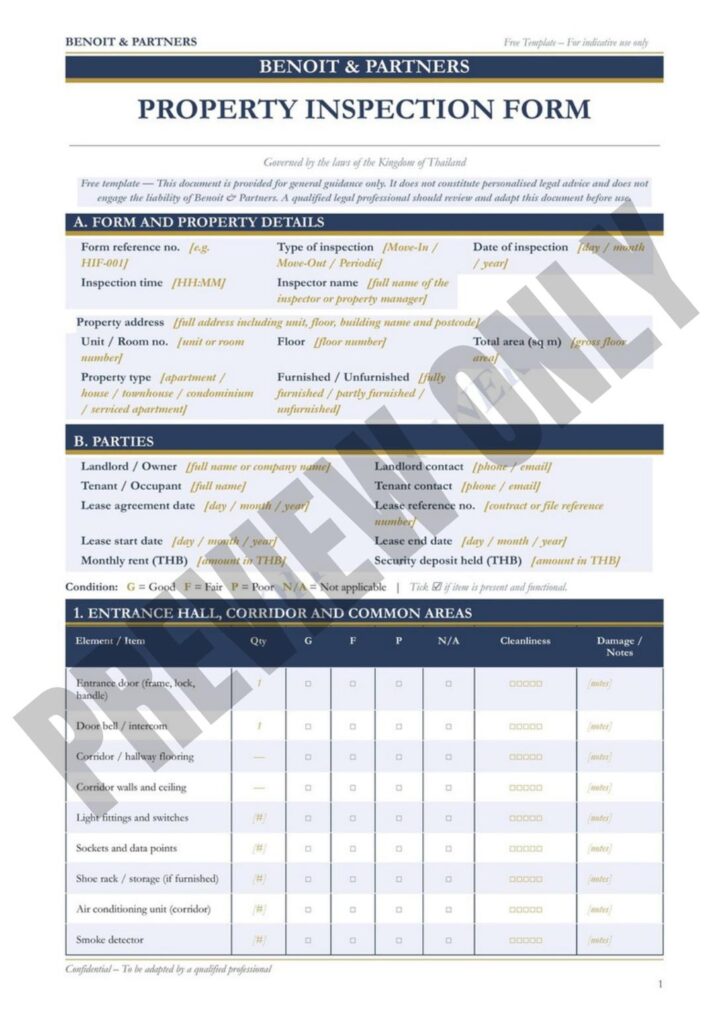
Our Property Inspection Form template for Thailand has been drafted and reviewed by qualified lawyers to ensure compliance with Thai law and standard property management practice. It provides a structured framework for documenting the condition of a residential property at move-in, move-out, or during a periodic inspection.
Designed for use by both landlords and tenants, this template covers all essential elements of a thorough property inspection: identification of the parties and the property, room-by-room condition assessment, utility meter readings, keys and access items handover, and a section for recording pre-existing damage and agreed repairs.
For arrangements requiring additional clauses or a customised inspection protocol, our legal team can assist within a short timeframe.
Disclaimer : This template is provided for general informational purposes only and does not constitute legal advice. For complex arrangements, professional legal advice should be sought to ensure compliance with applicable Thai legislation.
Need a Contract Tailored to Your Needs ? Get a Free Consultation.
When should you use a Property Inspection Form in Thailand?
A Property Inspection Form should be completed whenever a residential property changes hands between a landlord and a tenant in Thailand, at move-in, at move-out, or during a periodic check. It creates a dated, signed record of the property’s condition that both parties have agreed upon, and serves as the primary reference document in the event of a dispute over damage or deposit deductions at the end of the tenancy.
Under Thai law, the Civil and Commercial Code places the burden of proof on the landlord when seeking to retain all or part of a security deposit. Without a signed inspection record, establishing whether damage occurred before or during the tenancy becomes significantly more difficult. A properly completed inspection form removes this ambiguity and protects both parties equally.
This document is particularly important where the property is furnished, where a significant security deposit has been paid, or where the occupant is a foreign national. It provides clear evidence of the agreed state of the property, its contents, and its utility meter readings at the time of handover, which is essential for resolving any disagreement that may arise later.
For more complex situations, such as high-value properties, shared accommodation, or properties managed through a corporate structure, our legal team can assist with a tailored inspection protocol and supporting documentation.
Without a completed and signed Property Inspection Form, both landlord and tenant are exposed to disputes over pre-existing damage, missing items, and the proper allocation of repair and cleaning costs at the end of the tenancy.

1. Property and party identification
The form must record the full address and type of property, the inspection date and type (move-in, move-out, or periodic), and the names and contact details of both the landlord and the tenant, along with a reference to the applicable lease agreement.
2. Room-by-room condition assessment
Each area of the property, entrance, living room, kitchen, bedrooms, bathrooms, balcony, must be assessed individually, with the condition of every element rated and any damage or deficiency noted, to establish an agreed baseline at the time of inspection.
3. Cleanliness rating and damage notes
Each item must be assessed for cleanliness on a standardised scale and any visible damage, wear, or malfunction recorded in writing, so that the parties have a shared, documented understanding of the property's state at handover.
4. Utility meter readings
Electricity, water, gas, and internet meter readings must be recorded at both move-in and move-out to enable an accurate calculation of consumption charges and to prevent disputes over outstanding utility costs.
5. Keys and access items handover
The number of keys, access cards, remote controls, and other access items issued to the tenant must be recorded at move-in and verified at move-out, to ensure that all items are returned and that any missing items can be addressed promptly.
6. Agreed notes, pre-existing damage, and signatures
Any pre-existing damage agreed by both parties, repairs to be carried out by the landlord, and the tenant's comments or objections must be recorded and signed by both parties to give the document full legal weight under the Civil and Commercial Code.
Key clauses and additional protections in a Property Inspection Form
A Property Inspection Form is an essential document for any residential tenancy in Thailand. It records the agreed condition of the property at a specific point in time, protects both parties against unfounded claims, and provides the factual basis for any deposit deduction or repair claim at the end of the arrangement.
Under the Civil and Commercial Code, damage beyond fair wear and tear may be charged to the tenant and deducted from the security deposit, but only where the landlord can demonstrate that the damage was not pre-existing. A signed inspection form, supported by a photographic record, is the most effective way to establish this.
This document is used for private rentals between individuals, as well as for corporate landlords managing multiple units or properties with a high-value inventory. While a standard template covers most situations, inspections involving luxury properties, shared accommodation, or significant pre-existing issues may benefit from additional documentation and legal support.
A properly completed Property Inspection Form reduces the risk of disputes at the end of the tenancy and provides both parties with a reliable, enforceable record of the property’s condition.
Why customise a Property Inspection Form with a lawyer in Thailand?
While a standard template covers the essential elements of most residential inspections, some tenancies involve specific circumstances that require a more tailored approach.
In practice, inspections of furnished properties with a detailed inventory, high-value items, shared accommodation, or units managed through a corporate structure may require adapted condition ratings, a bespoke photographic record protocol, specific provisions on pre-existing damage, or cross-referencing with the underlying lease agreement and applicable PDPA obligations.
Our legal team assists landlords, tenants, and property managers with customised inspection forms and supporting documentation, ensuring full alignment with Thai law and with the terms of the applicable lease arrangement.
A properly tailored inspection form reduces the risk of post-tenancy disputes and provides both parties with a solid, enforceable record.
Property Inspection Form template
Instant Download
Easy to Customize
Ready to Sign
Crafted by Lawyers
FAQ
What is a Property Inspection Form in Thailand?
A Property Inspection Form is a document used to record the condition of a residential property at the time of move-in, move-out, or a periodic check. It is signed by both the landlord and the tenant and serves as the agreed reference for any deposit deduction or repair claim under the Civil and Commercial Code.
When should it be completed?
It should be completed at move-in, at move-out, and optionally at any agreed interim inspection during the tenancy. Completing the form at both ends of the tenancy is the most effective way to protect both parties and to resolve any disagreement over the property’s condition.
Is it legally required in Thailand?
No statutory obligation requires landlords or tenants to complete a formal inspection form. However, it is strongly recommended, as it provides the primary evidence base for any deposit dispute under the Civil and Commercial Code and significantly reduces the risk of litigation.
Can it be used to justify deposit deductions?
Yes. A signed inspection form recording damage beyond fair wear and tear at move-out, compared against the move-in record, provides a solid legal basis for deposit deductions. Without such a document, the landlord’s ability to retain any portion of the deposit may be difficult to enforce.
Should photographs be taken during the inspection?
Yes. Photographs should be taken of every room and of any existing or new damage, and attached to the form as Annex 1. A dated photographic record significantly strengthens the evidentiary value of the inspection form in the event of a dispute.
Does the PDPA apply?
Yes. Personal data collected during the inspection — including copies of identification documents — must be handled in accordance with the Personal Data Protection Act B.E. 2562 (2019). Both parties should ensure that personal data is processed and stored appropriately and is not retained longer than necessary.
Do I need a lawyer to complete this form?
For a standard rental between individuals, a template is generally sufficient. For high-value properties, furnished units with a detailed inventory, or tenancies involving corporate parties, legal assistance ensures that the form is properly tailored and legally enforceable.
What happens if no inspection form is signed?
Without a signed record, neither party has reliable evidence of the property’s condition at the start or end of the tenancy. This significantly increases the risk of disputes over damage, cleaning costs, and deposit deductions, and may result in litigation that could have been avoided.