
Purchase Order in Thailand
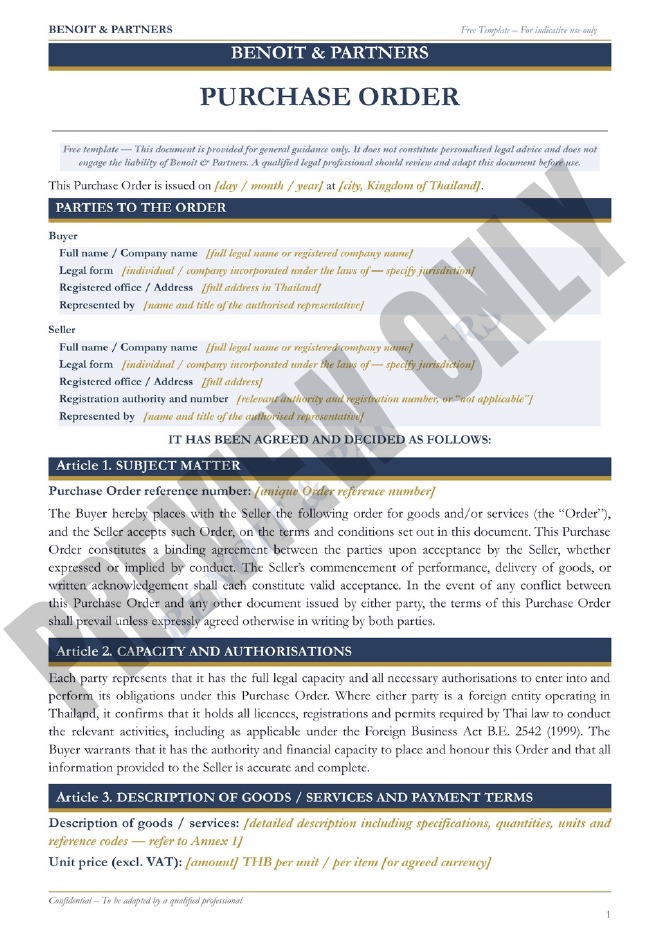
Our Purchase Order in Thailand template has been prepared and reviewed by experienced lawyers to ensure compliance with Thai law and practical business needs. It provides a reliable legal framework for standard procurement transactions in Thailand.
Designed for buyers, suppliers, and companies purchasing goods and services, the template covers key legal aspects such as product and service descriptions, payment terms, delivery conditions, warranties, and regulatory compliance under Thai law.
Depending on the transaction, additional clauses or customised structuring may be required, particularly for cross-border sourcing, tax matters, or specific commercial risks. Our legal team can assist with tailored Purchase Orders adapted to your needs within a short timeframe.
Disclaimer: This template is provided for general informational purposes only and does not constitute legal advice. For complex or high-value transactions, legal advice should be sought to ensure proper structuring and compliance under Thai law.
Need a Contract Tailored to Your Needs? Get a Free Consultation.
When should you use a purchase order in Thailand?
A Purchase Order is used whenever a buyer in Thailand formally orders goods and/or services from a seller. This situation commonly arises in domestic procurement, supply chain management, import and export transactions, public or private tenders, and ongoing commercial relationships between companies.
Under Thai law, purchase transactions are governed by the Civil and Commercial Code, notably the provisions on sale of goods (Sections 453 to 490), which regulate the transfer of ownership, delivery obligations, and seller warranties. For service-related orders, the provisions on hire of work (Sections 587 to 607) apply.
This document becomes particularly important when the transaction involves significant financial value, multiple deliveries, foreign suppliers, or complex payment structures. It allows the parties to clearly define the terms of the transaction, including price, payment conditions, warranties, delivery obligations, and risk allocation mechanisms.
In more complex transactions, additional clauses may be required regarding VAT obligations, withholding tax, escrow arrangements, confidentiality, dispute resolution, deferred payments, or compliance with foreign trade regulations. Our legal team assists clients with the preparation of customised Purchase Orders tailored to their transaction in order to provide stronger legal protection and ensure compliance with Thai law.
In practice, this agreement is also crucial when due diligence has been conducted on a supplier, as it formalises the allocation of risks identified during the review process.
Without a properly drafted Purchase Order, parties expose themselves to disputes, delivery failures, payment defaults, regulatory issues, and potential liability under Thai commercial law.

1. Identification of the parties and company
A Purchase Order in Thailand must clearly identify the buyer and the seller, including their full legal names, registration details, addresses, and the names of authorised representatives empowered to bind each party to the transaction.
2. Description of the transferred shares
The agreement must specify the nature, quantity, unit price, and technical specifications of the goods or services ordered, including references to annexes or product codes to avoid any ambiguity.
3. Purchase price and payment terms
The Purchase Order in Thailand must clearly define the total order value, applicable VAT at 7%, payment method, and due date, as well as late payment consequences in accordance with Section 224 of the Civil and Commercial Code.
4. Representations and warranties
Representations and warranties confirm the seller's legal capacity, the conformity of goods and services with agreed specifications, and the absence of third-party claims or encumbrances affecting the order.
5. Transfer and registration of ownership
The Purchase Order must specify the delivery address, requested delivery date, and applicable Incoterms 2020. Title and risk of loss transfer from seller to buyer upon delivery at the agreed destination.
6. Tax and regulatory compliance
The agreement must address VAT obligations under the Thai Revenue Code, withholding tax requirements, and compliance with the Foreign Business Act B.E. 2542 (1999) where foreign sellers are involved.
Key clauses and additional protections in a purchase order for Thailand
A Purchase Order is a key commercial document governing the procurement of goods and/or services in Thailand. It defines the rights and obligations of the buyer and seller while ensuring compliance with Thai corporate and commercial law.
Under the Civil and Commercial Code, a valid sale requires agreement on the subject matter and the price. A properly drafted Purchase Order in Thailand helps secure the transaction and reduce legal and commercial risks.
This type of document is commonly used in domestic procurement between Thai companies, import transactions involving foreign suppliers, service agreements with Thai or international providers, tender processes, and long-term supply relationships. While standard transactions may rely on a general template, more complex deals often require additional legal protections and customised clauses depending on the structure of the transaction and the risks involved.
A properly customised Purchase Order in Thailand helps secure the transaction and better protect the interests of the parties involved.
Why customise a purchase order with a lawyer in Thailand?
While a standard Purchase Order template for Thailand may be sufficient for simple procurement transactions, many transactions involve legal, financial, and regulatory considerations requiring more advanced drafting and tailored protections.
In practice, each transaction has its own structure and level of risk. Foreign supplier involvement, delivery complexity, payment structures, tax exposure, or ongoing supply relationships may require provisions that are not included in a standard template.
Depending on the transaction, specific clauses may be added relating to Incoterms 2020 delivery conditions, VAT at 7% and withholding tax obligations under the Revenue Code, liquidated damages and penalty clauses for late delivery, conditions precedent and advance payment requirements, force majeure events, confidentiality obligations and PDPA compliance, dispute resolution procedures, or compliance with foreign business restrictions under the Foreign Business Act B.E. 2542 (1999).
Tailoring a Purchase Order also allows the parties to better allocate responsibilities and anticipate risks identified during negotiations or legal review. This is particularly important for high-value orders, cross-border transactions, regulated goods, or complex supply arrangements.
Our legal team assists buyers, suppliers, and companies with the preparation and review of customised Purchase Orders in Thailand adapted to their transaction structure and commercial objectives. In many cases, tailored agreements can be prepared within a short timeframe while ensuring compliance with Thai corporate and commercial laws.
A properly drafted agreement not only helps secure the transaction, but also reduces the risk of future disputes, regulatory issues, and unexpected liabilities.
Purchase Order template Thailand
Instant Download
Easy to Customize
Ready to Sign
Crafted by Lawyers
FAQ
What is a Purchase Order in Thailand?
A Purchase Order is a commercial document issued by a buyer to a seller, formally requesting the supply of goods and/or services under specified terms and conditions. In Thailand, it constitutes a binding agreement upon acceptance by the seller and is governed by the Civil and Commercial Code and the Revenue Code.
Is a Purchase Order legally binding in Thailand?
Yes. A Purchase Order becomes legally binding once accepted by the seller, whether through written acknowledgement, commencement of performance, or delivery of goods. Clearly defined terms are essential to ensure enforceability and avoid disputes between the parties.
What are the VAT and tax obligations for a Purchase Order in Thailand?
VAT at 7% applies to most transactions involving goods and services. Buyers may also be required to deduct withholding tax at source — typically 3% on service fees — and issue a withholding tax certificate (Form PND 3 or PND 53) to the seller within the statutory deadline.
What delivery terms are commonly used in Purchase Orders in Thailand?
Purchase Orders in Thailand commonly refer to Incoterms 2020, such as DDP, EXW, or FOB, to define delivery obligations and the transfer of risk between the parties.
What happens in case of late delivery or non-performance?
The buyer may claim liquidated damages as specified in the Purchase Order, or seek remedies under the Civil and Commercial Code. The agreement should include penalty clauses, notification obligations, and cancellation rights in case of persistent default.
Do I need a lawyer to draft a Purchase Order in Thailand?
For simple transactions, a standard template may be sufficient. For high-value orders, cross-border transactions, or complex payment arrangements, legal assistance is strongly recommended to ensure compliance with Thai law and protect the parties’ interests.
Can a Purchase Order be used for international procurement in Thailand?
Yes. Purchase Orders are frequently used for import and export transactions. Cross-border deals may however require additional clauses on foreign business regulations, customs duties, currency of payment, and international dispute resolution.
How does the PDPA apply to Purchase Orders in Thailand?
If a Purchase Order involves the exchange of personal data, the parties must comply with the Personal Data Protection Act B.E. 2562 (2019). The agreement should include appropriate confidentiality and data processing provisions to ensure full compliance.