
Quotation in Thailand
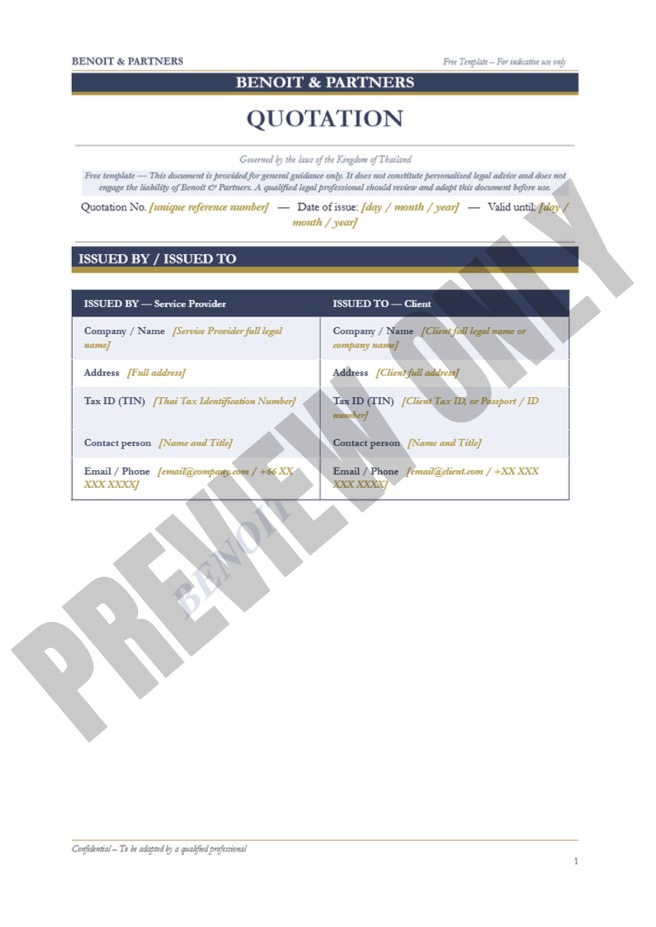
Our Quotation template in Thailand is drafted and reviewed by experienced lawyers to ensure compliance with Thai law and practical business use. It provides a reliable legal framework for formally setting out the price, scope, and conditions under which a business offers to supply goods or services to a client in Thailand.
Designed for businesses and sole traders seeking to present a clear and legally sound offer to a prospective client in Thailand, this template covers key legal aspects such as identification of the parties, a precise description of the goods or services offered, the price and payment terms, the validity period of the quotation, delivery or completion arrangements, and compliance with applicable Thai commercial and consumer law requirements.
However, some situations may require additional clauses or tailored structuring depending on the nature of the goods or services, the value of the transaction, the commercial relationship between the parties, or the specific terms and conditions the supplier wishes to incorporate. Our legal team can assist clients with customised Quotations adapted to their specific situation within a short timeframe.
Disclaimer: This template is provided for general informational purposes only and does not constitute legal advice. While it has been prepared by legal professionals, it may not reflect your specific situation or regulatory constraints. For high-value transactions or arrangements involving complex terms and conditions, legal advice should be sought to ensure proper structuring and compliance under Thai commercial law.
Need a Contract Tailored to Your Needs? Get a Free Consultation.
When should you use a Quotation in Thailand?
A Quotation template in Thailand is the appropriate document when a business wishes to formally present a priced offer to supply goods or services to a prospective client in Thailand. It is used across a wide range of commercial contexts from the supply of manufactured goods and construction materials to the provision of professional, technical, or creative services and serves as the commercial foundation on which a binding contract is subsequently formed when the client accepts the offer.
Under Thai contract law as set out in the Civil and Commercial Code, a quotation that is sufficiently definite in its terms and communicated to the intended recipient constitutes an offer capable of acceptance. Once accepted, the quotation and any incorporated terms and conditions form a binding agreement between the parties.
A well-prepared quotation carries clear practical advantages. It eliminates ambiguity about the scope and price of the work, reduces the risk of disputes about what was agreed, and provides a clear starting point for the commercial relationship.
More complex transactions may require additional elements in the quotation, including detailed technical specifications, staged payment schedules, performance guarantees, or the incorporation of standard terms and conditions that address liability, intellectual property, and dispute resolution. Our legal team is available to assist with tailored quotations that reflect the specific commercial and legal requirements of the transaction.
Without a properly prepared quotation, the terms of the supply arrangement may be unclear or incomplete, increasing the risk of disputes about price, scope, or delivery that could have been avoided by a carefully drafted initial document.

1. Identification of the Parties
The quotation should clearly identify the supplier and the prospective client by their full legal names, addresses, and contact details, together with any relevant account or reference numbers that allow the document to be linked to the commercial relationship between the parties.
2. Description of the Goods or Services
The scope of the offer should be set out in precise terms, specifying the nature, quantity, and specification of the goods or services being offered. Ambiguity in the scope description is a common source of commercial disputes and should be eliminated at the quotation stage.
3. Price and Tax
The total price should be stated clearly, with a breakdown of individual items where relevant, and should specify whether the stated price is inclusive or exclusive of VAT and any other applicable taxes or duties.
4. Payment Terms
The quotation in Thailand should specify the payment schedule including the due date or dates, the acceptable methods of payment, and any deposit or advance payment required before work commences or goods are dispatched.
5. Validity Period
A defined period during which the quotation remains open for acceptance should be stated. This protects the supplier against being bound by a price that may no longer be achievable due to changes in material costs, exchange rates, or other commercial factors.
6. Delivery or Completion Terms
The expected delivery date or completion timeline, the place of delivery, and the allocation of risk in transit should be clearly set out. Where delivery is subject to conditions such as the timely provision of information or materials by the client.
Key Clauses and Essential Elements in a Quotation
A well-constructed Quotation in Thailand gives the prospective client everything they need to make an informed decision about whether to proceed, while clearly establishing the commercial and legal framework within which the supply will be made if the offer is accepted.
It sets out the price and scope of the offer with precision and includes the key terms and conditions that will govern the transaction.
Under Thai law, a quotation that is accepted creates a binding contract. The terms of the quotation therefore determine the rights and obligations of both parties, making it important that the document is accurate, complete, and consistent with the supplier’s standard terms and commercial intentions.
This document is relevant across all sectors and categories of commercial supply from retail and manufacturing to construction, technology, and professional services and is applicable whether the parties are both Thai entities, both foreign, or a combination of the two.
Why customise a Quotation with a lawyer in Thailand?
A standard Quotation template in Thailand is adequate for routine commercial transactions, but a range of situations call for a more carefully considered approach before the document is issued to a prospective client.
The nature of the goods or services, the value of the transaction, and the commercial profile of the client all influence what the quotation needs to contain and what protections the supplier needs to include.
Depending on the context, the quotation may also cover: the interaction between the quotation and any applicable standard terms and conditions of the client; the allocation of liability for defects, delays, or non-performance; intellectual property ownership in respect of deliverables created in the course of the supply; the VAT and withholding tax treatment of the transaction; or the dispute resolution mechanism that will apply if a disagreement arises about the scope or quality of the supply.
Our legal team works with businesses to prepare quotations that are commercially precise, legally sound, and appropriately protective of the supplier’s interests. The result is a document that forms a solid commercial foundation for the transaction and reduces the risk of disputes about what was offered and accepted.
Quotation Thailand
Instant Download
Easy to Customize
Ready to Sign
Crafted by Lawyers
FAQ
What is a Quotation in Thailand?
A formal commercial document through which a supplier sets out the price, scope, and conditions under which they are prepared to supply goods or services to a prospective client, which becomes a binding contract when accepted by the client within the validity period.
Is a Quotation legally binding in Thailand?
A quotation becomes legally binding when it is accepted by the prospective client within the validity period stated in the document. Once accepted, it constitutes a binding contract under the Civil and Commercial Code, subject to any terms and conditions incorporated into the quotation.
What is the difference between a Quotation and a Proforma Invoice in Thailand?
A quotation is an offer to supply goods or services on specified terms and becomes binding on acceptance. A proforma invoice is a preliminary document used to confirm the terms of a transaction for customs, banking, or administrative purposes and does not in itself create a binding obligation.
Does a Quotation need to include VAT in Thailand?
Suppliers registered for VAT in Thailand must charge VAT at the applicable rate on taxable supplies. The quotation should clearly state whether the price is inclusive or exclusive of VAT to avoid ambiguity and potential disputes about the total amount payable.
How long should a Quotation remain valid in Thailand?
The validity period is a matter of commercial judgment and will depend on the nature of the goods or services and the volatility of input costs. Common validity periods range from seven to thirty days. A clearly stated validity period protects the supplier against being held to a price that is no longer commercially viable.
Can a Quotation be withdrawn before acceptance in Thailand?
Under Thai contract law, an offer may generally be withdrawn before it is accepted, provided the withdrawal is communicated to the prospective client before acceptance takes place. A clearly stated validity period also limits the window within which the quotation can be accepted.
What happens if a client modifies a Quotation before accepting it in Thailand?
A purported acceptance that introduces new or different terms constitutes a counter-offer rather than an acceptance under Thai contract law. This means that no binding contract is formed until the supplier accepts the counter-offer, either expressly or by conduct.
How does the PDPA apply to a Quotation in Thailand?
Where the quotation contains personal data such as the name and contact details of an individual client or contact person that data must be handled in accordance with the Personal Data Protection Act B.E. 2562 (2019), used only for the purpose of managing the commercial relationship, and stored securely.