
Real Estate Agent Agreement in Thailand
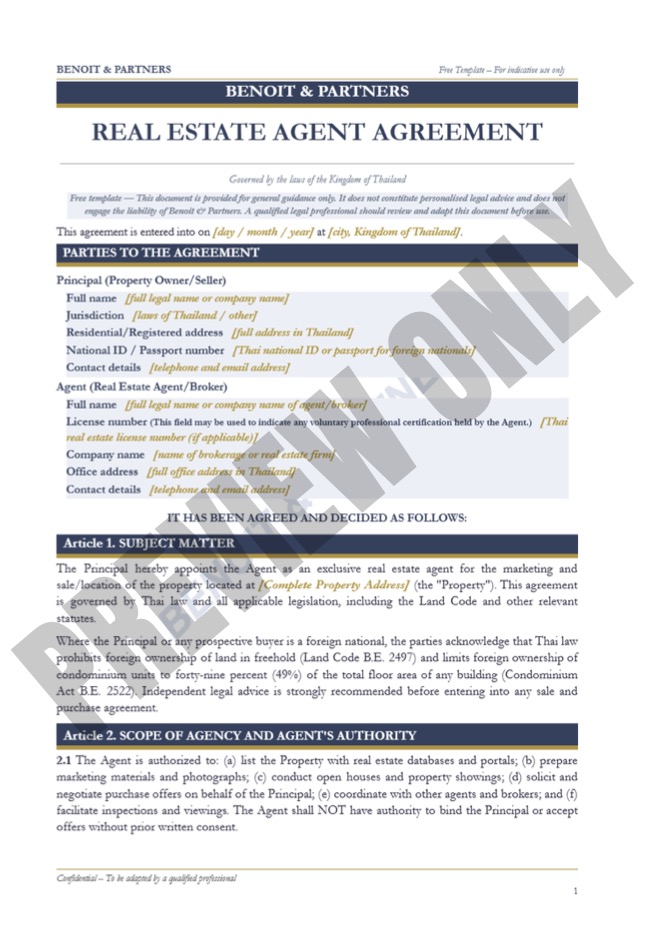
Our Real Estate Agent Agreement in Thailand is drafted and reviewed by experienced lawyers to ensure compliance with Thai law and practical business use. It provides a reliable legal framework for formally engaging a real estate agent to market, sell, lease, or assist with the acquisition of property in Thailand.
Designed for property owners, buyers, and real estate agencies seeking to formalise the terms of an agency engagement in Thailand, this template covers key legal aspects such as identification of the parties, the scope of the agent’s mandate, the commission structure, exclusivity arrangements, and compliance with the requirements of the Civil and Commercial Code governing agency relationships.
However, some situations may require additional clauses or tailored structuring depending on whether the engagement relates to sale, leasing, or acquisition, the value and nature of the property involved, whether the transaction involves a foreign buyer or seller, or specific commission and exclusivity terms negotiated between the parties. Our legal team can assist clients with customised Real Estate Agent Agreements adapted to their specific situation within a short timeframe.
Disclaimer: This template is provided for general informational purposes only and does not constitute legal advice. While it has been prepared by legal professionals, it may not reflect your specific situation or regulatory constraints. For high-value property transactions or arrangements involving foreign ownership structures, legal advice should be sought to ensure proper structuring and compliance under Thai property law.
Need a Contract Tailored to Your Needs? Get a Free Consultation.
When should you use a Real Estate Agent Agreement in Thailand?
A Real Estate Agent Agreement in Thailand is the appropriate instrument whenever a property owner or prospective buyer wishes to formally engage a real estate agent to act on their behalf in connection with the sale, purchase, or leasing of property in Thailand. It establishes the legal basis for the agency relationship and defines the commercial terms on which the agent will be remunerated for their services.
Under the Civil and Commercial Code, an agency relationship arises where one party authorises another to act on their behalf in dealings with third parties. While Thai law does not impose a specific licensing regime for residential real estate agents in the way some jurisdictions do, a written agreement remains essential to establish the agent’s authority, the scope of their mandate, and their entitlement to commission.
A properly documented agreement protects both the property owner and the agent by clearly defining the scope of the engagement, the commission payable upon a successful transaction, and the circumstances in which commission becomes due particularly important in property markets where multiple agents may be involved in introducing a buyer.
Engaging an agent without a written agreement frequently leads to disputes over whether commission is payable, particularly where a transaction closes after the agency relationship has formally ended or where more than one agent claims to have introduced the eventual buyer.

1. Identification of the Parties
The agreement should clearly identify the property owner or principal and the appointed agent or agency, including relevant registration details where the agent operates through a licensed company.
2. Description of the Property and Scope of Mandate
The property to be sold, leased, or sought should be clearly described, together with the scope of the agent's mandate whether limited to marketing and introducing buyers, or extending to negotiation and transaction management.
3. Exclusivity
The agreement should state whether the agent has been granted an exclusive mandate or whether the principal is free to engage other agents or conclude a transaction independently, and the consequences for commission in either case.
4. Commission Structure
The rate or amount of commission payable should be specified clearly, together with the basis for its calculation, typically a percentage of the sale price or annual rental value.
5. Trigger for Commission Entitlement
The agreement should define precisely when commission becomes payable whether on the signing of a sale and purchase agreement, on completion of the transaction, or on the introduction of a buyer who subsequently completes a transaction within a defined period.
6. Duration of the Agreement
The term of the engagement should be stated, together with any provisions addressing the agent's entitlement to commission for transactions that close shortly after the agreement's expiry where the agent was the effective introducing party.
Key Clauses and Essential Elements in a Real Estate Agent Agreement
A well-structured Real Estate Agent Agreement in Thailand gives both the property owner and the agent a clear and shared understanding of the scope of the engagement and the commercial terms governing the agent’s remuneration, significantly reducing the potential for disputes once a transaction is concluded.
Because commission disputes are among the most common sources of conflict in real estate transactions, the agreement should define with precision both the circumstances that trigger an entitlement to commission and the method by which that commission is calculated and paid.
This document applies across a wide range of real estate transactions in Thailand, from residential condominium sales to commercial leasing and land transactions, and its terms should be adapted to reflect the specific nature of the property and the transaction being pursued.
Why customise a Real Estate Agent Agreement with a lawyer in Thailand?
A standard template of Real Estate Agent Agreement Thailand is generally adequate for straightforward residential transactions, but more complex or higher-value engagements call for a carefully tailored agreement that anticipates the specific risks involved.
Transactions involving foreign buyers, commercial or large-scale property portfolios, multiple competing agents, or unconventional commission structures each present considerations that a generic template may not adequately address.
Depending on the situation, the agreement may need to address the interaction between Thai foreign ownership restrictions and the agent’s role in structuring a compliant transaction, the allocation of commission where multiple agents are involved, the agent’s obligations regarding due diligence and disclosure, or specific protections for the principal against misrepresentation by the agent.
Our legal team works with property owners, buyers, and agencies to prepare real estate agent agreements that clearly define the scope of the engagement and the commission arrangements, reducing the risk of disputes once a transaction proceeds.
Real Estate Agent Agreement Thailand
Instant Download
Easy to Customize
Ready to Sign
Crafted by Lawyers
FAQ
What is a Real Estate Agent Agreement in Thailand?
A written agreement between a property owner or prospective buyer and a real estate agent, setting out the scope of the agent’s mandate, the commission payable, and the terms governing the agency relationship in connection with a property transaction.
Are real estate agents required to be licensed in Thailand?
Thailand does not currently operate a comprehensive licensing regime for individual residential real estate agents comparable to some other jurisdictions, though agents commonly operate through registered companies and professional associations have established codes of conduct.
Is commission payable to a real estate agent in Thailand if the property owner sells the property directly?
This depends on the terms of the agreement. Where an exclusive mandate has been granted, the agreement may provide for commission to be payable even on a direct sale concluded by the owner during the term of the exclusivity period.
What happens if more than one agent introduces the same buyer in Thailand?
Disputes of this nature are common and are generally resolved by reference to which agent can demonstrate they were the effective cause of the transaction. A well-drafted agreement that defines the trigger for commission helps to reduce the scope for such disputes.
Can a Real Estate Agent Agreement be terminated early in Thailand?
Yes, generally, subject to the specific termination provisions set out in the agreement. Where an exclusive mandate has been granted, early termination provisions should address whether any commission remains payable for transactions in progress at the time of termination.
What commission rates are typical for real estate agents in Thailand?
Commission rates vary by transaction type and property value, but a range of three to five percent of the sale price is common for residential sales, while leasing transactions often involve a commission equivalent to one month’s rent.
Can a foreign buyer engage a Thai real estate agent under this type of agreement?
Yes. Foreign buyers frequently engage Thai real estate agents to assist with property searches and transactions, though the agreement should take into account the specific restrictions applicable to foreign ownership of land and certain categories of property in Thailand
How does the PDPA apply to a Real Estate Agent Agreement in Thailand?
The agreement and the agent’s marketing activities will involve the processing of personal data relating to the property owner and prospective buyers or tenants. This data must be handled in accordance with the Personal Data Protection Act B.E. 2562 (2019).