
Real Estate Brokerage Agreement in Thailand
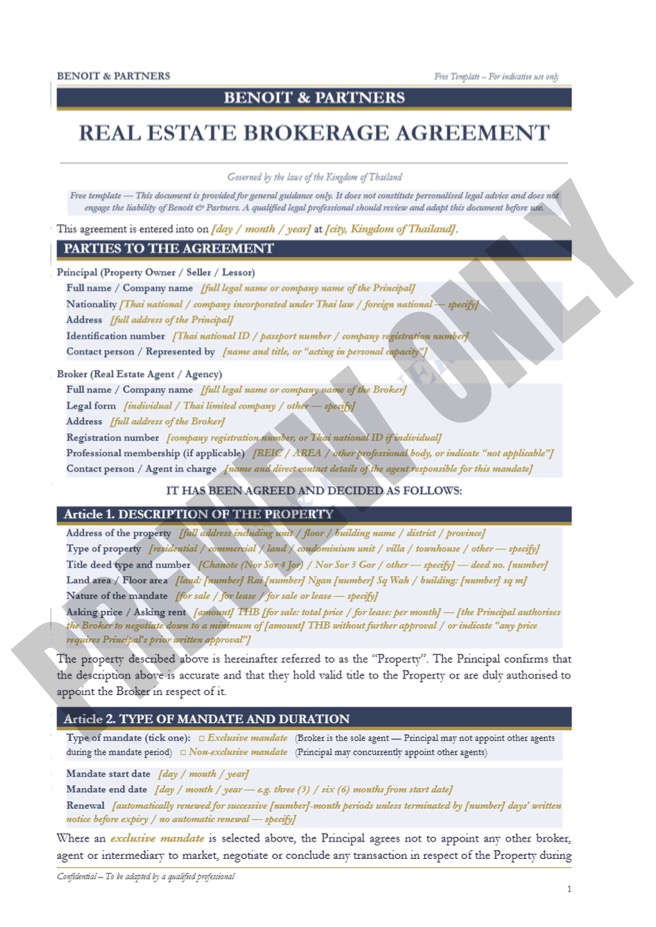
Our Real Estate Brokerage Agreement in Thailand is drafted and reviewed by experienced lawyers to ensure compliance with Thai law and practical business use. It provides a reliable legal framework for formally engaging a broker to market and facilitate the sale, purchase, or lease of real estate in Thailand in exchange for a commission.
Designed for property owners, investors, and brokerage firms seeking to formalise the terms of a property brokerage engagement in Thailand, this template covers key legal aspects such as identification of the parties, the scope of the broker’s mandate, commission structure and payment triggers, exclusivity arrangements, and compliance with the Civil and Commercial Code provisions governing brokerage contracts.
However, some situations may require additional clauses or tailored structuring depending on whether the mandate is exclusive or non-exclusive, the type and value of the property involved, the involvement of multiple brokers, or specific marketing and reporting obligations. Our legal team can assist clients with customised Real Estate Brokerage Agreements adapted to their specific situation within a short timeframe.
Disclaimer: This template is provided for general informational purposes only and does not constitute legal advice. While it has been prepared by legal professionals, it may not reflect your specific situation or regulatory constraints. For high-value properties or complex commission structures, legal advice should be sought to ensure proper structuring and compliance under Thai law.
Need a Contract Tailored to Your Needs? Get a Free Consultation.
When should you use a Real Estate Brokerage Agreement in Thailand?
A Real Estate Brokerage Agreement in Thailand becomes the appropriate instrument when a property owner wishes to formally engage a broker to find a buyer, tenant, or seller for a property in Thailand, in return for a commission payable upon a successful transaction. It is relevant to residential and commercial sales, leasing mandates, and land transactions alike.
Brokerage relationships in Thailand are governed by the general provisions on agency and brokerage contained in the Civil and Commercial Code, which entitle a broker to commission once they have successfully brought about the conclusion of the contract they were engaged to facilitate. The Code also addresses the broker’s entitlement to commission where a transaction is concluded directly between the principal and a party the broker introduced.
Formalising the engagement in a written agreement carries significant practical advantages. It removes ambiguity about whether the mandate is exclusive, defines precisely what triggers the broker’s entitlement to commission, and protects the property owner from being liable to multiple brokers in respect of the same transaction.
More complex engagements may require additional provisions covering minimum marketing commitments, the broker’s authority to negotiate on the owner’s behalf, the treatment of co-brokerage arrangements, or specific commission tiers based on the final sale price achieved. Our legal team is available to assist with tailored agreements that address these dimensions clearly.
Proceeding on an informal or verbal basis, without a written brokerage agreement, frequently leads to disputes over whether a commission is owed and in what amount, particularly where more than one broker has been involved in introducing a prospective buyer or tenant.

1. Identification of the Parties
The agreement should state the full name and contact details of the property owner and the broker, together with confirmation of the broker's licensing status where applicable under Thai regulations.
2. Description of the Property and Scope of the Mandate
The agreement should clearly identify the property being marketed and specify whether the mandate covers a sale, a lease, or both, together with the asking price or rental figure the owner is seeking.
3. Exclusivity
The agreement should state clearly whether the broker has been granted an exclusive mandate or a non-exclusive mandate, and, if exclusive, the duration of that exclusivity and the consequences of the owner engaging other brokers or concluding a direct sale during the exclusivity period.
4. Commission Structure
The agreement should specify the commission rate or amount, whether calculated as a percentage of the sale or lease price, and the precise event that triggers the obligation to pay typically the signing of a sale and purchase agreement or lease contract with a buyer or tenant introduced by the broker.
5. Marketing and Reporting Obligations
Where relevant, the agreement should set out the broker's obligations regarding marketing activities, such as listing the property on specific platforms, organising viewings, and providing regular updates to the owner on market interest and offers received.
6. Duration and Termination
The agreement should specify the term of the engagement and the circumstances in which either party may terminate it, including any tail period during which commission remains payable if a transaction concludes shortly after termination with a buyer introduced during the mandate.
Key Clauses and Essential Elements in a Real Estate Brokerage Agreement
A well-constructed Real Estate Brokerage Agreement in Thailand gives both the property owner and the broker a clear and shared understanding of the scope of the engagement, the broker’s authority, and the precise circumstances in which commission becomes payable.
It reduces the risk of disputes at the point of a successful transaction, which is often when commission entitlements are most fiercely contested.
Under the Civil and Commercial Code, a broker’s right to commission depends on their having been the effective cause of the transaction being concluded. A properly drafted agreement defines this trigger with precision, reducing the scope for argument about whether the broker’s efforts actually led to the eventual sale or lease.
This document is relevant to all categories of real estate brokerage engagement in Thailand from single-property residential mandates to large commercial or land brokerage assignments and the core structure remains consistent, though the specific commission terms and exclusivity provisions will vary according to the nature of the engagement.
Why customise a Real Estate Brokerage Agreement with a lawyer in Thailand?
A standard template of Real Estate Brokerage Agreement in Thailand is suitable for straightforward single-property mandates, but several situations call for a more carefully tailored agreement before the engagement begins.
The value of the property, the exclusivity arrangement, and the involvement of multiple brokers or international buyers all influence what the agreement needs to address and how commission disputes can best be avoided.
Depending on the situation, the agreement may need to cover: the treatment of co-brokerage arrangements and the split of commission between introducing and closing brokers; a tail clause protecting the broker’s commission where a sale concludes shortly after the mandate ends with a buyer they introduced; the broker’s authority, if any, to accept deposits or negotiate price on the owner’s behalf; or specific provisions addressing transactions involving foreign buyers and the documentation such buyers typically require.
Our legal team works with property owners and brokerage firms to prepare agreements that are clear, commercially balanced, and properly aligned with Thai law governing brokerage relationships, reducing the risk of disputes at the point a transaction is concluded.
Real Estate Brokerage Agreement Thailand
Instant Download
Easy to Customize
Ready to Sign
Crafted by Lawyers
FAQ
What is a Real Estate Brokerage Agreement in Thailand?
A written contract through which a property owner engages a broker to find a buyer or tenant for a property, setting out the scope of the mandate, the commission payable, and the circumstances in which that commission becomes due.
When does a broker become entitled to commission in Thailand?
Under the Civil and Commercial Code, a broker is generally entitled to commission once they have been the effective cause of the transaction being concluded — typically when a sale and purchase agreement or lease contract is signed with a party the broker introduced.
What is the difference between an exclusive and non-exclusive brokerage mandate in Thailand?
An exclusive mandate restricts the owner from engaging other brokers or selling directly without paying commission during the exclusivity period, while a non-exclusive mandate allows the owner to work with multiple brokers simultaneously and pay commission only to the broker who successfully introduces the eventual buyer or tenant.
Is there a standard commission rate for real estate brokers in Thailand?
There is no statutory fixed rate, but market practice commonly ranges between three and five percent of the sale price for residential property, with rates for commercial and land transactions varying depending on the value and complexity of the deal. The applicable rate should be agreed and recorded clearly in the agreement.
What happens if a property is sold without the broker's direct involvement in the final negotiation in Thailand?
If the buyer was originally introduced by the broker, the broker is generally still entitled to commission, even if the final negotiation was conducted directly between the owner and the buyer, provided the broker’s introduction was the effective cause of the eventual transaction.
Can a property owner be liable to pay commission to more than one broker in Thailand?
Yes, where multiple brokers have been engaged on a non-exclusive basis and more than one broker can demonstrate that their introduction contributed to the eventual transaction. A well-drafted agreement reduces this risk by clearly defining the trigger for commission and, where appropriate, establishing exclusivity.
What is a tail clause in a Real Estate Brokerage Agreement and why does it matter in Thailand?
A tail clause protects the broker’s right to commission if a transaction concludes with a buyer they introduced shortly after the brokerage agreement has ended. Without such a clause, an owner could potentially avoid paying commission by terminating the mandate shortly before completing a sale with a buyer the broker found.
How does the PDPA apply to a Real Estate Brokerage Agreement in Thailand?
The agreement and the brokerage process typically involve personal data relating to the property owner and prospective buyers or tenants. Under the Personal Data Protection Act B.E. 2562 (2019), this data must be collected, used, and disclosed only for purposes connected with the brokerage mandate and handled securely throughout.