
Remote Working Contract Thailand
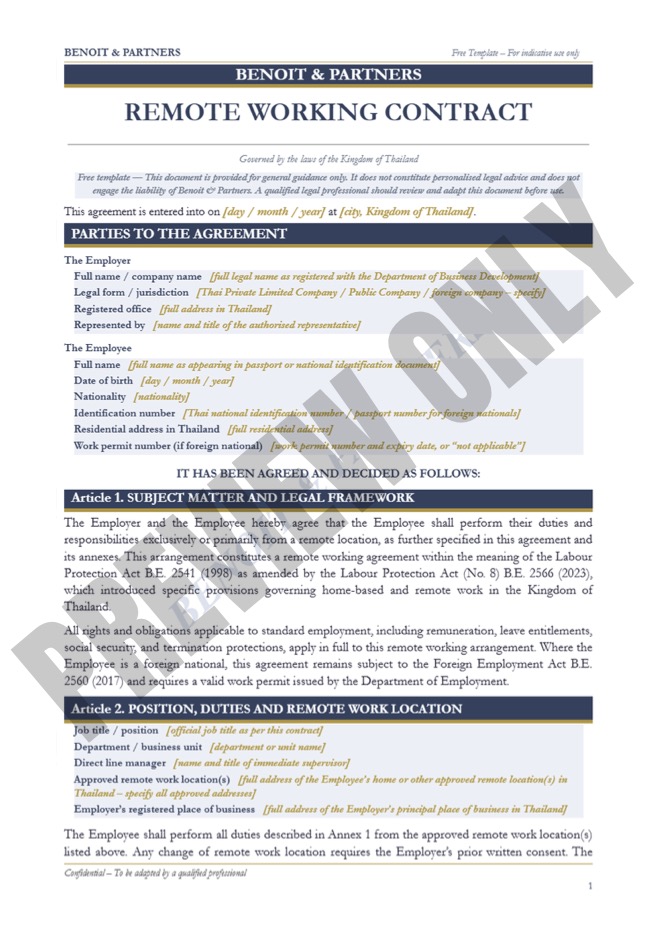
Our Remote Working Contract Thailand is drafted and reviewed by experienced lawyers to ensure compliance with Thai law and practical business use. It provides a reliable legal framework for formalising remote working arrangements between employers and employees in Thailand, whether on a fully remote or hybrid basis.
Designed for employers, HR departments, and companies engaging remote staff in Thailand, this template covers key legal aspects such as identification of the parties, scope of the role, remote working arrangements, working hours and availability requirements, equipment and expense provisions, data security obligations, remuneration and benefits, and compliance with the Labour Protection Act and other applicable Thai employment regulations.
However, some situations may require additional clauses or tailored structuring depending on the nature of the role, the location from which the employee will work, foreign national employment considerations, data protection requirements, or the specific terms of the remote working arrangement. Our legal team can assist clients with customised Remote Working Contracts adapted to their specific situation within a short timeframe.
Disclaimer: This template is provided for general informational purposes only and does not constitute legal advice. While it has been prepared by legal professionals, it may not reflect your specific situation or regulatory constraints. For complex or senior-level appointments, legal advice should be sought to ensure proper structuring and compliance under Thai employment law.
Need a Contract Tailored to Your Needs? Get a Free Consultation.
When should you use a Remote Working Contract in Thailand?
A Remote Working Contract is used whenever an employer formally engages an employee to perform their duties from a location other than the employer’s principal place of business, whether from home, a co-working space, or any other agreed remote location in Thailand. This situation commonly arises following the adoption of flexible working policies, the recruitment of employees based in different regions of Thailand, or the continuation of working arrangements established during periods of business disruption.
Under Thai law, remote working relationships are governed by the Labour Protection Act B.E. 2541 (1998) and its amendments, which establish minimum employment standards applicable to all employees regardless of their place of work. The Labour Protection Act was amended in 2023 to introduce specific provisions governing remote working arrangements, including the employee’s right to disconnect outside of agreed working hours and the employer’s obligation to agree the terms of the remote working arrangement in writing.
This agreement becomes particularly important when the remote working arrangement is a permanent or long-term feature of the employment relationship, as it provides both parties with a clear and legally compliant framework governing the working location, agreed hours, availability requirements, equipment arrangements, and data security obligations.
In more complex situations, additional provisions may be required regarding cross-border remote working, cybersecurity obligations, expense reimbursement policies, health and safety responsibilities, or work permit requirements for foreign nationals. Our legal team assists clients with the preparation of customised Remote Working Contracts tailored to their specific requirements under Thai employment law.
In practice, this agreement is also crucial for managing the risks associated with remote working, including data security breaches, productivity monitoring, and the blurring of boundaries between working and non-working time, all of which require careful contractual management to protect both the employer and the employee.
Without a properly drafted Remote Working Contract, employers risk disputes over working hours, availability expectations, equipment responsibilities, data security obligations, and the right to require the employee to return to the workplace, all of which can give rise to significant legal and operational difficulties under Thai employment law.

1. Identification of the Parties
The contract must clearly identify the employer and the employee, including the employer's full legal name and registered address, the employee's full name and identification details, and the names and titles of the authorised representatives signing on behalf of each party.
2. Remote Working Arrangement and Location
The contract must specify the agreed remote working arrangement, whether fully remote or hybrid, the approved location or locations from which the employee is authorised to work, and any restrictions on working from locations outside Thailand or from public or unsecured networks.
3. Working Hours, Availability and Right to Disconnect
The contract must define the agreed working hours, the employee's availability and responsiveness requirements during those hours, the procedure for varying working hours where necessary, and the employee's right to disconnect from work communications outside of agreed working hours, in accordance with the 2023 amendments to the Labour Protection Act.
4. Equipment, Tools and Expense Reimbursement
The contract must specify whether the employer or the employee is responsible for providing the necessary equipment, the procedure for replacing defective equipment, and the employer's policy on reimbursement of reasonable expenses such as internet connectivity costs.
5. Data Security and Confidentiality
The contract must include data security obligations requiring the employee to comply with the employer's information security policies, use only approved systems and networks, protect confidential and personal data, and promptly report any suspected breach or security incident, in compliance with the Personal Data Protection Act B.E. 2562 (2019).
6. Health and Safety
The contract should address the employer's health and safety obligations for remote work, including the employee's duty to maintain a safe workspace, the employer's right to conduct reasonable assessments of the remote working environment, and the procedure for reporting work-related accidents or injuries occurring while working remotely.
Key Clauses and Essential Elements in a Remote Working Contract
A Remote Working Contract is a key legal document governing the terms of a remote employment relationship in Thailand. It defines the rights and obligations of the employer and the employee while ensuring compliance with the Labour Protection Act and the specific remote working provisions introduced by the 2023 amendments.
Under the Labour Protection Act as amended, employers must agree the terms of remote working arrangements in writing and respect the employee’s right to disconnect outside of agreed working hours. A properly drafted Remote Working Contract helps ensure compliance with these requirements and reduces the risk of future disputes.
This type of contract is commonly used across all sectors for roles that can be performed effectively from a remote location, including professional services, technology, finance, marketing, and administrative functions.
While standard situations may rely on a general template, more complex arrangements often require additional provisions depending on the nature of the role and the specific remote working terms agreed.
Why customise a Remote Working Contract with a lawyer in Thailand?
While a standard Remote Working Contract template for Thailand may be sufficient for straightforward remote arrangements, many remote working situations involve legal, regulatory, and practical considerations requiring more careful drafting and tailored protections.
In practice, each remote working arrangement has its own structure and level of risk. Cross-border remote working, data security requirements, sector-specific regulations, performance monitoring obligations, or complex equipment and expense arrangements may all require provisions that are not included in a standard template.
Our legal team assists employers, HR departments, and companies with the preparation and review of customised Remote Working Contracts for Thailand adapted to their specific workforce management needs and compliance obligations. In many cases, tailored contracts can be prepared within a short timeframe while ensuring full compliance with Thai labour, data protection, and regulatory law.
A properly drafted Remote Working Contract not only provides clarity and certainty for both the employer and the employee, but also reduces the risk of future employment disputes, data security incidents, and unexpected liabilities arising from the remote working arrangement.
Remote Working Contract Thailand
Instant Download
Easy to Customize
Ready to Sign
Crafted by Lawyers
FAQ
What is a Remote Working Contract in Thailand?
A written contract governing the terms of a remote working arrangement in Thailand, where the employee performs their duties from a location other than the employer’s premises. Governed by the Labour Protection Act B.E. 2541 (1998) as amended in 2023, which introduced specific provisions on remote working and the right to disconnect.
Are remote working arrangements legally recognised in Thailand?
Yes. The 2023 amendments to the Labour Protection Act formally recognised remote working arrangements and introduced specific obligations on employers, including the requirement to agree the terms of remote working in writing and to respect the employee’s right to disconnect outside of agreed working hours.
Does a Remote Working Contract need to be in writing in Thailand?
Yes. Under the 2023 amendments to the Labour Protection Act, the terms of a remote working arrangement must be agreed in writing between the employer and the employee. A properly drafted Remote Working Contract satisfies this requirement and provides clear evidence of the agreed terms.
What is the right to disconnect under Thai employment law?
Under the 2023 amendments to the Labour Protection Act, remote working employees have the right to disconnect from work communications outside of their agreed working hours without being penalised or disadvantaged. Employers must respect this right and must not require employees to be available or responsive outside of agreed hours.
Who is responsible for providing equipment for remote working in Thailand?
Thai law does not prescribe a mandatory allocation of equipment responsibility. The parties may agree in the Remote Working Contract whether the employer or the employee provides the necessary equipment, and whether the employer will reimburse reasonable expenses incurred in connection with the remote working arrangement.
Can a foreign national work remotely from Thailand?
Yes, subject to holding a valid work permit and appropriate visa authorising work in Thailand. Foreign nationals working remotely for a Thai employer or a foreign employer with a presence in Thailand must comply with applicable work permit requirements. The Long-Term Resident visa introduced in 2022 may be relevant for certain categories of remote workers.
Can an employer monitor a remote working employee in Thailand?
Yes, within limits. Employers may use reasonable monitoring tools to assess productivity and ensure data security, but must comply with the Personal Data Protection Act B.E. 2562 (2019) and respect the employee’s right to privacy. The scope and nature of any monitoring must be clearly disclosed to the employee.
How does the PDPA apply to a Remote Working Contract in Thailand?
Personal data processed in connection with the remote working arrangement, including monitoring data and communication records, must be handled in accordance with the Personal Data Protection Act B.E. 2562 (2019). Appropriate data protection provisions and disclosure obligations should be included in the Remote Working Contract.