
Rental Receipt in Thailand
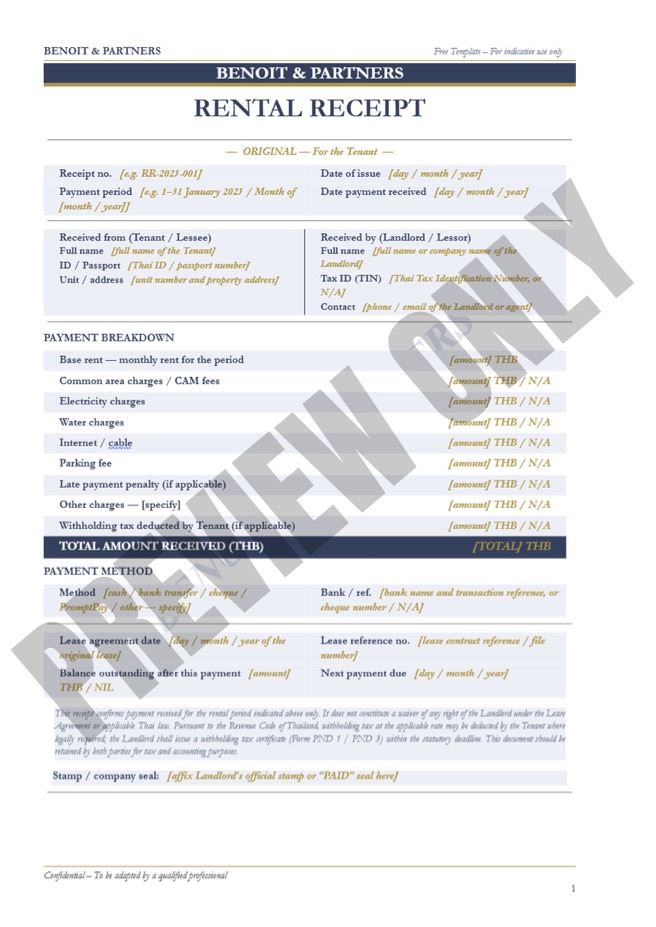
Our Rental Receipt in Thailand is drafted and reviewed by experienced lawyers to ensure compliance with Thai law and practical business use. It provides a reliable legal framework for formally acknowledging receipt of rent payment between a landlord and a tenant in Thailand.
Designed for landlords, property managers, and tenants seeking a clear and properly documented record of rent payments made under a lease in Thailand, this template covers key legal aspects such as identification of the parties and the property, the amount and period of rent paid, the method of payment, and compliance with applicable Thai civil and tax record-keeping requirements.
However, some situations may require additional clauses or tailored structuring depending on whether the receipt is required for tax purposes, whether withholding tax applies, or whether the rent payment includes additional charges such as utilities or service fees. Our legal team can assist clients with customised Rental Receipts adapted to their specific situation within a short timeframe.
Disclaimer: This template is provided for general informational purposes only and does not constitute legal advice. While it has been prepared by legal professionals, it may not reflect your specific situation or regulatory constraints. For tax-related questions arising from rental income, legal or tax advice should be sought to ensure proper compliance under Thai law.
Need a Contract Tailored to Your Needs? Get a Free Consultation.
When should you use a Rental Receipt in Thailand?
A Rental Receipt in Thailand is the appropriate document whenever a landlord receives a rent payment from a tenant and needs to provide formal written acknowledgement of that payment. This applies to residential, commercial, and retail tenancies alike, and is relevant whether rent is paid monthly, quarterly, or annually.
Under Thai civil law, a tenant who has paid rent is entitled to request evidence of payment, and a landlord who receives rental income is generally required to maintain records of payments received for personal income tax reporting purposes under the Thai Revenue Code.
A properly issued receipt protects both parties. It provides the tenant with proof of payment that can be relied upon in the event of a future dispute about whether rent was paid for a particular period, and it gives the landlord an organised record to support their tax filings.
For tenants who require the Rental Receipt Thailand to support an expense claim, a work permit application, or a visa renewal, a clearly formatted receipt that states the property address, the period covered, and the amount paid is often a specific requirement of the receiving authority.
Without a properly issued written receipt, both parties are left without clear documentary evidence of payment, which can create difficulty in resolving disputes about rent arrears or compliance with the lease.

1. Identification of the Parties
The receipt should state the full name of the landlord issuing the receipt and the full name of the tenant making the payment, together with the address of the leased property.
2. Payment Period
The receipt should clearly state the period to which the rent payment relates, such as a specific calendar month or quarter, to avoid any ambiguity about which obligation has been satisfied.
3. Amount Paid
The exact amount received should be stated in Thai Baht, in both figures and words where a higher level of formality is required, together with a breakdown if the payment includes items beyond base rent, such as utilities or service charges.
4. Method of Payment
The receipt should indicate how payment was made, whether by bank transfer, cheque, or cash, and may reference a transaction or cheque number for ease of reconciliation.
5. Date of Payment and Issue
The date on which payment was received and the date the receipt is issued should both be stated, particularly where these dates differ.
6. Outstanding Balance, If Any
Where the payment received does not settle the full amount due for the period, the receipt should note the outstanding balance and the date by which it is expected to be paid.
Key Clauses and Essential Elements in a Rental Receipt
A well-prepared Rental Receipt in Thailand gives both the landlord and tenant a clear, accurate, and properly dated record of a specific rent payment. It removes any ambiguity about which period the payment relates to, the amount paid, and the method of payment used.
Although Thai law does not prescribe a fixed format for rental receipts, a receipt that contains complete and accurate information is more likely to be accepted by tax authorities, banks, and other institutions that may require evidence of rental payment.
In addition to confirming that payment has been received, a properly drafted Rental Receipt Thailand serves as an important evidentiary document in the event of a dispute concerning rent arrears, payment history, or compliance with the lease agreement. It should clearly identify the parties, the leased property, the rental period covered, the amount received, the date of payment, and any applicable taxes or charges.
Why customise a Rental Receipt with a lawyer in Thailand?
A standard Rental Receipt in Thailand template is generally sufficient for routine residential and small commercial tenancies, but certain situations call for additional care in how the receipt is structured and issued.
Where rental income forms part of a landlord’s taxable income, or where a tenant requires the receipt to support a formal application such as a visa or work permit renewal, the receipt may need to meet specific content or formatting requirements.
Depending on the situation, the Rental Receipt Thailand may need to address the correct treatment of withholding tax where applicable, the breakdown of rent from other charges for tax reporting purposes, or the issuance of a tax invoice alongside the receipt where the landlord is VAT-registered.
Our legal team assists landlords and property managers in preparing rental receipt formats that are accurate, properly structured, and suitable for the specific purpose for which they are required, whether for tax compliance, dispute prevention, or supporting a tenant’s external application.
Rental Receipt Thailand
Instant Download
Easy to Customize
Ready to Sign
Crafted by Lawyers
FAQ
What is a Rental Receipt in Thailand?
A written document issued by a landlord to a tenant acknowledging receipt of a rent payment, stating the amount paid, the period covered, the method of payment, and the date of payment.
Is a landlord legally required to issue a Rental Receipt in Thailand?
There is no general statutory requirement to issue a receipt for every rent payment, but a tenant is entitled to request one, and landlords are advised to issue receipts as a matter of good practice and for their own tax record-keeping purposes.
Does a Rental Receipt need to be issued in a specific format in Thailand?
Thai law does not prescribe a mandatory format. However, a receipt should clearly state the parties, the property, the period covered, the amount paid, and the date, and should be signed by the landlord to be considered properly issued.
Is rental income subject to tax in Thailand?
Yes. Rental income received by a landlord is generally subject to personal income tax under the Thai Revenue Code, and landlords should retain accurate records of rent received, including issued receipts, to support their tax filings.
Does withholding tax apply to rent payments in Thailand?
Withholding tax may apply where the tenant is a company or registered business paying rent to an individual or another company, depending on the specific arrangement. The applicable rate and procedure should be confirmed with a tax adviser.
Can a Rental Receipt be issued electronically in Thailand?
Yes, provided the receipt contains all the necessary information and is properly authorised by the landlord. Many landlords issue receipts by email or through property management software, which is generally acceptable provided a clear record is retained.
What should a tenant do if a landlord refuses to issue a Rental Receipt in Thailand?
A tenant should request the receipt in writing and retain evidence of the payment made, such as a bank transfer confirmation. Persistent refusal to issue a receipt may be relevant if a dispute later arises about whether rent was paid.
How does the PDPA apply to a Rental Receipt in Thailand?
Where the receipt contains personal data relating to the landlord or tenant, both parties must handle that data in accordance with the Personal Data Protection Act B.E. 2562 (2019), using it only for purposes connected with the tenancy and any related tax reporting.