
Request for Fee Waiver in Thailand
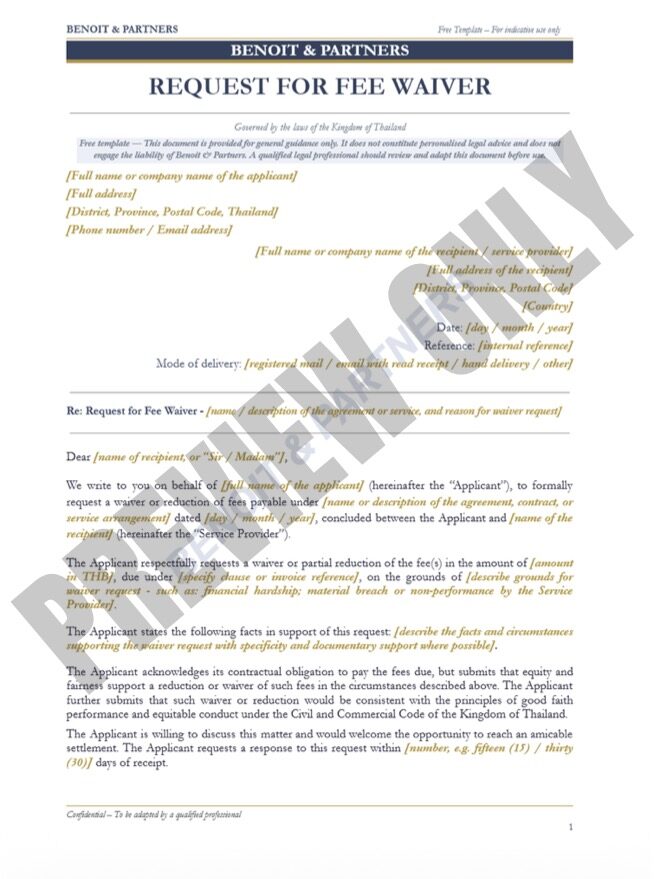
Our Request for Fee Waiver in Thailand is drafted and reviewed by experienced lawyers to ensure compliance with Thai law and practical business use. It provides a reliable legal framework for formally applying to a court, regulatory authority, or administrative body in Thailand for a waiver or reduction of applicable fees on the grounds of financial hardship or other recognised criteria.
Designed for individuals and organisations seeking to obtain relief from court filing fees, administrative charges, or other official fees in Thailand, this template covers key legal aspects such as identification of the applicant, a clear statement of the grounds for the request, supporting financial information, the specific fee or fees in respect of which a waiver is sought, and compliance with the procedural requirements of the relevant Thai court or authority.
However, some situations may require additional clauses or tailored structuring depending on the nature of the proceedings, the specific authority to which the request is directed, the grounds relied upon, or the documentation required to support the application. Our legal team can assist clients with customised Requests for Fee Waiver adapted to their specific situation within a short timeframe.
Disclaimer: This template is provided for general informational purposes only and does not constitute legal advice. While it has been prepared by legal professionals, it may not reflect your specific situation or regulatory constraints. For complex proceedings or high-value matters, legal advice should be sought to ensure that the application is properly structured and supported in accordance with Thai procedural law.
Need a Contract Tailored to Your Needs? Get a Free Consultation.
When should you use a Request for Fee Waiver in Thailand?
A Request for Fee Waiver in Thailand is used to seek exemption from court or administrative fees in Thailand, usually by showing insufficient financial means under the Civil Procedure Code.
Thai law provides a mechanism for fee waivers in civil proceedings through the Civil Procedure Code, which permits the court to grant full or partial exemption from filing fees where the applicant can demonstrate financial hardship. The court exercises a discretion in assessing such applications and will consider the applicant’s financial position, the nature and merits of the underlying claim, and the interests of justice in the specific case.
A well-prepared and properly documented application significantly improves the prospects of a favourable outcome. Courts and administrative bodies are more receptive to requests that are supported by clear financial evidence, present the grounds for relief in a structured and measured way, and demonstrate that the applicant has a genuine and arguable claim that would otherwise be inaccessible due to financial constraints.
More complex applications may require additional documents, such as income and asset declarations, proof of family or dependent obligations, third-party statements, or a summary of the underlying claim. Our legal team can assist in preparing a strong, well-supported waiver application.

1. Identification of the Parties
The request should include the applicant’s full name, address, contact details, and ID or company number if applicable, along with a brief description of their relevant circumstances.
2. Description of the Proceedings
The application should identify the court or authority to which it is addressed, the nature and reference number of the underlying proceedings, and the stage those proceedings have reached, so that the decision-maker can assess the request in its proper procedural context.
3. Statement of Financial Circumstances
A clear financial account income, assets, liabilities, and dependants should be provided with evidence where possible. Unsupported statements are unlikely to satisfy the court.
4. Specific Fee or Fees in Respect of Which a Waiver is Sought
The application should identify precisely which fee or fees are the subject of the request, together with the amounts involved and the stage of the proceedings to which they relate.
5. Grounds for the Request
The legal and factual grounds on which the waiver is sought should be set out clearly, with reference to the applicable provisions of the Civil Procedure Code or the relevant authority's fee relief framework. Where financial hardship is the primary ground, this should be supported by specific and verifiable evidence.
6. Summary of the Underlying Claim
Where required by the relevant authority, the application should include a concise summary of the nature and merits of the underlying claim or proceedings, demonstrating that the applicant has a genuine and arguable case that warrants access to the justice system.
Key Clauses and Essential Elements in a Request for Fee Waiver
A well-constructed Request for Fee Waiver Thailand presents the applicant’s case clearly and completely, demonstrating both their financial need and the legitimacy of the underlying proceedings for which the waiver is sought. It organises the relevant information in a format that the decision-making authority can assess efficiently and provides a complete factual and evidential foundation for a favourable decision.
Thai courts and administrative bodies applying a fee waiver process will expect the application to address both the applicant’s financial circumstances and the nature of the proceedings in a clear and structured manner. An application that fails to address either dimension is likely to be refused or returned for further information.
This document is relevant to a wide range of applicants from individual litigants to small businesses and non-profit organisations and may be used in connection with civil court proceedings, administrative appeals, or applications before regulatory bodies that operate a fee relief mechanism.
Why customise a Request for Fee Waiver with a lawyer in Thailand?
A standard template of Request for Fee Waiver Thailand Request provides a useful starting point for straightforward fee waiver applications, but a number of circumstances call for a more carefully prepared submission before it is filed with the relevant court or authority.
The specific requirements of the court or body to which the application is directed, the complexity of the applicant’s financial circumstances, and the nature of the underlying proceedings all influence what the application needs to contain and how the case for a waiver should be presented.
Depending on the situation, the application may need to address: the specific financial thresholds or criteria applied by the relevant court; the interaction between the fee waiver application and the underlying merits of the claim; the documentary evidence required to substantiate the financial hardship grounds; the procedural consequences of a refusal and the options for reconsideration or appeal; or the impact of the fee waiver on any costs order that may be made at the conclusion of the proceedings.
Our legal team works with individuals and organisations to prepare fee waiver applications that are clearly structured, properly evidenced, and compellingly presented. The result is an application that gives the applicant the strongest possible prospect of obtaining access to the justice system on fair terms.
Request for Fee Waiver Thailand
Instant Download
Easy to Customize
Ready to Sign
Crafted by Lawyers
FAQ
What is a Request for Fee Waiver in Thailand?
A formal written application submitted to a court, regulatory authority, or administrative body seeking full or partial exemption from the payment of official fees that would otherwise be required as a condition of initiating or continuing legal or administrative proceedings.
Who is eligible to apply for a court fee waiver in Thailand?
Under the Civil Procedure Code, an applicant may seek a fee waiver by demonstrating to the court that they lack the financial means to meet the applicable filing fees without undue hardship. The court exercises a discretion in assessing each application on its specific facts.
What evidence is required to support a fee waiver application in Thailand?
The court will typically require evidence of the applicant’s income, assets, liabilities, and family circumstances. This may include salary slips, bank statements, a list of assets and debts, and evidence of any dependent obligations. The more specific and verifiable the evidence, the stronger the application.
Can a fee waiver be sought at any stage of court proceedings in Thailand?
A fee waiver may be sought at the point of filing an initial claim or at a later stage of the proceedings where additional fees become payable. The application should be submitted to the court before the relevant fees fall due, and the proceedings should not be allowed to lapse pending the outcome of the application.
What happens if a Request for Fee Waiver is refused in Thailand?
If the court refuses the application, the applicant will be required to pay the applicable fees within a period specified by the court. The applicant may be able to seek reconsideration or, in some cases, to appeal the refusal. Legal advice should be sought promptly if a refusal is received.
Does obtaining a fee waiver affect the outcome of the underlying proceedings in Thailand?
A fee waiver is a procedural measure that affects the applicant’s obligation to pay court fees, it does not affect the substantive merits of the underlying claim or the court’s assessment of the case. However, the court may take into account the costs position at the conclusion of proceedings when making a costs order.
Can a company apply for a fee waiver in Thailand?
Yes, although corporate applicants face a higher threshold than individuals. A company seeking a fee waiver will need to demonstrate genuine financial difficulty and may be required to provide audited financial statements, a list of creditors, and evidence of the company’s current financial position.
How does the PDPA apply to a Request for Fee Waiver in Thailand?
The application will contain personal financial data about the applicant. Under the Personal Data Protection Act B.E. 2562 (2019), this data must be handled by the receiving authority with appropriate security and confidentiality, and must be used only for the purpose of assessing the fee waiver application.