
Salary Adjustment Request Letter Thailand
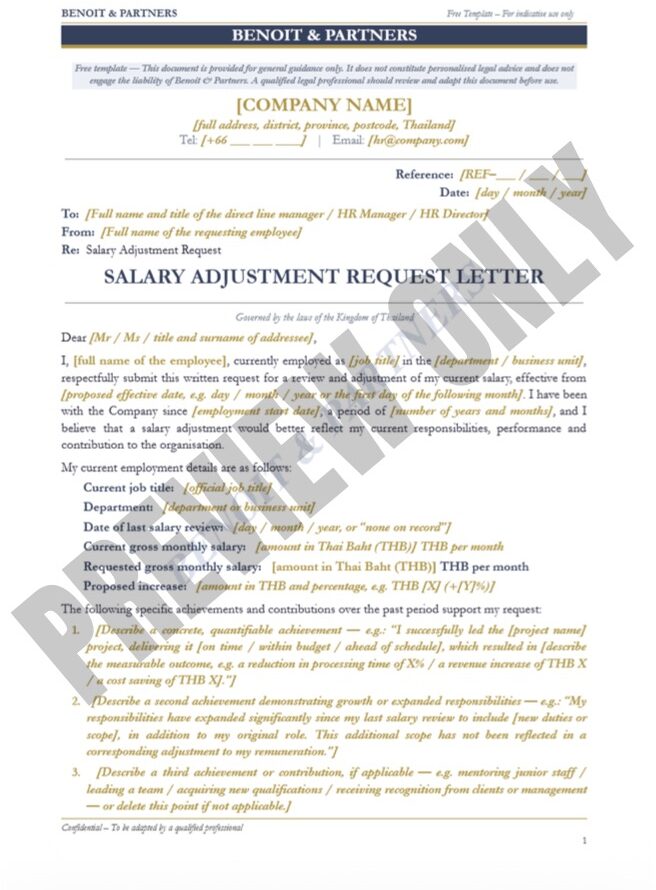
Our Salary Adjustment Request Letter in Thailand is drafted and reviewed by experienced lawyers to ensure compliance with Thai law and practical business use. It provides a reliable legal framework for formally requesting a review and adjustment of an employee’s salary from their employer in Thailand.
Designed for employees, executives, and individuals seeking to formally request a salary increase or adjustment from their employer in Thailand, this template covers key legal aspects such as identification of the parties, current remuneration details, basis and justification for the requested adjustment, proposed new salary, and compliance with applicable Thai employment and labour regulations.
However, some situations may require additional clauses or tailored structuring depending on the seniority of the position, the terms of the existing employment contract, applicable collective bargaining arrangements, or the specific grounds relied upon for the adjustment request. Our legal team can assist clients with customised Salary Adjustment Request Letters adapted to their specific situation within a short timeframe.
Disclaimer: This template is provided for general informational purposes only and does not constitute legal advice. While it has been prepared by legal professionals, it may not reflect your specific situation or regulatory constraints. For complex or senior-level employment situations, legal advice should be sought to ensure proper structuring and compliance under Thai employment law.
Need a Contract Tailored to Your Needs? Get a Free Consultation.
When should you use a Salary Adjustment Request Letter in Thailand?
A Salary Adjustment Request Letter in Thailand is used whenever an employee wishes to formally request a review and increase of their current salary from their employer in Thailand. This situation commonly arises following a period of strong performance, a significant increase in responsibilities, a change in market rates for comparable positions, the completion of a probationary period, or the passage of a considerable period of time since the last salary review.
Under Thai law, employment relationships and remuneration are primarily governed by the Labour Protection Act B.E. 2541 (1998) and its amendments, which establish minimum wage requirements and regulate the conditions under which employment terms may be varied. While Thai law does not grant employees a general statutory right to a salary increase, it does protect employees against unlawful reductions in remuneration and requires that any variation of employment terms be agreed between the parties.
This document becomes particularly important when an employee wishes to formally place their salary adjustment request on record, demonstrate the basis for the request with reference to their performance and market data, and initiate a structured dialogue with their employer about their remuneration. It allows the employee to clearly articulate the grounds for the requested adjustment, set out the proposed new salary, and invite the employer to respond within a reasonable timeframe.
In more complex situations, additional considerations may arise regarding the interaction between the salary adjustment request and existing contractual provisions, applicable performance review procedures, collective bargaining agreements, or the tax and social security implications of a proposed salary increase. Our legal team assists clients with the preparation of customised Salary Adjustment Request Letters tailored to their specific employment situation and objectives under Thai employment law.
In practice, a formal written request also provides the employee with documentary evidence of the request and the employer’s response, which may be relevant in the context of any subsequent employment dispute or negotiation regarding the terms of the employment relationship.

1. Identification of the Parties
The letter must clearly identify the employee making the request and the employer or relevant manager to whom it is addressed, including the employee's full name, current position, department, and the date on which the letter is issued.
2. Current Remuneration Details
The letter must set out the employee's current salary and any other material components of the remuneration package, including the date on which the current salary was last reviewed or adjusted, to provide the employer with a clear baseline for considering the request.
3. Grounds for the Requested Adjustment
The letter must clearly articulate the grounds on which the salary adjustment is requested, which may include demonstrated performance achievements, a significant increase in responsibilities or scope of role, market benchmarking data showing a gap between the current salary and prevailing rates for comparable positions, cost of living changes, or the passage of time since the last salary review.
4. Proposed New Salary
The letter must specify the proposed new salary being requested, expressed as a monthly or annual figure in Thai Baht, and explain the basis on which that figure has been determined, with reference to market data, internal benchmarks, or other relevant factors where available.
5. Supporting Evidence and Achievements
The letter should include a concise summary of the employee's key achievements, contributions, and performance since the last salary review, providing the employer with specific and quantifiable evidence to support the case for an adjustment.
6. Request for Meeting or Response
The letter must include a clear request for the employer to consider the salary adjustment and respond within a reasonable timeframe, and should invite the employer to arrange a meeting to discuss the request if appropriate, to facilitate a constructive dialogue between the parties.
Key Clauses and Essential Elements in a Salary Adjustment Request Letter
A Salary Adjustment Request Letter is a key professional document formally setting out an employee’s request for a salary review and adjustment in Thailand. It provides the employer with a clear and well-structured basis for considering the request and ensures that the employee’s position is formally documented in accordance with good employment practice.
Under the Labour Protection Act, any agreed variation of employment terms, including remuneration, should be documented in writing to provide clarity and avoid future disputes. A properly drafted Salary Adjustment Request Letter helps initiate this process in a professional and legally appropriate manner.
This type of document is commonly used by employees at all levels of seniority, including executives, managers, technical specialists, and professional staff, in both local and international companies operating in Thailand.
While standard situations may rely on a general template, more complex requests often require tailored content depending on the grounds for the adjustment and the specific terms of the existing employment arrangement.
Why customise a Salary Adjustment Request Letter with a lawyer in Thailand?
In practice, each salary adjustment request has its own context and level of sensitivity. Senior executive remuneration negotiations, requests arising from a significant change in responsibilities, situations where the employer has failed to honour a contractual salary review commitment, or requests made in the context of a broader employment dispute may all require a more carefully structured approach than a standard template provides.
Salary Adjustment Request Letter Thailand
Instant Download
Easy to Customize
Ready to Sign
Crafted by Lawyers
FAQ
What is a Salary Adjustment Request Letter in Thailand?
A formal written document by which an employee requests a review and increase of their current salary, setting out the grounds for the request, the proposed new remuneration, and an invitation to the employer to respond or arrange a meeting to discuss the matter.
Does an employee have a legal right to a salary increase in Thailand?
Thai law does not grant employees a general statutory right to a salary increase. However, where the employment contract or company policy provides for periodic salary reviews, the employer may be contractually obliged to conduct that review. Any agreed increase must be documented in writing.
Can an employer refuse a salary adjustment request in Thailand?
Yes, unless the employment contract or applicable policy requires a salary review or increase in specific circumstances. Employers should respond to formal requests in a timely and professional manner to avoid potential disputes or claims of constructive dismissal in cases where remuneration has become significantly below market rates.
What grounds can support a salary adjustment request in Thailand?
Common grounds include strong performance achievements, a significant increase in responsibilities, market benchmarking data showing a gap with prevailing rates, cost of living increases, or the passage of considerable time since the last salary review. Quantifiable evidence strengthens the request significantly.
Should a salary adjustment be documented in writing in Thailand?
Yes. Any agreed salary adjustment should be documented in a written amendment to the employment contract or a formal salary adjustment letter signed by both parties, to provide clarity and avoid future disputes over the agreed remuneration.
What are the tax implications of a salary increase in Thailand?
A salary increase will affect the employee’s personal income tax liability, calculated on a progressive scale under the Thai Revenue Code, as well as social security contributions for both the employee and the employer. Both parties should consider these implications when negotiating the new salary level.
Can a salary adjustment request be made during a probationary period in Thailand?
It is uncommon to request a salary adjustment during a probationary period, as this period is generally used to assess the employee’s suitability for the role. However, if the role or responsibilities have changed significantly from those described at the time of hiring, a request may be appropriate.
How does the PDPA apply to a Salary Adjustment Request Letter in Thailand?
Where the letter contains personal data such as salary details or performance information, both parties should handle that data in accordance with the Personal Data Protection Act B.E. 2562 (2019), ensuring that it is used only for the purpose of the salary review process and handled with appropriate confidentiality.