
Salary Certificate for Thailand
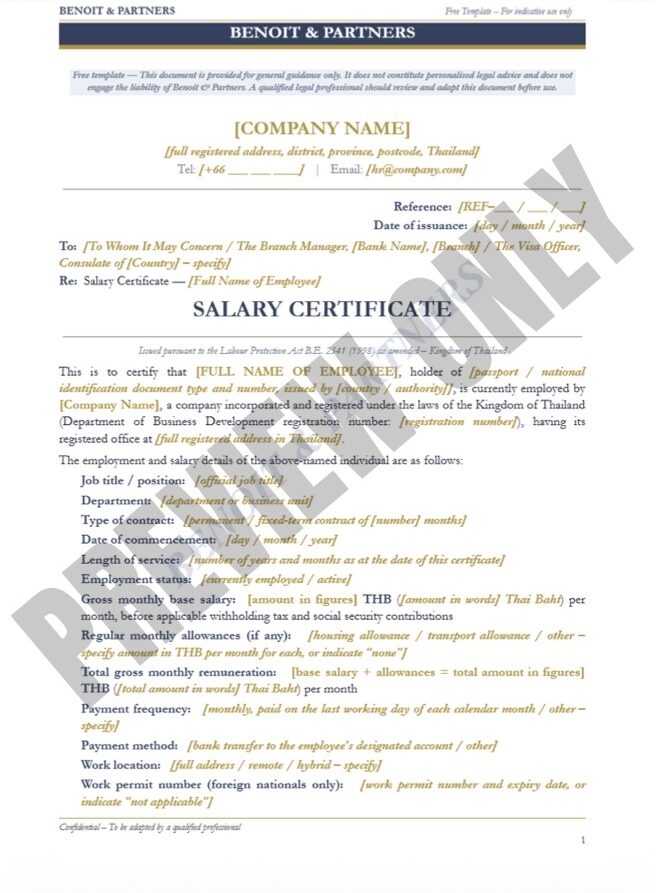
Our Salary Certificate for Thailand is drafted and reviewed by experienced lawyers to ensure compliance with Thai law and practical business use. It provides a reliable legal framework for formally confirming an employee’s current salary and compensation details to a third party in Thailand.
Designed for employers, HR departments, and companies required to issue formal confirmation of an employee’s remuneration to banks, financial institutions, government authorities, embassies, or other third parties in Thailand, this template covers key legal aspects such as confirmation of the employee’s identity, current position, monthly salary, additional compensation components, and compliance with applicable Thai employment and data protection regulations.
However, some situations may require additional clauses or tailored structuring depending on the purpose for which the certificate is required, the complexity of the employee’s remuneration package, the specific information requested by the receiving party, or the need for bilingual or notarised documentation. Our legal team can assist clients with customised Salary Certificates adapted to their specific situation within a short timeframe.
Disclaimer: This template is provided for general informational purposes only and does not constitute legal advice. While it has been prepared by legal professionals, it may not reflect your specific situation or regulatory constraints. For complex or sensitive situations, legal advice should be sought to ensure proper structuring and compliance under Thai employment and data protection law.
Need a Contract Tailored to Your Needs? Get a Free Consultation.
When should you use a Salary Certificate in Thailand?
A Salary Certificate in Thailand is used whenever an employer is required to formally confirm the remuneration of a current employee to a third party in Thailand. This situation commonly arises when an employee applies for a bank loan or mortgage, requires proof of income for a rental or tenancy agreement, needs supporting documentation for a visa or immigration application, or must demonstrate financial capacity to a government authority, foreign embassy, or other institution.
Under Thai law, employment relationships and remuneration are governed by the Labour Protection Act B.E. 2541 (1998) and its amendments. The Personal Data Protection Act B.E. 2562 (2019) further regulates the handling and disclosure of employee personal data, including salary information. A Salary Certificate must be accurate, limited to the information necessary for the stated purpose, and issued with due regard to the employee’s data protection rights.
This document becomes particularly important when the employee is a foreign national requiring confirmation of income for immigration or visa renewal purposes, or when a financial institution requires certified proof of salary as a condition for approving a credit facility, mortgage, or other financial product. It provides formal written confirmation of the employee’s current remuneration as verified and certified by the employer, giving the receiving party confidence in the accuracy of the information disclosed.
In more complex situations, additional information may be required regarding the employee’s full remuneration package including allowances, bonuses, and benefits in kind, the employee’s employment history with the company, or the consistency of the salary information with tax filings and social security contributions. Our legal team assists clients with the preparation of customised Salary Certificate Thaialand tailored to the specific requirements of the receiving party while ensuring compliance with Thai employment and data protection law.
In practice, this document is also crucial when issued in connection with visa or work permit applications, as it must accurately reflect the employee’s current remuneration and be consistent with the information previously declared to the Thai Revenue Department and the Social Security Office.

1. Employer Identification
The certificate must clearly identify the issuing employer, including the company's full legal name, registration number, registered address, and the name, title, and contact details of the authorised signatory issuing the certificate on behalf of the employer.
2. Employee Identification
The certificate must clearly identify the employee, including their full legal name, nationality, date of birth, and national identification or passport number, to allow the receiving party to accurately verify the individual's identity and match the certificate to other submitted documentation.
3. Position and Employment Status
The certificate must confirm the employee's current position, job title, department, and nature of employment, whether permanent, fixed-term, or probationary, as well as the employee's start date and current employment status with the issuing company.
4. Monthly Base Salary
The certificate must confirm the employee's current monthly base salary expressed in Thai Baht, as the primary component of remuneration verified and certified by the employer for the purposes of the receiving party's assessment.
5. Additional Remuneration Components
Where requested, the certificate must also confirm additional elements of remuneration, including allowances, bonuses, commissions, provident fund contributions, or benefits in kind, clearly specifying each component and its payment frequency.
6. Annual Income Confirmation
Where required, the certificate should confirm the employee's total annual income, including all fixed and variable components of remuneration, to allow the receiving party to assess the employee's overall financial capacity for the purposes of the application.
Key Clauses and Essential Elements in a Salary Certificate
A Salary Certificate Thailand is a key document formally confirming the remuneration details of an employee in Thailand. It provides third parties with verified information about the employee’s income and must be accurate, complete, and compliant with Thai employment and data protection law.
Under the Personal Data Protection Act B.E. 2562 (2019), salary information constitutes personal data and must be handled with care. Employers must ensure that the information disclosed is accurate, limited to what is necessary for the stated purpose, and that appropriate consent or a legitimate basis exists for the disclosure. A properly drafted Salary Certificate Thailand helps protect both the employer and the employee and reduces the risk of disputes or liability.
This type of document is commonly issued for bank loan and mortgage applications, visa and immigration submissions, rental agreement requirements, financial institution credit assessments, and government authority requests.
While standard situations may rely on a general template, specific purposes often require tailored content depending on the information requested by the relevant institution or authority.
Why customise a Salary Certificate with a lawyer in Thailand?
In practice, each certificate request has its own purpose and level of sensitivity. Bank loan applications, visa and immigration submissions, senior executive income verification, or situations involving complex remuneration structures may all require content that is not included in a standard template.
Depending on the situation, specific considerations may arise relating to the level of detail required by the receiving institution, the treatment of variable remuneration components such as bonuses and commissions, consistency of the salary information with tax filings submitted to the Thai Revenue Department, compliance with PDPA obligations when disclosing personal data to third parties, the language requirements of the receiving party including the need for a Thai or bilingual version, notarisation or legalisation requirements for use abroad, or the employer’s potential liability for misrepresentation if the certificate contains inaccurate or misleading information.
Tailoring a Salary Certificate Thailand also allows the employer to control the information disclosed, limit potential liability, and ensure that the document accurately reflects the employee’s remuneration while remaining compliant with Thai employment and data protection law. This is particularly important for senior employees, foreign nationals, or situations where the certificate is to be used in connection with significant financial or immigration applications.
Our legal team assists employers, HR departments, and companies with the preparation and review of customised Salary Certificates for Thailand adapted to the specific purpose and requirements of the request. In many cases, tailored certificates can be prepared within a short timeframe while ensuring full compliance with Thai labour and data protection law.
A properly drafted Salary Certificate not only satisfies the requirements of the receiving party, but also protects the employer against liability for misrepresentation and ensures full compliance with Thai data protection obligations in respect of the employee’s personal and financial information.
Salary Certificate Thailand
Instant Download
Easy to Customize
Ready to Sign
Crafted by Lawyers
FAQ
What is a Salary Certificate in Thailand?
A formal document issued by an employer confirming an employee’s current remuneration, including base salary and any additional compensation components. Commonly required for bank loan applications, visa submissions, and financial institution assessments in Thailand.
Is an employer legally required to issue a Salary Certificate in Thailand?
Thai law does not impose a general statutory obligation to issue a Salary Certificate on request. However, refusal may cause practical difficulties for the employee and reputational issues for the employer. It is standard practice to issue the certificate promptly upon a legitimate request.
Can a Salary Certificate be used for a visa or work permit application in Thailand?
Yes. A Salary Certificate is commonly required as supporting documentation for visa renewals and work permit applications for foreign national employees. It must accurately reflect the employee’s current salary and be consistent with information previously submitted to the Department of Employment and the Immigration Bureau.
What information should a Salary Certificate contain in Thailand?
It should confirm the employer’s identity, the employee’s full name and identification details, current position and employment status, monthly base salary, any additional remuneration components where requested, and the purpose for which the certificate is issued.
Can a Salary Certificate include bonuses and allowances in Thailand?
Yes, where requested by the receiving party. Variable components such as bonuses and commissions should be clearly described, including their frequency and basis of calculation, to allow the receiving party to accurately assess the employee’s total income.
Does a Salary Certificate need to be notarised for use abroad?
Depending on the country where it will be used, the certificate may need to be notarised, legalised by the Ministry of Foreign Affairs, and further authenticated by the relevant foreign embassy. Legal advice should be sought for certificates intended for use outside Thailand.
How does the PDPA apply to a Salary Certificate in Thailand?
Salary information constitutes personal data under the Personal Data Protection Act B.E. 2562 (2019). Employers must ensure that data disclosed is accurate, limited to what is necessary, and that the employee is aware of and consents to the disclosure where required. Appropriate internal data handling procedures should be followed.
Can a Salary Certificate be issued for a former employee in Thailand?
A Salary Certificate typically confirms current remuneration and is therefore most appropriate for current employees. For former employees, a Certificate of Employment confirming their previous salary at the time of departure is more appropriate and should be issued with care to ensure accuracy.