
Shareholder Agreement in Thailand
Our Shareholder Agreement in Thailand is drafted and reviewed by experienced lawyers to ensure compliance with Thai law and practical business use. It provides a reliable legal framework for formally regulating the relationship between the shareholders of a Thai company, supplementing the company’s articles of association with agreed terms governing their rights, obligations, and governance arrangements.
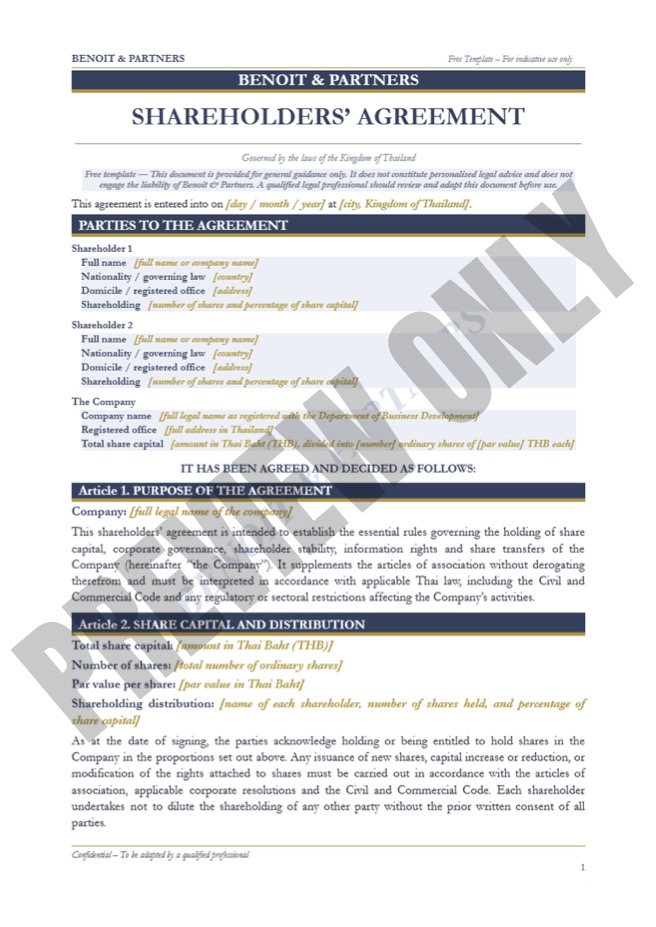
Designed for shareholders of Thai limited companies seeking to formalise the terms of their relationship and protect their respective interests in the company, this template covers key legal aspects such as identification of the parties and their shareholdings, governance and decision-making arrangements, reserved matters requiring shareholder consent, transfer restrictions and pre-emption rights, dividend policy, deadlock resolution, and compliance with the applicable provisions of the Thai Civil and Commercial Code and the Public Limited Companies Act.
However, some situations may require additional clauses or tailored structuring depending on the nature of the business, the composition of the shareholder group, the involvement of foreign shareholders, applicable regulatory requirements, or the specific protections that the parties wish to put in place. Our legal team can assist clients with customised Shareholder Agreements adapted to their specific situation within a short timeframe.
Disclaimer: This template is provided for general informational purposes only and does not constitute legal advice. While it has been prepared by legal professionals, it may not reflect your specific situation or regulatory constraints. For complex corporate structures, arrangements involving foreign shareholders, or companies operating in regulated sectors, legal advice should be sought to ensure proper structuring and compliance under Thai company and commercial law.
Need a Contract Tailored to Your Needs? Get a Free Consultation.
When should you use a Shareholder Agreement in Thailand?
A Shareholder Agreement in Thailand is the appropriate instrument when two or more shareholders in a Thai company wish to regulate their relationship and protect their respective interests beyond what is provided by the company’s articles of association and the default provisions of Thai company law.
Thai company law is governed primarily by the Civil and Commercial Code for private limited companies and by the Public Limited Companies Act B.E. 2535 (1992) for public companies. The statutory framework provides a basic structure for shareholder rights and company governance, but leaves significant scope for the shareholders to agree additional protections and arrangements through a separate shareholders’ agreement. Unlike the articles of association which are a public document, a shareholder agreement is a private contract between the parties and is not required to be filed with or disclosed to the Department of Business Development.
A shareholder agreement is particularly important in joint ventures and arrangements where the shareholders have different levels of involvement in the business, different risk profiles, or different expectations about the future direction and exit strategy of the company.
More complex arrangements particularly those involving foreign shareholders subject to the Foreign Business Act, BOI-promoted companies, or shareholders with specific regulatory obligations may require additional provisions tailored to the specific legal and commercial context. Our legal team is available to assist with fully customised shareholder agreements in Thailand that address these dimensions comprehensively.
Without a properly documented Shareholder Agreement, the governance of the company and the relationship between the shareholders are determined primarily by the articles of association and the statutory defaults, which may leave important issues unaddressed and create significant scope for future disputes.

1. Identification of the Parties and their Shareholdings
The agreement should clearly identify all shareholders by their full legal names and, where applicable, their registered addresses and identification or registration numbers, and should specify the number and class of shares held by each party at the date of the agreement.
2. Governance and Board Composition
The agreement should set out the composition of the board of directors, the mechanism by which each shareholder is entitled to nominate or appoint directors, and the quorum and voting requirements for board meetings.
3. Reserved Matters A list of material decisions
A list of material decisions such as changes to the business plan, significant capital expenditure, the issuance of new shares, the incurring of significant debt, or amendments to the articles of association.
4. Transfer Restrictions and Pre-emption Rights
The conditions under which a shareholder may transfer their shares and the right of existing shareholders to acquire those shares in priority to any proposed transferee should be clearly defined. Drag-along and tag-along rights are commonly included to manage exit scenarios.
5. Dividend Policy
The basis on which the company will declare and distribute dividends including any minimum distribution obligation, any reinvestment policy, and the procedure for agreeing the annual distribution should be addressed to manage shareholder expectations and avoid disputes about cash flow allocation
6. Deadlock Resolution
A defined mechanism for resolving deadlocks in shareholder or board decision-making whether through escalation to senior management, mediation, or a buy-sell procedure should be included to prevent the company from being paralysed by an inability to reach agreement on key decisions.
Key Clauses and Essential Elements in a Shareholder Agreement
A well-drafted Shareholder Agreement in Thailand gives the shareholders a clear, complete, and enforceable framework for the governance of their company and the management of their relationship. It supplements the articles of association, addresses the issues that the statutory framework does not adequately resolve, and provides a private and binding record of the shareholders’ agreed arrangements.
Under Thai company law, the shareholders’ agreement operates alongside and in some cases takes precedence over the articles of association as between the contracting parties. A carefully drafted agreement that addresses the key governance, transfer, and exit issues is the foundation of a stable and well-managed shareholder relationship.
This document is relevant across all types of private limited company from small family businesses to complex multi-party joint ventures and in both domestically owned Thai companies and companies with foreign participation.
The core structure remains consistent, though the specific protections and governance arrangements will vary significantly depending on the composition of the shareholder group and the nature of the business.
Why customise a Shareholder Agreement with a lawyer in Thailand?
A standard template of Shareholder Agreement in Thailand provides a useful starting point for simple two-shareholder arrangements in straightforward businesses, but the vast majority of shareholder relationships involve commercial and legal considerations that require a more carefully tailored approach.
The specific composition of the shareholder group, the nature of the business, and the respective objectives and risk profiles of the shareholders all shape what the agreement needs to achieve. A joint venture between a Thai company and a foreign investor, a shareholder arrangement in a regulated sector, or a structure involving multiple classes of shares with different economic and governance rights each requires a level of legal precision and commercial sophistication that a generic template cannot deliver.
In certain circumstances, the agreement may also need to address: the interaction between the shareholder agreement and the Foreign Business Act and any applicable licensing requirements; the structuring of the shareholder arrangement to achieve a desired tax outcome; the interaction between the agreement and any investment or financing arrangements; the protection of intellectual property contributed by one or more shareholders; the treatment of key person risk and the consequences of the departure or incapacity of a shareholder who is also a key employee; or the enforcement of the agreement’s provisions against shareholders who are based outside Thailand.
Our legal team works with shareholders, investors, and joint venture partners to prepare shareholder agreements that are structurally sound, commercially realistic, and comprehensively protective of each party’s interests. The result is an agreement that gives all shareholders a clear and shared understanding of the terms on which they own and govern their company together.
Shareholder Agreement Thailand
Instant Download
Easy to Customize
Ready to Sign
Crafted by Lawyers
FAQ
What is a Shareholder Agreement in Thailand?
A private written contract between the shareholders of a Thai company that regulates their relationship, supplements the company’s articles of association, and sets out agreed terms governing governance, transfer restrictions, dividend policy, exit rights, and other matters not adequately addressed by the statutory framework.
Is a Shareholder Agreement legally binding in Thailand?
Yes. A shareholder agreement is a binding contract between its parties under Thai contract law. Unlike the articles of association, it does not need to be registered with the Department of Business Development and remains a private document between the contracting shareholders.
What is the difference between a Shareholder Agreement and the Articles of Association in Thailand?
The articles of association are a public constitutional document of the company, registered with the Department of Business Development, that governs the company’s internal management and the rights of shareholders in their capacity as members.
Can a foreign shareholder be a party to a Shareholder Agreement in Thailand?
Yes. Foreign shareholders can participate in a Thai company and be parties to a shareholder agreement, subject to the restrictions imposed by the Foreign Business Act B.E. 2542 (1999) on foreign participation in certain categories of business. The agreement should be carefully structured to ensure compliance with applicable foreign ownership limits and licensing requirements.
What happens if a shareholder breaches the Shareholder Agreement in Thailand?
A breach of the shareholder agreement gives the non-defaulting shareholders the right to seek remedies under Thai contract law, which may include damages, specific performance, or depending on the terms of the agreement, the compulsory transfer of the defaulting shareholder’s shares.
Can a Shareholder Agreement override the Articles of Association in Thailand?
As between the contracting shareholders, the shareholder agreement will generally prevail in the event of a conflict with the articles of association. However, the articles govern the company’s relationship with third parties and the general operation of the company, and provisions in the shareholder agreement that conflict with mandatory provisions of Thai company law cannot be enforced against the company itself.
How are disputes between shareholders resolved under Thai law?
Disputes between shareholders may be resolved through the mechanisms set out in the shareholder agreement such as mediation, arbitration, or a buy-sell procedure or, in the absence of agreed mechanisms, through the Thai courts. A well-drafted shareholder agreement should include a clear and workable dispute resolution mechanism to reduce the risk of costly and disruptive litigation.
How does the PDPA apply to a Shareholder Agreement in Thailand?
Where the agreement involves the collection and processing of personal data of the shareholders or other individuals such as directors or key employees the company and the shareholders must comply with the Personal Data Protection Act B.E. 2562 (2019). Personal data should be collected with a lawful basis, stored securely, and used only for legitimate corporate governance purposes.