
Sublease Agreement Template for Thailand
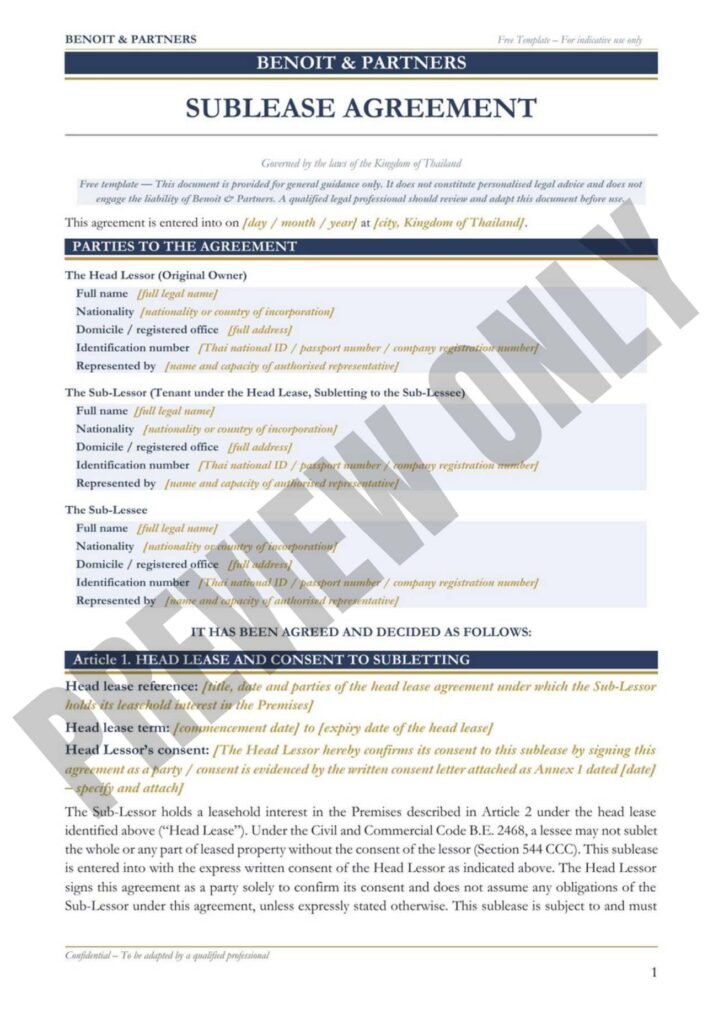
Our Sublease Agreement Thailand template has been prepared and reviewed by experienced Thai lawyers to ensure full compliance with Thai law and practical enforceability. It provides a solid legal foundation for tenants who wish to sublet all or part of their leased premises to a third party.
Designed for sub-lessors, sub-lessees, and head lessors involved in a subletting arrangement, this template addresses the key legal requirements specific to subleases in Thailand: head lessor consent, alignment with the head lease, rent and deposit terms, and the respective obligations of all three parties.
Depending on the nature of the transaction, additional provisions may be necessary, particularly regarding registration requirements, step-in rights, or restrictions applicable to foreign nationals. Our legal team can assist with the preparation of a fully customised Sublease Agreement within a short timeframe.
Disclaimer: This template is provided for general informational purposes only and does not constitute legal advice. While prepared by legal professionals, it may not address your specific circumstances or applicable regulatory constraints. For transactions involving significant value or complexity, professional legal advice should be sought before use.
Need a Contract Tailored to Your Needs ? Get a Free Consultation.
When should you use a Sublease Agreement Agreement in Thailand?
A Sublease Agreement is required whenever a tenant holding a leasehold interest under an existing lease wishes to sublet the premises, or part of them, to a third party. This arrangement is common in both residential and commercial contexts, where the original tenant no longer occupies the property full-time, needs to share costs, or holds surplus space.
Under Section 544 of the Civil and Commercial Code, a lessee is not permitted to sublet leased property, in whole or in part, without the express consent of the lessor. Any sublease entered into without such consent may be void and expose the sub-lessor to termination of the head lease.
This document becomes essential when the parties wish to formalise the subletting arrangement, define the rights and obligations of all three parties, head lessor, sub-lessor, and sub-lessee and ensure that the sublease does not conflict with the terms of the underlying head lease.
For subleases exceeding three years, registration at the Land Department is required under Section 538 of the Civil and Commercial Code for the agreement to be enforceable against third parties. Additional legal considerations may arise in connection with stamp duty, withholding tax, or the involvement of foreign nationals.
Without a properly structured Sublease Agreement in Thailand, the parties risk disputes over occupancy rights, liability for head lease obligations, and potential unenforceability under Thai property law.

1. Identification of the parties and the head lease
The agreement must clearly identify all three parties, the head lessor, the sub-lessor, and the sub-lessee and make precise reference to the original head lease being sublet under, including its date, parties, and term.
2. Head lessor's consent
Given that Thai law requires express consent from the head lessor for any subletting arrangement to be valid, the agreement must document how and in what form that consent has been obtained, whether directly within the agreement or by way of an attached consent letter.
3. Description of the subleased premises
The sublease agreement in Thailand must specify the exact scope of the sublease: whether the entire premises or a specific part is being sublet, the permitted use, the condition of the property, and any included furniture or equipment.
4. Sublease term and registration
The sublease term must remain within the remaining duration of the head lease and may not exceed thirty years. Where the term exceeds three years, the parties must register the sublease with the competent Land Office.
5. Rent, deposit, and payment terms
The sublease rent, security deposit, payment schedule, and consequences of late payment must be clearly defined. The sub-lessor remains independently liable for the head lease rent regardless of whether the sub-lessee meets its payment obligations.
6. Obligations of the sub-lessee and relationship with the head lease
The sub-lessee is bound by all obligations of the sub-lessor under the head lease insofar as they relate to the use of the premises. The agreement must also address what happens in the event the head lease is terminated before the sublease expires.
Key clauses and additional protections in a Sublease Agreement
A Sublease Agreement in Thailand governs a three-party arrangement in which the sub-lessee’s rights depend entirely on the continued existence of the head lease. It sets out the specific terms of the subletting, confirms the head lessor’s consent, and allocates responsibilities between all parties in compliance with Thai property law.
Under the Civil and Commercial Code, any sublease concluded without the head lessor’s express consent is unenforceable, and a sublease term exceeding the remaining duration of the head lease has no legal effect beyond that limit. A properly drafted agreement addresses these constraints directly and ensures that the sub-lessee’s occupation is legally secured for the agreed period.
While a template may be sufficient for straightforward arrangements, transactions involving foreign parties, complex head lease restrictions, or high-value commercial premises often require additional protections and tailored drafting. A properly customised Sublease Agreement helps all three parties understand their rights, anticipate the consequences of a potential head lease termination, and reduce the risk of disputes over occupancy or reinstatement obligations.
Why customise a Sublease Agreement with a lawyer in Thailand?
While a standard template provides a reliable starting point, subleases in Thailand often involve legal, financial, and structural considerations that go beyond what a general form can adequately address.
Each sublease has its own risk profile. The identity of the parties, the nature of the head lease, the duration of the sublease, and the type of property, commercial, residential, or mixed-use, all affect what provisions should be included and how they should be drafted.
Depending on the transaction, customised clauses may be required in relation to step-in rights in the event of head lease termination, subletting restrictions applicable to foreign nationals, reinstatement and fit-out obligations, revised deposit and rent review mechanisms, withholding tax and VAT implications, Land Department registration procedures, or the allocation of liability between sub-lessor and sub-lessee.
A tailored Sublease Agreement in Thailand allows all parties to clearly understand their respective rights and obligations, and to anticipate risks specific to the arrangement. This is particularly important where the head lease contains restrictions that could affect the sub-lessee’s security of tenure.
Our legal team assists head lessors, sub-lessors, and sub-lessees with the preparation of fully personalised Sublease Agreements adapted to their situation. In many cases, such agreements can be drafted promptly while ensuring compliance with Thai property and commercial law.
A well-drafted sublease reduces the risk of disputes arising from unclear terms, conflicts with the head lease, and obligations the sub-lessee may unknowingly have assumed.
Sublease Agreement template
Instant Download
Easy to Customize
Ready to Sign
Crafted by Lawyers
FAQ
What is a Sublease Agreement in Thailand?
A Sublease Agreement allows a tenant holding a leasehold interest to sublet the property or part of it to a third party. It governs the rights and obligations of all three parties: the head lessor, the sub-lessor, and the sub-lessee, and must be consistent with the terms of the underlying head lease.
Is the head lessor's consent required?
Yes. Under Section 544 of the Civil and Commercial Code, a lessee may not sublet leased property without the express consent of the lessor. Subletting without such consent may render the arrangement void and expose the sub-lessor to termination of the head lease.
Does a Sublease Agreement need to be registered in Thailand?
Registration at the Land Department is required if the sublease term exceeds three years, in order for the agreement to be enforceable against third parties under Section 538 of the Civil and Commercial Code.
Can the sub-lessor set the sublease rent freely?
Yes. Thai law does not require the sublease rent to match the head lease rent. The sub-lessor is free to negotiate the sublease rent independently, but remains solely responsible for paying the head lease rent to the head lessor.
What happens if the head lease is terminated early?
Under Thai law, termination of the head lease generally causes the sublease to terminate automatically. The sub-lessee would lose its right to occupy the premises, though it may have a claim against the sub-lessor for breach of warranty if the termination was caused by the sub-lessor’s default.
Can a foreign national be a party to a Sublease Agreement in Thailand?
Yes. Foreign nationals may enter into sublease arrangements in Thailand, subject to compliance with applicable restrictions on lease duration and land ownership. Legal advice is recommended to ensure the arrangement is structured in compliance with Thai law.
Do I need a lawyer to prepare a Sublease Agreement?
For straightforward arrangements, a standard template may be adequate. For commercial subleases, transactions involving foreign parties, or any situation where the head lease contains complex restrictions, professional legal assistance is strongly recommended.
What are the stamp duty implications of a Sublease Agreement in Thailand?
A Sublease Agreement may attract stamp duty under the Thai Revenue Code. Where the sublease involves the payment of rent, stamp duty is generally calculated at 0.1% of the total rental value over the sublease term. The parties should confirm their respective obligations in the agreement and seek advice where the transaction involves significant rental amounts or an extended term.