
Termination Letter in Thailand
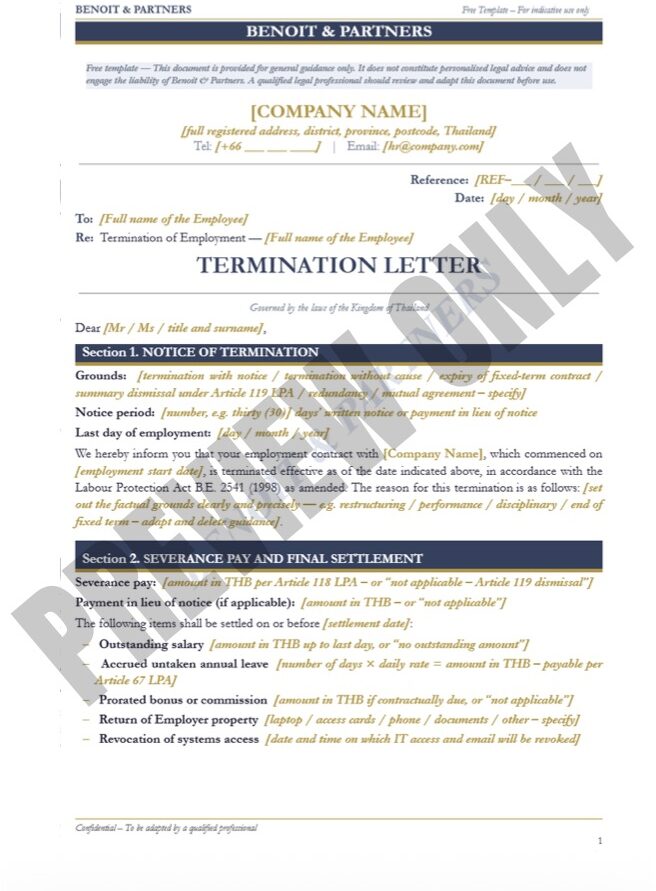
Our Termination Letter Thailand is drafted and reviewed by experienced lawyers to ensure compliance with Thai law and practical business use. It provides a reliable legal framework for formally notifying an employee of the termination of their employment in Thailand.
Designed for employers, HR departments, and companies managing employee terminations in Thailand, this template covers key legal aspects such as identification of the parties, grounds for termination, notice period or payment in lieu, severance pay entitlements, final salary and benefit calculations, return of company property, and compliance with the Labour Protection Act and other applicable Thai employment regulations.
However, some situations may require additional clauses or tailored structuring depending on the grounds for termination, the seniority of the employee, the sector of activity, foreign national employment considerations, or the specific terms of the employment contract. Our legal team can assist clients with customised Termination Letters adapted to their specific situation within a short timeframe.
Disclaimer: This template is provided for general informational purposes only and does not constitute legal advice. While it has been prepared by legal professionals, it may not reflect your specific situation or regulatory constraints. For complex or senior-level terminations, legal advice should be sought to ensure proper structuring and compliance under Thai employment law.
Need a Contract Tailored to Your Needs? Get a Free Consultation.
When should you use a Termination Letter in Thailand?
A Termination Letter in Thailand is used whenever an employer wishes to formally notify an employee that their employment is being brought to an end, whether by reason of redundancy, performance, misconduct, or any other ground recognised under Thai employment law. This situation commonly arises in restructuring and downsizing situations, performance management processes, disciplinary proceedings, and the non-renewal of fixed-term contracts.
Under Thai law, employment terminations are governed by the Labour Protection Act B.E. 2541 (1998) and its amendments, which establish strict requirements regarding notice periods, severance pay entitlements, and the grounds on which an employer may terminate without notice or severance. Failure to comply with these requirements exposes the employer to significant legal and financial liability, including claims for unfair dismissal before the Labour Court.
This document becomes particularly important as it constitutes the formal written record of the termination, triggers the employee’s entitlement to notice pay or severance pay, and provides documentary evidence of the grounds and circumstances of the dismissal in the event of any subsequent dispute or litigation. It allows the employer to clearly communicate the reason for termination, the effective date, the amounts payable to the employee, and any post-termination obligations applicable to both parties.
In more complex situations, additional provisions may be required regarding the payment of outstanding commissions or bonuses, the treatment of share options or long-term incentive awards, post-termination confidentiality and non-solicitation obligations, the cancellation of a work permit for foreign national employees, or the terms of any settlement agreement reached between the parties. Our legal team assists clients with the preparation of customised Termination Letters tailored to their specific situation and compliance obligations under Thai employment law.
In practice, issuing a properly drafted Termination Letter is a critical step in managing the termination process, as it reduces the risk of claims for wrongful dismissal, ensures that all statutory payments are correctly calculated and made, and provides the employer with clear documentary evidence in the event of any subsequent dispute before the Labour Court or the Labour Department.
Without a properly drafted Termination Letter, employers risk claims for unfair dismissal, incorrect severance pay calculations, failure to comply with notice requirements, and significant financial and reputational exposure under Thai employment law.

1. Identification of the Parties
The letter must clearly identify the employer and the employee, including the employer's full legal name and registered address, the employee's full name, position, and employee identification details, and the name and title of the authorised representative signing on behalf of the employer.
2. Grounds for Termination
The letter must clearly state the grounds for termination, whether redundancy, performance, misconduct, or another recognised ground, with sufficient factual detail to justify the dismissal and demonstrate compliance with the procedural requirements of the Labour Protection Act and the employment contract.
3. Effective Date of Termination
The letter must specify the effective date on which the employment will terminate, whether at the end of a notice period, on a specific date with payment in lieu of notice, or with immediate effect where the termination is for cause and no notice or severance is required under the Labour Protection Act.
4. Notice Period or Payment in Lieu
The letter must confirm whether the employee is required to work during a notice period or whether the employer is making a payment in lieu of notice, and specify the amount of any payment in lieu, calculated in accordance with the employment contract and the Labour Protection Act.
5. Severance Pay
The letter must set out the employee's severance pay entitlement calculated in accordance with Section 118 of the Labour Protection Act, which prescribes minimum severance pay based on the employee's length of service, ranging from 30 days to 400 days of the last wage rate depending on the number of years worked.
6. Final Salary and Outstanding Payments
The letter must confirm the calculation of the employee's final salary payment, including any accrued but untaken annual leave, outstanding expenses, and any other amounts owed to the employee, and specify the date by which these amounts will be paid in accordance with the Labour Protection Act.
Key Clauses and Essential Elements in a Termination Letter
A Termination Letter is a key legal document formally recording the end of an employment relationship in Thailand. It sets out the grounds for termination, the effective date, the payments due to the employee, and any post-termination obligations, in compliance with the Labour Protection Act and other applicable Thai employment regulations.
Under the Labour Protection Act, employers must comply with strict notice and severance pay requirements upon termination. A properly drafted Termination Letter helps ensure compliance with these obligations and provides essential documentary evidence in the event of any subsequent dispute or Labour Court proceedings.
This type of document is used for all categories of employment termination in Thailand, including redundancy, performance-related dismissal, disciplinary termination, and non-renewal of fixed-term contracts.
While standard situations may rely on a general template, more complex terminations often require additional provisions depending on the grounds for dismissal and the specific terms of the employment contract.
Why customise a Termination Letter with a lawyer in Thailand?
While a standard Termination Letter Thailand may be sufficient for straightforward terminations, many dismissal situations involve legal, financial, and procedural considerations requiring more careful drafting and tailored protections.
In practice, each termination has its own structure and level of risk. The grounds for dismissal, the seniority of the employee, the terms of the employment contract, the availability of a fair dismissal defence, and the potential exposure to Labour Court proceedings all affect how the letter should be drafted and what it should contain.
Depending on the situation, clauses may address severance and long-service payments, unpaid bonuses, commissions or incentives, post-termination confidentiality and non-solicitation duties, cancellation of work permits and visas for foreign employees, settlement terms, PDPA compliance during termination, and measures to reduce the risk of Labour Court disputes.
Tailoring a Termination Letter also allows the employer to clearly communicate the termination decision, ensure that all statutory obligations are met, and protect the employer’s legal position in the event of any subsequent dispute. This is particularly important for senior employee terminations, dismissals involving allegations of misconduct, redundancy situations affecting multiple employees, or terminations of foreign national employees.
Our legal team assists employers, HR departments, and companies with the preparation and review of customised Termination Letters for Thailand adapted to their specific situation and risk profile. In many cases, tailored letters can be prepared within a short timeframe while ensuring full compliance with Thai labour law and minimising exposure to unfair dismissal claims.
A properly drafted Termination Letter not only ensures legal compliance, but also reduces the risk of Labour Court proceedings, incorrect severance calculations, and reputational damage arising from a poorly managed termination process.
Termination Letter Thailand
Instant Download
Easy to Customize
Ready to Sign
Crafted by Lawyers
FAQ
What is a Termination Letter in Thailand?
A formal written document by which an employer notifies an employee of the termination of their employment, setting out the grounds, effective date, and amounts payable. Governed by the Labour Protection Act B.E. 2541 (1998), which establishes strict requirements on notice, severance pay, and fair dismissal grounds.
Is a Termination Letter legally required in Thailand?
Yes. Under the Labour Protection Act, employers must provide written notice of termination. Failure to do so may expose the employer to claims for wrongful dismissal and additional compensation before the Labour Court.
What severance pay is an employee entitled to in Thailand?
Severance pay is prescribed by Section 118 of the Labour Protection Act based on length of service, ranging from 30 days pay for employees with 120 days to one year of service, up to 400 days pay for employees with 20 or more years of service.
Can an employer terminate without notice or severance in Thailand?
Yes, in limited circumstances. Under Section 119 of the Labour Protection Act, an employer may terminate without notice or severance where the employee has committed serious misconduct, acted dishonestly, caused intentional damage, or been negligent causing serious harm to the employer.
What is the notice period for termination in Thailand?
The Labour Protection Act requires notice to be given at or before the next wage payment date to take effect at the following wage payment date. Employment contracts may specify longer notice periods. Employers may make a payment in lieu of notice instead of requiring the employee to work the notice period.
Can a foreign national employee be terminated in Thailand?
Yes. The same Labour Protection Act requirements apply regardless of nationality. Upon termination, the employer must also take steps to cancel the employee’s work permit and notify the relevant immigration authorities where applicable.
What is special severance pay in Thailand?
Employees aged 55 or over with at least 10 years of service who are terminated due to retirement or redundancy may be entitled to special severance pay under the Labour Protection Act, in addition to standard severance. Legal advice should be sought to confirm the applicable entitlements.
How does the PDPA apply to a Termination Letter in Thailand?
Personal data processed in connection with the termination, including performance records and disciplinary documentation, must be handled in accordance with the Personal Data Protection Act B.E. 2562 (2019). Appropriate data handling procedures should be followed throughout the termination process.