
Terms and Conditions in Thailand
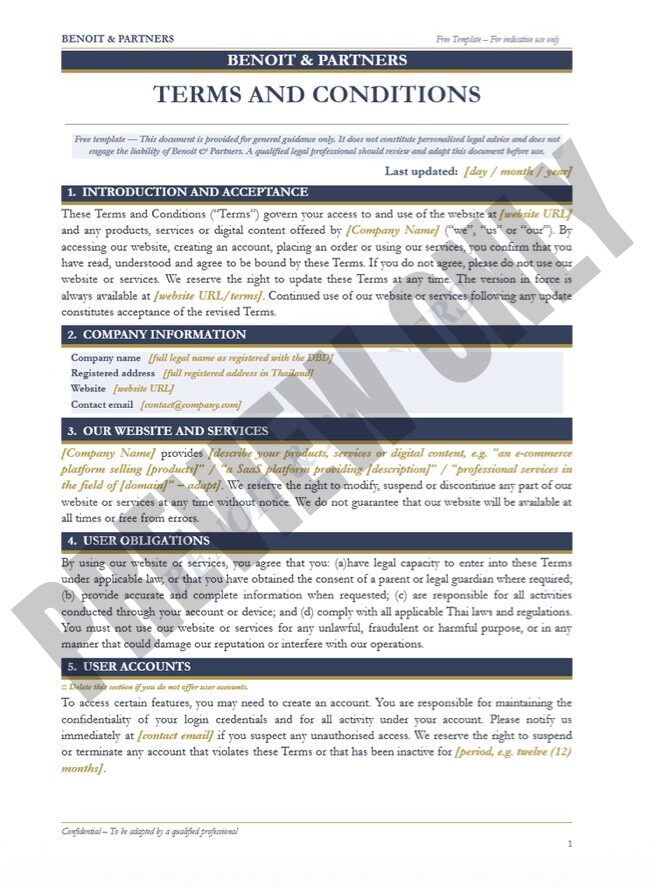
Our Terms and Conditions in Thailand is drafted and reviewed by experienced lawyers to ensure compliance with Thai law and practical business use. It provides a reliable legal framework for governing the relationship between a business and its customers or users in Thailand, setting out the rights and obligations of each party in connection with the supply of goods, services, or digital content.
Designed for businesses of all sizes operating in Thailand whether through a physical presence, a website, a mobile application, or a digital platform, this template covers key legal aspects such as the scope of the agreement, ordering and payment terms, delivery and performance obligations, limitation of liability, intellectual property ownership, dispute resolution, and compliance with the Thai Civil and Commercial Code and applicable consumer protection legislation.
However, some situations may require additional clauses or tailored structuring depending on the nature of the business, the categories of goods or services supplied, the target customer base, or the digital and regulatory environment in which the business operates. Our legal team can assist clients with customised Terms and Conditions adapted to their specific situation within a short timeframe.
Disclaimer: This template is provided for general informational purposes only and does not constitute legal advice. While it has been prepared by legal professionals, it may not reflect your specific situation or regulatory constraints. For businesses operating in regulated sectors or supplying to consumers at scale, legal advice should be sought to ensure proper structuring and compliance under Thai consumer protection and commercial law.
Need a Contract Tailored to Your Needs? Get a Free Consultation.
When should you use Terms and Conditions in Thailand?
Terms and Conditions in Thailand are required whenever a business wishes to establish a clear and binding contractual framework governing its relationship with customers or users in Thailand.
Thai contract law is primarily governed by the Civil and Commercial Code, which sets out the general rules on contract formation, performance, and breach. Consumer transactions are additionally subject to the Consumer Protection Act B.E. 2522 (1979) and, for electronic commerce, the Electronic Transactions Act B.E. 2544 (2001), both of which impose specific obligations on businesses dealing with consumers and regulate certain categories of contractual terms.
A business that operates without clearly documented Terms and Conditions Thailand is exposed to significant uncertainty about the basis on which it is contracting with its customers.
More complex business models such as subscription services, marketplace platforms, software-as-a-service offerings, or businesses supplying to both consumers and corporate clients require Terms and Conditions that are specifically tailored to the nature of the relationship and the regulatory requirements applicable to the relevant sector. Our legal team is available to assist with tailored documents that address these dimensions comprehensively.
Without properly drafted Terms and Conditions, a business lacks the contractual foundation necessary to manage customer relationships effectively, limit its legal exposure, and protect its intellectual property and commercial interests.

1. Scope and Acceptance
The Terms and Conditions should clearly identify the business and the scope of the agreement, and should specify the mechanism by which a customer or user accepts the terms.
2. Ordering and Payment
The terms governing the ordering process, pricing, payment methods, and the circumstances in which an order may be cancelled or modified should be set out clearly, together with the business's right to decline or cancel an order in defined circumstances.
3. Delivery and Performance
The business's obligations regarding the delivery of goods or the performance of services including applicable timelines, delivery methods, and the consequences of delay should be addressed specifically, together with the customer's obligations regarding acceptance.
4. Returns, Refunds, and Cancellations
The policy on returns, refunds, and cancellations should be clearly stated, including any applicable timeframes, conditions for a valid return or refund claim, and the process the customer must follow.
5. Limitation of Liability
The extent to which the business limits its liability for loss or damage arising from the supply of goods or services should be clearly expressed, subject to the restrictions imposed by Thai consumer protection law on the exclusion of liability for certain categories of loss.
6. Intellectual Property
The ownership of intellectual property rights in the goods, services, content, or software supplied and the scope of any licence granted to the customer should be addressed clearly, together with any restrictions on the customer's permitted use.
Key Clauses and Essential Elements in Terms and Conditions
Well-drafted Terms and Conditions in Thailand give both the business and its customers a clear understanding of their respective rights and obligations, provide the business with the contractual tools it needs to manage risk and protect its interests, and ensure that the relationship is conducted on a documented and legally sound basis.
Under Thai consumer protection law, certain categories of contractual terms including unreasonably broad exclusions of liability and terms that create a significant imbalance between the parties may be unenforceable as unfair contract terms. A properly structured set of Terms and Conditions Thailand takes account of these restrictions and avoids provisions that are likely to be challenged or set aside.
This document is relevant across all categories of business and all channels of supply from retail and hospitality to technology and professional services and is applicable whether the business is dealing with individual consumers, corporate clients, or both.
Why customise Terms and Conditions with a lawyer in Thailand?
A standard of Terms and Conditions in Thailand provides a reasonable starting point for businesses with straightforward supply relationships, but a wide range of commercial and regulatory circumstances require a more carefully considered approach before Terms and Conditions are published or relied upon.
The nature of the goods or services supplied, the profile of the customer base, the channel through which the business operates, and the regulatory environment in which it is active all bear directly on what the Terms and Conditions need to address and how they should be structured.
In preparing the document, consideration may need to be given to: the specific disclosure and fairness requirements applicable to consumer contracts under Thai law; the regulatory obligations of businesses operating in licensed or regulated sectors; the particular considerations arising from subscription, marketplace, or platform business models; the treatment of user-generated content and the allocation of intellectual property rights in a digital context; and the PDPA implications of data collected through the customer relationship.
Our legal team works with businesses across all sectors to prepare Terms and Conditions Thailand that are legally sound, commercially balanced, and properly tailored to the specific nature of the business and its customer relationships.
Terms and Conditions Thailand
Instant Download
Easy to Customize
Ready to Sign
Crafted by Lawyers
FAQ
What are Terms and Conditions in Thailand?
A set of contractual provisions that govern the relationship between a business and its customers or users, setting out the rights and obligations of each party in connection with the supply of goods, services, or digital content in Thailand.
Are Terms and Conditions legally required in Thailand?
While there is no general statutory obligation to publish Terms and Conditions, they are effectively required for any business that wishes to contract with customers on defined and enforceable terms. Certain regulated sectors.
Can a business limit its liability through Terms and Conditions in Thailand?
Yes, subject to the restrictions imposed by Thai consumer protection law. Certain categories of liability including liability for death or personal injury caused by negligence, and liability arising from fraud cannot be excluded. Limitations of liability for other categories of loss are permissible provided they are fair and clearly expressed.
Are unfair contract terms enforceable in Thailand?
Under the Unfair Contract Terms Act B.E. 2540 (1997), terms that create a significant imbalance between the parties to the detriment of the consumer may be declared unenforceable by a Thai court. Businesses dealing with consumers must ensure that their Terms and Conditions do not contain provisions that could be challenged on this basis.
Do Terms and Conditions need to be in Thai?
There is no general statutory requirement for Terms and Conditions to be in the Thai language, but consumer-facing businesses are advised to make their terms available in Thai to ensure accessibility and to reduce the risk of a consumer arguing that they were not aware of the terms. Certain regulated sectors may impose specific language requirements.
How should a business ensure that customers accept its Terms and Conditions in Thailand?
The most reliable method is to require customers to actively confirm their acceptance for example, by ticking a checkbox or clicking an “I agree” button — before completing a transaction or accessing a service. Passive acceptance mechanisms, such as a notice that continued use constitutes acceptance, are less reliable and may be challenged.
How often should Terms and Conditions be reviewed in Thailand?
Terms and Conditions should be reviewed whenever there is a material change to the business’s products, services, or operating model, and at regular intervals at least annually to ensure continued compliance with applicable law. Customers should be notified of material changes and given the opportunity to review the updated terms before they take effect.
How does the PDPA interact with Terms and Conditions in Thailand?
Where Terms and Conditions address the collection or use of personal data for example, through account registration, transaction processing, or marketing activities they must be consistent with the organisation’s Privacy Policy and with the requirements of the PDPA.