
Unsecured Loan Agreement Template Thailand
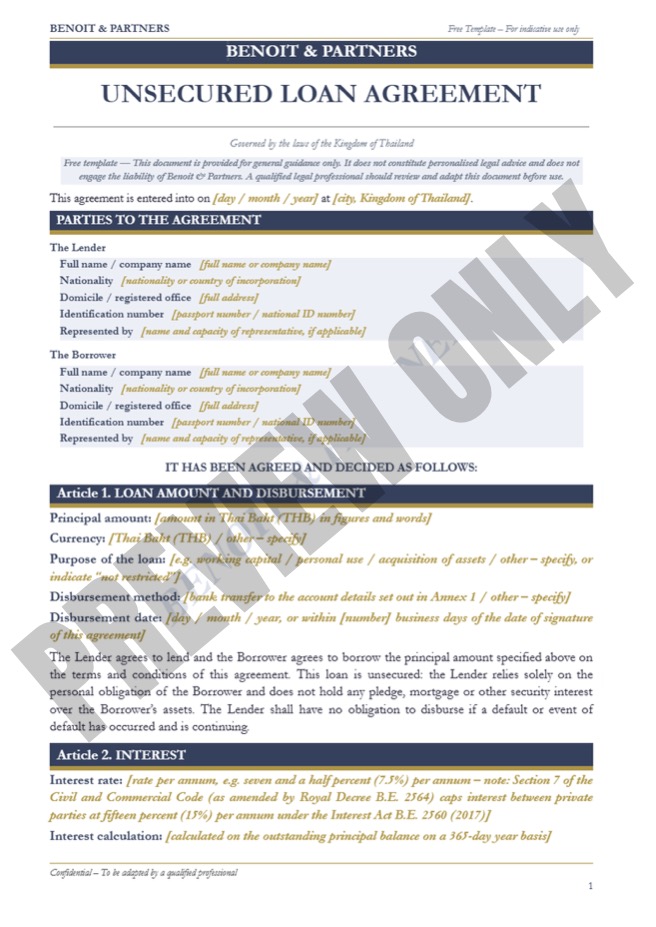
Our Unsecured Loan Agreement Thailand is drafted and reviewed by experienced lawyers to ensure compliance with Thai law and practical business use. It provides a reliable legal framework for loan transactions made without collateral between individuals or companies in Thailand.
This template is intended for individuals and businesses entering into unsecured lending transactions in Thailand. It includes provisions relating to the parties, loan amount, disbursement terms, repayment obligations, interest arrangements, events of default, and the enforceability of the agreement under Thai law.
However, some transactions may require additional clauses or tailored structuring depending on the nature of the loan, foreign lender or borrower involvement, tax considerations, or commercial risks. Our legal team can assist clients with customised Unsecured Loan Agreements adapted to their transaction within a short timeframe.
Disclaimer: This template is intended as a general legal resource and may not be suitable for every lending transaction. Specific circumstances, regulatory requirements, and commercial objectives should be reviewed before use. Our legal team can assist in adapting this document to your particular needs under Thai law.
Need a Contract Tailored to Your Needs? Get a Free Consultation.
When should you use an Unsecured Loan Agreement in Thailand?
An Unsecured Loan Agreement is used whenever a lender provides funds to a borrower without requiring any collateral or security interest over assets in exchange for the commitment to repay the principal amount, together with any agreed interest, within a defined period. This situation commonly arises in private loans between individuals, friendly loans between family members or business partners, intercompany and shareholder loans, short-term working capital facilities, and commercial arrangements where the parties have an established relationship of trust and the lender is willing to rely solely on the borrower’s personal or corporate covenant.
Under Thai law, unsecured loan agreements are governed by the Civil and Commercial Code B.E. 2468 (1925), notably Sections 650 to 656, which regulate the rights and obligations of lenders and borrowers, including the conditions for disbursement, repayment, interest calculation, and enforcement in the event of default. Interest rates on private unsecured loans are subject to a statutory cap under the Civil and Commercial Code and applicable consumer protection regulations. In the absence of agreed interest, Thai law does not automatically imply an obligation to pay interest on a loan between private parties.
This agreement becomes particularly important when the transaction involves significant financial value, foreign lenders or borrowers, intercompany or related-party lending, or situations where the lender wishes to formalise the arrangement for accounting, tax, or regulatory purposes. It allows the parties to clearly define the terms of the lending, including the loan amount, disbursement conditions, repayment schedule, applicable interest rate, and consequences of default, without the need for security registration or collateral documentation.
In more complex transactions, additional clauses may be required regarding foreign exchange considerations, withholding tax on interest payments, transfer pricing compliance for intercompany loans, PDPA obligations where personal data is exchanged, or compliance with Bank of Thailand regulations on cross-border unsecured lending. Our legal team assists clients with the preparation of customised Unsecured Loan Agreements tailored to their transaction in order to provide stronger legal protection and ensure compliance with Thai law.
In practice, this agreement is also crucial when the loan is provided between related parties, as it formalises the transaction and provides documentary evidence of the lending relationship for accounting, tax, and regulatory purposes, including in the context of transfer pricing rules applicable to intercompany loans.
Without a properly drafted Unsecured Loan Agreement, parties expose themselves to disputes over repayment obligations, interest entitlement, default consequences, and the potential characterisation of the loan as a gift or equity contribution under Thai tax and accounting rules.

1. Identification of the Parties
The agreement must clearly identify the lender and the borrower, including their full legal names, registration details, and addresses, as well as the capacity in which each party enters into the agreement and any relevant authorisation for corporate borrowers or lenders.
2. Loan Amount and Disbursement Conditions
The agreement must specify the total loan amount, the currency, the disbursement method, and any conditions precedent to disbursement, such as the delivery of corporate authorisations, representations and warranties, or other documents agreed between the parties.
3. Repayment Schedule and Terms
The agreement must define the repayment schedule, including whether repayment is made in a single instalment or multiple instalments, the frequency and amount of each instalment, the final maturity date, and the conditions under which early repayment is permitted, including any notice requirements..
4. Interest Rate and Calculation
The agreement must specify the applicable interest rate, whether fixed or variable, the method of calculation, the payment dates, and the consequences of late payment, in compliance with the statutory interest rate cap of fifteen percent (15%) per annum under the Civil and Commercial Code as amended. Where no interest is charged, the agreement should expressly state that the loan is interest-free to avoid any ambiguity.
5. Representations and Warranties
The agreement must include representations and warranties by the borrower confirming its legal capacity to enter into and perform the agreement, the absence of any legal or regulatory restriction on borrowing, and the accuracy of any financial or other information provided to the lender in connection with the loan.
6. Events of Default and Acceleration
The agreement must define the events of default, including failure to repay any instalment on its due date, breach of representations or covenants, insolvency or financial deterioration of the borrower, and any other event that materially affects the borrower's ability to repay, and set out the lender's right to accelerate the outstanding balance and claim damages upon the occurrence of any such event.
Key Clauses and Essential Elements in an Unsecured Loan Agreement
An Unsecured Loan Agreement is a key legal document governing the lending and repayment of funds in Thailand without the benefit of collateral or security. It defines the rights and obligations of the lender and borrower while ensuring compliance with Thai civil and commercial law.
Under the Civil and Commercial Code, interest on unsecured loans between private parties is subject to a statutory maximum rate, and any interest provision must be expressly agreed in writing to be enforceable. A properly drafted Unsecured Loan Agreement helps formalise the transaction and reduce legal risk for both parties.
This type of agreement is commonly used in private and friendly lending, shareholder and intercompany loans, short-term commercial facilities, and working capital arrangements.
While standard transactions may rely on a general template, more complex arrangements often require additional legal protections and customised clauses depending on the nature of the loan, the relationship between the parties, and the risks involved.
Why customise an Unsecured Loan Agreement with a lawyer in Thailand?
Although a standard Unsecured Loan Agreement can be used for basic lending transactions, more complex situations often require customized provisions to properly allocate risks and protect the interests of both lender and borrower.
In practice, each transaction has its own structure and level of risk. Foreign lender or borrower involvement, intercompany or related-party lending subject to transfer pricing rules, cross-border loan arrangements subject to Bank of Thailand reporting requirements, or loans forming part of a broader commercial arrangement may all require provisions that are not included in a standard template.
Depending on the transaction, specific clauses may be added relating to interest rate mechanisms and adjustment provisions, representations and covenants by the borrower regarding its financial condition and compliance with applicable laws, financial reporting obligations during the life of the loan, cross-default provisions linking the loan to other agreements between the parties, foreign exchange and repatriation of loan proceeds and repayments for cross-border arrangements, withholding tax on interest payments and availability of tax treaty relief, stamp duty obligations under the Thai Revenue Code, transfer pricing documentation requirements for intercompany loans under Thai Revenue Department guidelines, PDPA compliance where personal data is exchanged between the parties, dispute resolution procedures and governing law, or compliance with Bank of Thailand regulations on foreign loans and cross-border transfers.
Tailoring an Unsecured Loan Agreement also allows the parties to better define their respective obligations, anticipate likely risks and dispute scenarios, and ensure that the agreement is properly structured and enforceable under Thai law. This is particularly important for high-value loans, intercompany arrangements subject to transfer pricing scrutiny, cross-border lending transactions, or loans forming part of a broader investment or restructuring arrangement.
Our legal team assists lenders, borrowers, and companies with the preparation and review of customised Unsecured Loan Agreements for Thailand adapted to their transaction structure, relationship, and commercial objectives. In many cases, tailored agreements can be prepared within a short timeframe while ensuring compliance with Thai civil, commercial, and tax law.
Unsecured Loan Agreement Thailand
Instant Download
Easy to Customize
Ready to Sign
Crafted by Lawyers
FAQ
What is an Unsecured Loan Agreement in Thailand?
An Unsecured Loan Agreement is a contract by which a lender provides funds to a borrower without requiring any collateral or security interest over assets, and the borrower undertakes to repay the principal and any agreed interest within a defined period. In Thailand, it is governed by the Civil and Commercial Code, Sections 650 to 656, and must comply with applicable interest rate caps and tax regulations.
What is the difference between a secured and an unsecured loan agreement in Thailand?
A secured loan agreement involves the creation of a security interest over assets of the borrower or a third party, such as a mortgage over immovable property or a pledge of movable assets, to secure repayment of the loan. An unsecured loan agreement relies solely on the borrower’s personal or corporate covenant to repay, without any collateral. In the event of default, a secured lender can enforce its security interest, while an unsecured lender must pursue the borrower through legal proceedings.
Is an Unsecured Loan Agreement legally binding in Thailand?
Yes. An Unsecured Loan Agreement is legally binding upon signature by both parties. However, it is important to note that under Thai law, a loan agreement for a sum exceeding 2,000 THB must be evidenced in writing and signed by the borrower to be enforceable in court proceedings. Stamp duty must be paid within 15 days of execution to avoid penalties.
Can a foreigner be a lender or borrower under a Thai Unsecured Loan Agreement?
Foreign nationals and foreign companies can enter into Unsecured Loan Agreements in Thailand as lenders or borrowers. However, cross-border unsecured loans may be subject to Bank of Thailand reporting requirements and foreign exchange regulations, and interest payments to foreign lenders may be subject to withholding tax under Thai law, subject to any applicable tax treaty relief.
What is the maximum interest rate for an Unsecured Loan Agreement in Thailand?
Under the Civil and Commercial Code as amended by the Interest Act B.E. 2560 (2017) and Royal Decree B.E. 2564, the maximum interest rate for private unsecured loans in Thailand is currently fifteen percent (15%) per annum. Charging interest above this rate is prohibited and may render the excess interest unenforceable. Default interest is capped at three percent (3%) per annum above the agreed rate.
Does an Unsecured Loan Agreement need to be registered in Thailand?
Loan Agreement does not require registration with any government authority. However, stamp duty at the rate of 0.05% of the loan amount, subject to a maximum of 10,000 THB, must be paid within 15 days of execution to avoid penalties and surcharges under the Thai Revenue Code.
What are the transfer pricing implications of an intercompany Unsecured Loan Agreement in Thailand?
Intercompany unsecured loans between related parties are subject to transfer pricing rules under the Thai Revenue Code and Revenue Department guidelines. The interest rate charged must reflect arm’s length terms, and the parties should maintain contemporaneous transfer pricing documentation to support the agreed interest rate. Failure to comply may result in adjustments by the Thai Revenue Department and additional tax liabilities.
What happens if the borrower fails to repay under an Unsecured Loan Agreement in Thailand?
Under the Civil and Commercial Code, the lender may demand immediate repayment of the outstanding balance upon default, claim default interest at the rate specified in the agreement or at the statutory rate of five percent (5%) per annum under Section 224 of the Civil and Commercial Code, and initiate civil proceedings before the competent Thai courts to obtain a judgment against the borrower. A well-drafted Unsecured Loan Agreement should include specific provisions on events of default, acceleration rights, and the lender’s remedies upon non-payment.