
Work From Home Request Letter Thailand
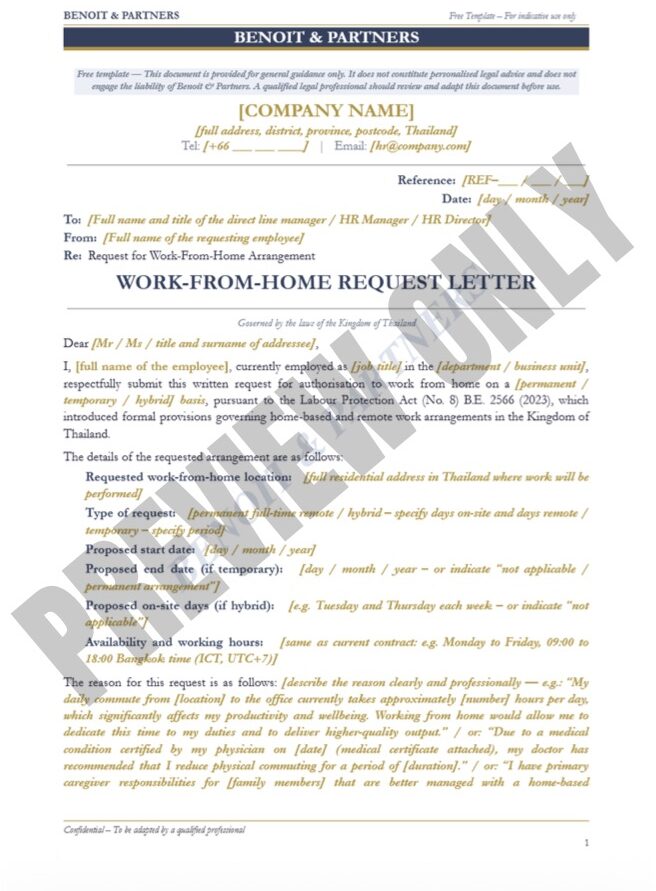
Our Work From Home Request Letter Thailand is drafted and reviewed by experienced lawyers to ensure compliance with Thai law and practical business use. It provides a reliable legal framework for formally requesting a remote working arrangement from an employer in Thailand.
Designed for employees and individuals seeking to formally request permission to work from home or adopt a remote working arrangement in Thailand, this template covers key legal aspects such as the basis for the request, proposed terms of the remote working arrangement, confirmation of the employee’s ability to perform their duties remotely, data protection and confidentiality considerations, and compliance with applicable Thai employment regulations.
However, some situations may require additional clauses or tailored structuring depending on the nature of the role, the employer’s internal policies, the duration of the requested arrangement, visa and work permit implications for foreign national employees, or specific operational requirements of the business. Our legal team can assist clients with customised Work From Home Request Letters adapted to their specific situation within a short timeframe.
Disclaimer: This template is provided for general informational purposes only and does not constitute legal advice. While it has been prepared by legal professionals, it may not reflect your specific situation or regulatory constraints. For complex or sensitive employment situations, legal advice should be sought to ensure proper structuring and compliance under Thai employment law.
Need a Contract Tailored to Your Needs? Get a Free Consultation.
When should you use a Work From Home Request Letter in Thailand?
A Work From Home Request Letter in Thailand is used whenever an employee wishes to formally request permission from their employer to perform their duties remotely, whether on a permanent, regular, or occasional basis. This situation commonly arises when an employee has personal or family care responsibilities, health considerations, a long commute, or when the nature of the role allows effective performance outside the employer’s premises.
Under Thai law, employment relationships are governed by the Labour Protection Act B.E. 2541 (1998) and its amendments. While Thai law does not confer a general statutory right to work from home, the parties may agree to vary the place of work by mutual agreement, and such an arrangement should be documented in writing to provide clarity and avoid future disputes. The Personal Data Protection Act B.E. 2562 (2019) further applies where the employee handles personal data while working remotely.
This document is important when formalising an informal arrangement, requesting a change of workplace, or defining a remote work framework covering working hours, availability, equipment, data security, and performance expectations. It allows the employee to outline the request, explain the reasons, and confirm commitment to productivity and compliance with company policies while working remotely.
In more complex cases, issues may include work permit conditions for foreign employees, data protection and cybersecurity in home working, tax implications of cross-border arrangements, and employer monitoring of performance and attendance. Our legal team prepares tailored Work From Home Request Letters aligned with Thai employment law and compliance requirements.
Without a properly drafted Work From Home Request Letter, employees risk leaving their remote working arrangement on an uncertain legal footing, failing to address key practical and compliance considerations, and exposing both themselves and their employer to potential disputes over the terms of the arrangement.

1. Identification of the Parties
The letter must clearly identify the employee making the request and the employer, including the employee's full name, position, department, and contact details, as well as the name and title of the manager or HR representative to whom the request is addressed.
2. Nature and Scope of the Request
The letter must clearly describe the nature of the remote working arrangement being requested, including whether it is a permanent, fixed-term, or occasional arrangement, the proposed working days or hours to be performed remotely, and the proposed location from which the employee intends to work.
3. Reasons for the Request
The letter must set out the employee's reasons for requesting the remote working arrangement, including any personal, health, family, or operational factors that support the request, to allow the employer to fully consider the basis and merits of the proposal.
4. Proposed Start Date and Duration
The letter must confirm the proposed start date of the remote working arrangement and, where applicable, its intended duration or the date on which it is proposed to be reviewed, to give the employer clarity as to the timeline of the request.
5. Commitment to Performance and Availability
The letter must include a clear statement of the employee's commitment to maintaining their performance, productivity, and availability during the remote working period, including their proposed working hours, communication methods, and response times during normal business hours.
6. Equipment and Data Security
The letter must address the equipment and technology that the employee will use while working remotely, confirm that appropriate data security measures will be maintained, and acknowledge the employee's obligations under the employer's data protection and cybersecurity policies and the Personal Data Protection Act B.E. 2562 (2019).
Key Clauses and Essential Elements in a Work From Home Request Letter
A Work From Home Request Letter Thaialnd is a key document formally setting out an employee’s request for a remote working arrangement in Thailand. It provides the employer with the information needed to consider the request and, if approved, forms the basis for a documented variation of the employee’s place of work.
Under the Labour Protection Act, any material change to the terms and conditions of employment, including the place of work, should be agreed in writing between the parties. A properly drafted Work From Home Request Letter helps ensure clarity as to the proposed arrangement and reduces the risk of future disputes over the terms of the remote working agreement.
This type of document is commonly used for permanent remote working requests, hybrid working arrangements, temporary remote working due to personal circumstances, and requests to formalise existing informal arrangements.
While standard situations may rely on a general template, more complex arrangements often require additional provisions depending on the nature of the role and the specific terms requested.
Why customise a Work From Home Request Letter with a lawyer in Thailand?
While a standard Work From Home Request Letter Thailand may be sufficient for straightforward remote working requests, some situations involve legal, regulatory, and operational considerations requiring more careful drafting and tailored content.
In practice, each remote working request has its own structure and level of complexity. Senior employee arrangements, foreign national work permit implications, cross-border remote working situations, data security obligations, or requests involving significant changes to contractual terms may all require provisions that are not included in a standard template.
Depending on the situation, clauses may address work permit and visa issues for foreign employees working remotely, tax consequences of cross-border arrangements, data protection and cybersecurity duties, allocation of equipment and costs, performance monitoring and reporting, health and safety responsibilities in the home working environment, PDPA compliance, and the relationship between remote work terms and existing contractual provisions on workplace location.
Tailoring a Work From Home Request Letter allows the employee to present their request clearly and professionally, anticipate employer concerns, and ensure the arrangement is fully documented. This is especially important for senior roles, foreign employees, or situations involving operational or compliance issues.
Our legal team assists employees, employers, and companies with the preparation and review of customised Work From Home Request Letters for Thailand adapted to their specific employment situation and operational requirements. In many cases, tailored letters can be prepared within a short timeframe while ensuring full compliance with Thai labour, immigration, and data protection law.
Work From Home Request Letter Thailand
Instant Download
Easy to Customize
Ready to Sign
Crafted by Lawyers
FAQ
What is a Work From Home Request Letter in Thailand?
A written request where an employee asks to work remotely, setting out the terms and reasons. Thai law does not grant a right to work from home, but such arrangements may be agreed by mutual consent and should be recorded in writing.
Do employees have a legal right to work from home in Thailand?
No. Thai law does not currently provide a general statutory right to work from home. Remote working arrangements are subject to the agreement of the employer and should be documented in writing to provide clarity and avoid disputes over the terms of the arrangement.
Can a Work From Home Request Letter affect a foreign national's work permit in Thailand?
Yes. In Thailand, work permits usually state the employer’s registered address as the place of work. Foreign employees working elsewhere may need a permit amendment, so legal advice should be obtained before starting remote work.
What are the data protection obligations of an employee working from home in Thailand?
Employees working from home must follow the employer’s data protection and cybersecurity policies and the Personal Data Protection Act B.E. 2562 (2019). They must also ensure proper protection of personal data, including secure networks and compliant devices.
Can an employer refuse a Work From Home Request in Thailand?
Yes. As there is no statutory right to work from home under Thai law, an employer may refuse a remote working request on operational or other legitimate grounds. The employer should consider the request fairly and communicate their decision clearly and promptly.
Can an employer withdraw an approved Work From Home arrangement in Thailand
Yes, provided reasonable notice is given. The terms for withdrawal should be set out in writing, and employers should act reasonably, giving sufficient notice to allow the employee to adjust and return to the workplace.
Does a Work From Home arrangement affect an employee's contractual terms in Thailand?
A remote working arrangement varies the contractual place of work but does not otherwise alter the employee’s terms and conditions of employment. All other contractual obligations, including working hours, performance standards, and confidentiality requirements, continue to apply in full during the remote working period.