
Working Environment Policy Thailand
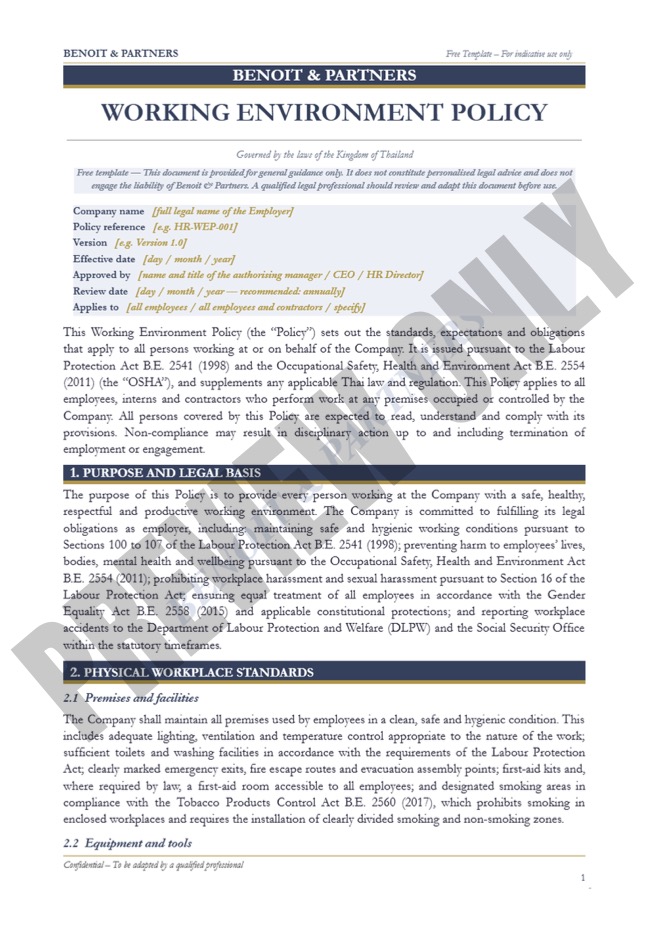
Our Working Environment Policy Thailand is drafted and reviewed by experienced lawyers to ensure compliance with Thai law and practical business use. It provides a reliable legal framework for establishing clear standards governing the physical and psychological working environment within a company operating in Thailand.
Designed for employers, HR departments, and companies seeking to implement a comprehensive working environment policy in Thailand, this template covers key legal aspects such as health and safety obligations, workplace harassment and discrimination prevention, employee wellbeing standards, disciplinary procedures, reporting mechanisms, and compliance with the Labour Protection Act and other applicable Thai employment regulations.
However, some situations may require additional clauses or tailored structuring depending on the sector of activity, the size of the workforce, the nature of the workplace environment, or specific regulatory requirements applicable to the employer’s industry. Our legal team can assist clients with customised Working Environment Policies adapted to their specific situation within a short timeframe.
Disclaimer: This template is provided for general informational purposes only and does not constitute legal advice. While it has been prepared by legal professionals, it may not reflect your specific situation or regulatory constraints. For complex or regulated industries, legal advice should be sought to ensure proper structuring and compliance under Thai employment law.
Need a Contract Tailored to Your Needs? Get a Free Consultation.
When should you use a Working Environment Policy in Thailand?
A Working Environment Policy is used whenever an employer wishes to formally establish the standards and expectations governing the physical and psychological environment in which its employees work. This situation commonly arises when a company is setting up operations in Thailand, expanding its workforce, implementing new HR frameworks, or seeking to comply with its legal obligations under Thai employment and occupational health and safety law.
Under Thai law, employers’ working environment obligations are primarily governed by the Labour Protection Act B.E. 2541 (1998), the Occupational Safety, Health and Environment Act B.E. 2554 (2011), and the Civil and Commercial Code. These laws impose specific obligations on employers regarding the physical safety of the workplace, the prevention of harassment and discrimination, the provision of adequate welfare facilities, and the establishment of clear disciplinary and grievance procedures.
This policy becomes particularly important when the workforce exceeds a certain size, as larger employers are subject to additional regulatory requirements including the obligation to establish a workplace safety committee, appoint a safety officer, and maintain records of workplace accidents and incidents. It allows the employer to clearly communicate its standards and expectations to all employees, establish clear reporting and escalation procedures, and demonstrate its commitment to maintaining a safe, respectful, and productive working environment.
In more complex situations, additional provisions may be required regarding sector-specific health and safety standards, the management of workplace harassment and bullying complaints, mental health and employee wellbeing programmes, the accommodation of employees with disabilities, or compliance with international workplace standards applicable to multinational employers operating in Thailand. Our legal team assists clients with the preparation of customised Working Environment Policies tailored to their specific operational requirements and compliance obligations under Thai law.
In practice, a well-drafted Working Environment Policy is also a valuable tool for managing employment disputes, as it provides clear documentary evidence of the employer’s standards and procedures and demonstrates the employer’s good faith compliance with its legal obligations under Thai employment law.
Without a properly drafted Working Environment Policy, employers risk regulatory penalties, employment disputes, reputational damage, and potential civil or criminal liability arising from workplace accidents, harassment incidents, or other working environment failures.

1. Scope and Application
The policy must clearly define its scope, including the categories of workers to whom it applies, the locations covered, and the relationship between the policy and other HR documents such as the employment contract and employee handbook.
2. Health and Safety Standards
The policy must set out the employer's health and safety obligations, including the provision and maintenance of a safe physical working environment, the identification and management of workplace hazards, the provision of appropriate personal protective equipment where required, and the procedures for reporting and investigating workplace accidents and incidents, in compliance with the Occupational Safety, Health and Environment Act B.E. 2554 (2011).
3. Workplace Harassment and Discrimination Prevention
The policy must include clear provisions prohibiting all forms of workplace harassment, bullying, and discrimination, defining the conduct that constitutes a violation, establishing a confidential reporting mechanism for complaints, and setting out the disciplinary consequences for employees found to have engaged in such conduct.
4. Employee Wellbeing and Mental Health
The policy must address the employer's commitment to supporting employee wellbeing and mental health, including access to support resources, the management of workplace stress, and the procedures for employees experiencing mental health difficulties to seek assistance without fear of adverse consequences.
5. Working Hours, Rest Periods and Welfare Facilities
The policy must confirm the employer's compliance with the working hours, rest period, and welfare facility requirements prescribed by the Labour Protection Act, including maximum daily and weekly working hours, mandatory rest breaks, and the provision of adequate sanitary and welfare facilities.
6. Workplace Safety Committee and Safety Officers
The policy must address the establishment and operation of the workplace safety committee and the appointment of safety officers where required by the Occupational Safety, Health and Environment Act, including their roles, responsibilities, and the frequency of safety committee meetings.
Key Clauses and Essential Elements in a Working Environment Policy
A Working Environment Policy is a key legal document establishing the standards and expectations governing the workplace in Thailand. It defines the employer’s obligations and the employee’s rights while ensuring compliance with the Labour Protection Act, the Occupational Safety, Health and Environment Act, and other applicable Thai regulations.
Under Thai law, employers are legally required to maintain a safe and healthy working environment and to take all reasonable steps to prevent workplace accidents, injuries, and harassment. A properly drafted Working Environment Policy helps ensure compliance with these obligations and reduces the risk of regulatory penalties and employment disputes.
This type of policy is applicable to all employers operating in Thailand regardless of size or sector, though larger employers and those operating in hazardous industries are subject to additional specific requirements.
While standard situations may rely on a general template, more complex workplaces often require additional provisions depending on the nature of the operations and the specific risks involved.
Why customise a Working Environment Policy with a lawyer in Thailand?
While a standard Working Environment Policy template for Thailand may be sufficient for straightforward workplaces, many employers operate in environments involving legal, regulatory, and operational considerations requiring more careful drafting and tailored protections.
In practice, each workplace has its own structure and level of risk. Hazardous industries, large workforces, multinational operations, regulated sectors, or workplaces with a history of employment disputes may all require provisions that are not included in a standard template.
Depending on the situation, specific clauses may be added relating to sector-specific health and safety standards applicable in construction, manufacturing, healthcare, or chemical industries, the management of workplace harassment investigations and the protection of complainants, mental health support programmes and employee assistance schemes, the accommodation of employees with disabilities in compliance with applicable Thai regulations, international workplace standards required by multinational parent companies, PDPA compliance in respect of personal data processed during workplace investigations, or the integration of the working environment policy with other HR documents including the employment contract, disciplinary policy, and employee handbook.
Tailoring a Working Environment Policy also allows the employer to clearly communicate its standards, manage operational and legal risks, and demonstrate its commitment to maintaining a safe and respectful workplace. This is particularly important for regulated industries, large employers subject to mandatory safety committee requirements, or multinational companies required to comply with both Thai law and international group standards.
Our legal team assists employers, HR departments, and companies with the preparation and review of customised Working Environment Policies for Thailand adapted to their specific operational needs and compliance obligations. In many cases, tailored policies can be prepared within a short timeframe while ensuring full compliance with Thai labour, health and safety, and data protection law.
A properly drafted Working Environment Policy not only helps protect employees and reduce the risk of workplace incidents, but also strengthens the employer’s legal position in the event of employment disputes, regulatory inspections, or civil or criminal proceedings arising from working environment failures.
Working Environment Policy Thailand
Instant Download
Easy to Customize
Ready to Sign
Crafted by Lawyers
FAQ
What is a Working Environment Policy in Thailand?
A formal document establishing the standards and expectations governing the physical and psychological working environment within a company in Thailand. Governed by the Labour Protection Act B.E. 2541 (1998), the Occupational Safety, Health and Environment Act B.E. 2554 (2011), and other applicable Thai employment and safety regulations.
Is a Working Environment Policy legally required in Thailand?
Certain elements are legally required, including health and safety standards, welfare facilities, and workplace accident reporting procedures under the Occupational Safety, Health and Environment Act. A comprehensive written policy is strongly recommended for all employers to demonstrate compliance and manage legal risk.
What are an employer's health and safety obligations in Thailand?
Employers must provide a safe physical working environment, identify and manage workplace hazards, provide appropriate protective equipment, establish accident reporting procedures, and appoint safety officers and establish a safety committee where required by the Occupational Safety, Health and Environment Act.
Is workplace harassment prohibited under Thai law?
Yes. Thai law prohibits workplace harassment and discrimination. Employers have an obligation to prevent and address harassment in the workplace and may face civil and criminal liability if they fail to take reasonable steps to prevent or respond to harassment complaints.
What are the working hours requirements under Thai employment law?
The Labour Protection Act prescribes a maximum of eight hours per day and 48 hours per week for general work, and seven hours per day and 42 hours per week for hazardous work. Employees are entitled to mandatory rest breaks and weekly rest days in accordance with the Act.
Do Thai employers need to establish a workplace safety committee?
Employers with 50 or more employees in certain sectors are required to establish a workplace safety committee under the Occupational Safety, Health and Environment Act. The committee must meet regularly and is responsible for overseeing workplace safety standards and investigating accidents.
How should workplace harassment complaints be handled in Thailand?
Complaints should be handled through a confidential and impartial investigation process, with appropriate protections for the complainant. The Working Environment Policy should set out clear reporting channels, investigation procedures, and disciplinary consequences for substantiated complaints.
How does the PDPA apply to a Working Environment Policy in Thailand?
Personal data collected and processed in connection with working environment complaints and investigations must be handled in accordance with the Personal Data Protection Act B.E. 2562 (2019). Appropriate data protection provisions, including lawful basis for processing and retention policies, should be included in the policy.